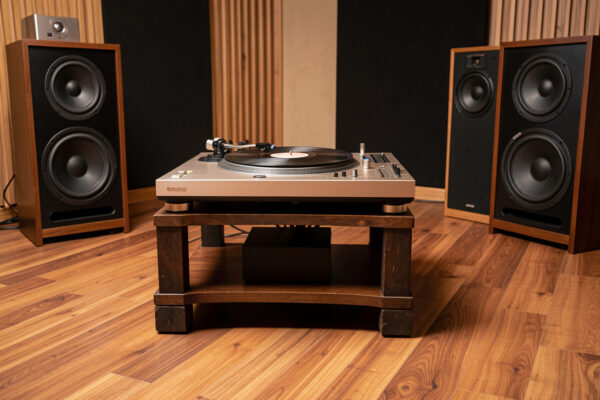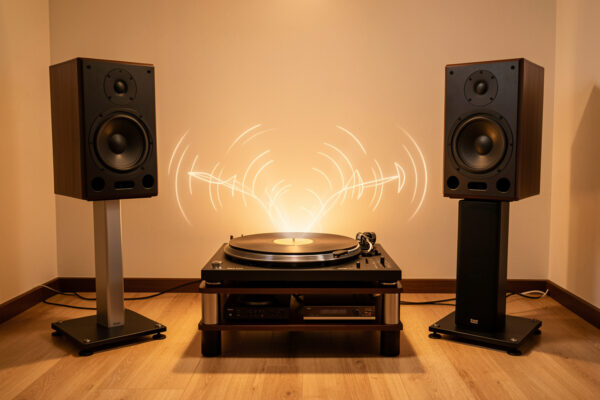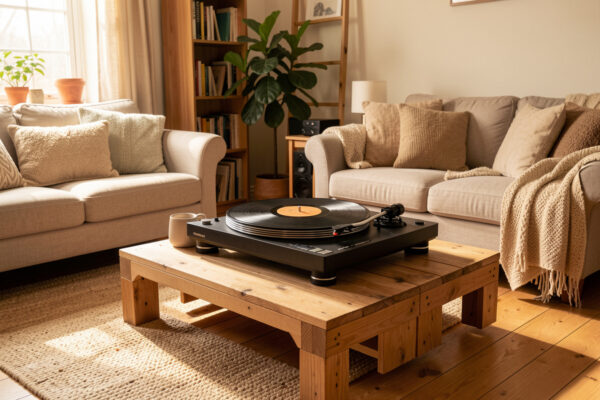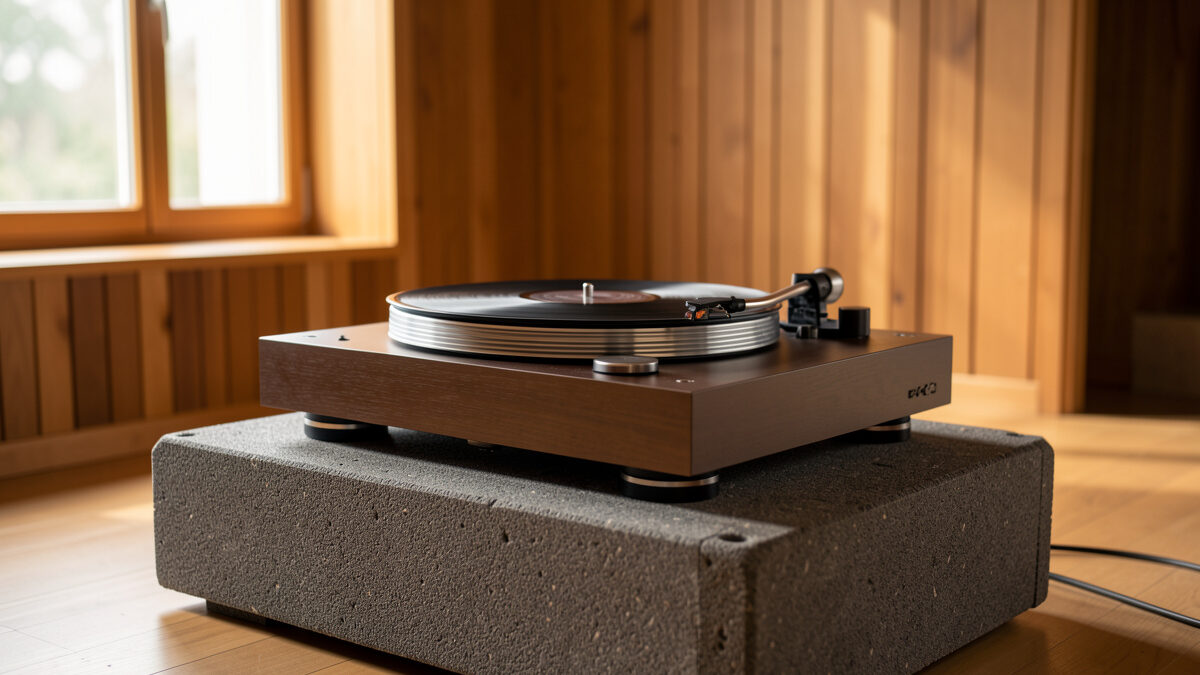
Turntable isolation is the practice of decoupling a record player from the floor, furniture, and air around it so that footsteps, speaker energy, and structural rumble never reach the stylus. Done right, it lowers the noise floor, kills the boom you hear when you walk past the deck, and lets the cartridge read only what is cut into the groove. On my bench I have measured the difference: a deck on a wobbly IKEA shelf skips on a heavy footfall; the same deck on a mass-loaded platform with sorbothane feet shrugs the same footfall off entirely.
I run a Technics SL-1200-class direct drive, a rebuilt Rega P3 with an RB330 arm, and a Pro-Ject X2 as my belt-drive comparator, and I have lived with all three on good and bad supports. This guide is the map of everything I have tried to isolate them: platforms, feet, springs, wall shelves, sorbothane, a DIY build, the furniture underneath, and the physics that decides which one you actually need. Isolation is the cheapest real upgrade most people ignore, and it is the part the unboxing videos skip.
Why Turntable Isolation Matters More Than the Table
A stylus tracks groove modulations measured in microns while pressing down with around 1.8 to 2.0 grams. Any vibration that reaches the platter the same size as a groove wiggle gets read as music it should not be reading. That is why a deck can measure beautifully on a test bench and sound congested in a real room: the room is feeding garbage into the cartridge.
There are only three paths for that garbage. It comes up through the floor (footfall and structural rumble), it comes through the air from your speakers (acoustic feedback), or it is generated inside the deck by the motor and bearing. Isolation handles the first two. The third is a maintenance problem I cover in my turntable bearing maintenance guide. Get the support wrong and even a re-greased bearing and a perfectly aligned cartridge cannot save you, because the cartridge is faithfully tracking your living room instead of the record.
This is where my workshop habit pays off in the listening room. I treat the deck the way I treat a router table or a CNC bed: as a structure that has to hold its position under a moving load. The platter is spinning, the stylus is dragging through the groove, and the whole assembly is being asked to stay dead still relative to a building that is anything but. Once you see the deck as a mechanical isolation problem rather than an audio mystery, the fixes stop being mysterious too. You are not chasing a sound; you are stopping energy from getting somewhere it should not be.
The Three Vibration Sources You Are Fighting
Footfall is low-frequency energy, typically under 50 Hz, that travels through a suspended timber floor and arrives at the deck as a slow heave. It is the one that makes the stylus jump when someone crosses the room. Airborne feedback is your speakers physically shaking the plinth and platter, worst when the table sits between or on top of the speakers and worst at high volume. Motor and bearing rumble is internal, a constant low hum you only notice once the other two are dealt with.
Knowing which one dominates your room decides your whole strategy, because the fixes pull in opposite directions. The footfall-versus-airborne diagnosis is the first thing to settle if you are not sure what is actually skipping your stylus, because buying the wrong fix is the most common isolation mistake I see. A simple test: turn the volume to zero and walk past the deck. If the stylus still misbehaves, it is footfall; if the trouble only appears at volume, it is airborne feedback.
Diagnosing Your Room Before You Spend Anything
Before buying a single isolation product, spend ten minutes finding out what you are actually fighting. The diagnosis costs nothing and saves you from throwing sorbothane at an airborne problem or a wall shelf at a feedback problem. I run the same three tests on every deck I set up in a new room.
First, the footfall test: drop the needle on a quiet lead-in groove with the volume at zero, then walk firmly across the room and around the deck. Watch the stylus and listen through headphones if you have them. If it jumps, lurches, or you hear thumps, you have a floor-borne footfall problem and the floor and furniture are the priority. Second, the feedback test: play music at a normal-to-loud level, then carefully lift the deck a few inches off its support while it plays. If the bass tightens and the muddiness clears when the deck is in your hands away from the rack, you have airborne feedback or a resonant support. Third, the knuckle test: with the system off, rap your knuckle on the plinth, the platter, and the shelf. A long ring means something is resonant and wants damping; a short dead thud is what you are aiming for. These three tests point you straight at the right spoke in this cluster.
What the Stylus Actually Tolerates
It helps to know the scale of the problem. A 33 RPM record carries groove modulations down to a fraction of a micron, and the cartridge generates its tiny signal from the difference in velocity between the stylus tip and the cartridge body. Anything that moves the body — the plinth flexing, the platter rocking, the whole deck heaving on a bouncy floor — gets added to the signal as noise or, worse, as intermodulation that smears everything. Subsonic energy below 20 Hz is the real menace: you cannot hear it directly, but it modulates the woofer, eats amplifier headroom, and muddies the bass you can hear. A rumble filter helps downstream, but the right place to stop it is at the deck, before it ever becomes signal. That is the entire reason isolation matters more than most of the boutique tweaks people chase first.
Mass, Damping, and Decoupling: The Three Tools
Every isolation solution uses some mix of three principles. Mass loading puts the deck on something heavy enough that vibration cannot easily move it — a thick slab of stone, MDF, or a constrained-layer sandwich. Damping converts vibration into heat using lossy materials like sorbothane, cork, or rubber so it does not ring. Decoupling floats the deck on a soft, low-resonance suspension — springs or compliant feet — so floor energy is filtered out before it arrives.
The best setups combine them: mass to resist, damping to absorb, decoupling to filter. A platform I trust uses a heavy top plate, a damping layer, and compliant feet underneath. The trap is stacking soft on soft, which just makes the whole thing bounce. The right order is heavy on top, damping in the middle, compliant feet underneath — get that stack wrong and even good materials do nothing.
Isolation Platforms: The First Thing to Buy
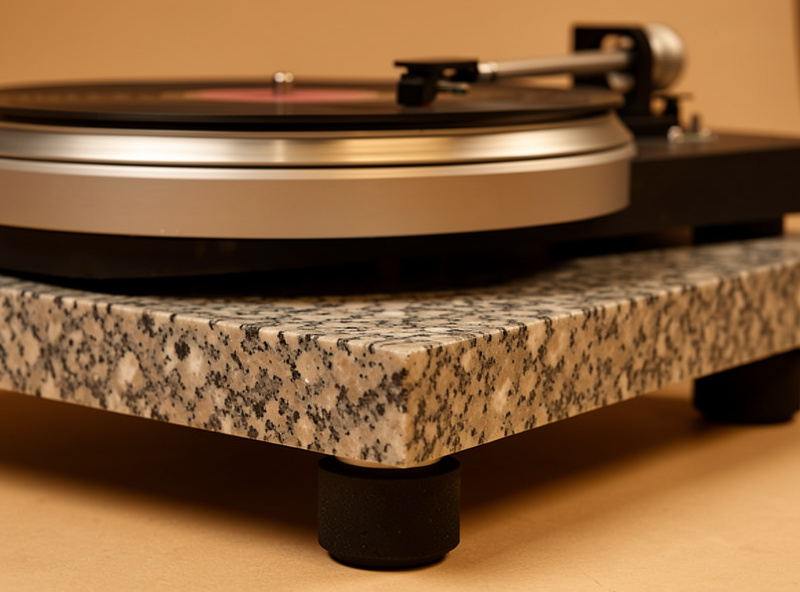
An isolation platform is a purpose-built slab you set the turntable on top of, and for most people it is the single highest-value isolation purchase. A good one combines a mass layer with a damping layer and decoupling feet so it handles both floor and airborne energy at once. Commercial options from IsoAcoustics and similar makers do this in a tidy package; a slab of granite on sorbothane does most of it for a fraction of the price.
The short version is that the platform matters more than the rack it sits on, because the platform is the last line of defense before the plinth. The real performers combine genuine mass with a lossy damping layer and compliant feet; the ones to skip are the slabs that are merely heavy and pretty with nothing underneath to filter the floor.
Isolation Feet and Spring Absorbers
Feet and spring absorbers decouple the deck (or the platform) from whatever sits below. Compliant feet — sorbothane, rubber, or purpose-made elastomer pucks — work above their resonant frequency, filtering footfall and structural rumble. Spring-based absorbers like the well-known wing-nut isolators go lower, tuning their resonance below the audio band so they filter a wider range, at the cost of a deck that wobbles if you bump it.
The choice between feet and springs is a real engineering tradeoff, not a brand preference. The numbers that matter are resonant frequency and loading: an absorber only filters frequencies well above its own resonance, so you weight-match it to the deck. Match the absorber to the load or it does nothing useful — an over-stiff foot under a light deck never moves, and an over-soft one under a heavy deck bottoms out solid.
Wall-Mounting: The Nuclear Option for Footfall
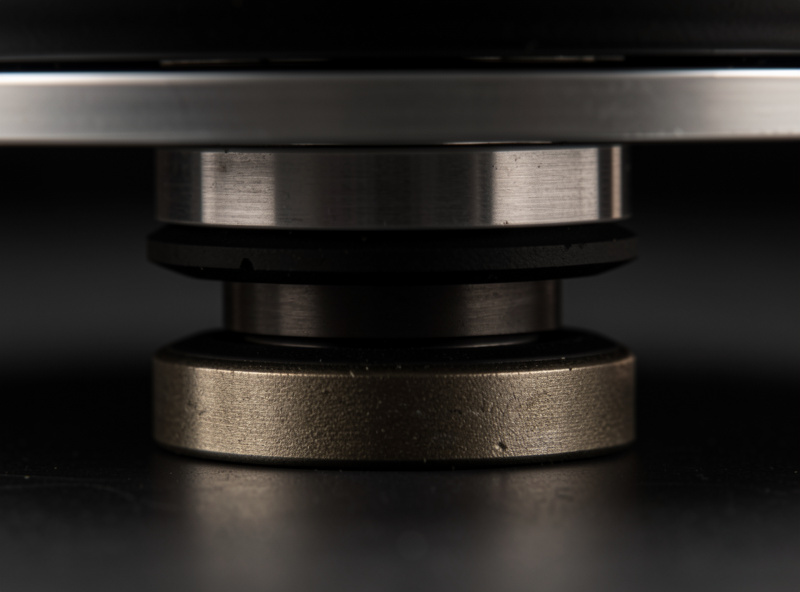
If your problem is footfall on a bouncy suspended floor, bolting an isolation shelf to a solid masonry wall is the most effective single fix there is. A brick or block wall does not transmit floor movement, so the deck is simply no longer connected to the part of the building that is moving. I have used a wall shelf to rescue a deck in an upstairs room where nothing on the floor would settle it.
The catch is that wall-mounting only works on a genuinely solid wall, and it does nothing for airborne feedback — it can even make it worse by putting the deck nearer the speakers. The quick test for a solid wall is to knock on it: a dull, dense thud means masonry that will hold an isolation shelf, while a hollow drum sound means a stud partition that will transmit and amplify exactly what you are trying to kill.
Sorbothane: The Most Misused Material in Audio
Sorbothane is a viscoelastic damping polymer that genuinely works, and that is exactly why it gets thrown at problems it cannot solve. It damps and decouples within a narrow load range; under-load it or over-load it and it either does nothing or bottoms out solid. The durometer (hardness) and the weight on each foot have to be matched, which most people never check.
Load matching is the whole game: pick a durometer soft enough to deflect a little under the weight on each foot but firm enough not to bottom out, and split the deck’s weight evenly across the pucks. Used correctly it is one of the best value materials in the hobby; used as a magic sticker slapped under a corner with no thought to the load, it is snake oil.
The Furniture Question
None of this works if the deck sits on the wrong rack. A flimsy, resonant stand is a tuning fork that amplifies everything you are trying to kill. The ideal turntable furniture is rigid, heavy, low, and decoupled from the floor — a dedicated audio rack with spiked or compliant feet, or a solid sideboard mass-loaded and sitting on the right footers.
What to look for is rigidity and mass low to the ground; what to avoid is the cheap glass shelf and the tall, wobbly flat-pack tower, both of which ring like a bell. The furniture is the foundation; the platform and feet build on it, and no amount of clever decoupling rescues a deck sitting on a tuning fork.
Common Isolation Mistakes I See Constantly
The most common error is treating isolation as a single product rather than a system. Someone buys expensive feet, leaves the deck on a flimsy glass shelf, and wonders why nothing changed — the feet were filtering a foundation that was itself a resonator. The fix has to start at the bottom and work up. The second mistake is stacking compliant layers: sorbothane under a platform that already sits on springy feet, on a wobbly stand. Soft on soft on soft does not isolate, it oscillates, and you end up with a deck that sways for seconds after any disturbance.
The third is ignoring load matching entirely — buying one durometer of sorbothane or one stiffness of spring regardless of deck weight. A 6 kg Pro-Ject and a 12 kg Technics need different compliance, and a foot tuned for one does little for the other. The fourth is putting the deck between the speakers because that is where the gap in the furniture happens to be; that placement maximizes airborne feedback no matter what you put underneath. And the fifth is decorating instead of damping: a pretty granite slab with nothing compliant beneath it transmits floor energy straight through. Mass without decoupling is just a heavier path for the vibration to travel.
How to Spend Your Isolation Budget, in Order
If you only do one thing, get the deck onto a rigid, decoupled support — fix the furniture. Next, add a proper platform with a damping layer, which you can buy or build — my DIY layered platform performs close to commercial units for far less. Then match feet or springs to your specific floor problem. Wall-mount only if footfall is the dominant issue and you have a solid wall. This order mirrors the spend-it-in-the-right-sequence logic I apply to the whole deck in my turntable upgrade guide — fix the foundation before you chase the exotic part.
Isolation Methods Compared
| Method | Best Against | How It Works | Typical Cost | Main Drawback |
|---|---|---|---|---|
| Mass-loaded platform | Airborne + mild footfall | Mass + damping | Low to mid | Heavy, needs strong shelf |
| Sorbothane feet | Footfall, structural rumble | Damping + decoupling | Low | Must match load exactly |
| Spring absorbers | Footfall, broad-band | Low-frequency decoupling | Low to mid | Deck wobbles, bump-sensitive |
| Wall-mount shelf | Severe footfall | Removes floor path | Low (hardware) | Needs solid wall; no airborne help |
| Rigid audio rack | Foundation for all | Rigidity + decoupled feet | Mid to high | Cost; needs floor decoupling too |
| DIY layered platform | Airborne + footfall | Mass + damping + decouple | Very low | Build time, get the stack right |
How Isolation Connects to the Rest of Your Setup
Isolation is one leg of a stable deck; the others are alignment, mass, and maintenance. A perfectly isolated table still sounds wrong if the cartridge is misaligned, so pair this with my cartridge alignment guide and the tracking force and anti-skate setup. Platter mass and mat choice also feed into resonance — see the turntable mat guide, the platter upgrade guide, and the leather versus felt versus cork comparison.
If you are still choosing a deck, the belt versus direct drive breakdown and the best vinyl player roundup matter, because some decks are more feedback-prone than others. New to all of this? Start with the record player guide. And once the deck is settled, the rest of the chain — your cartridge choice, your phono stage, and your speaker setup — finally gets to do its job over a quiet noise floor. A clamp or record weight (see the record weight engineering piece) couples the disc to the platter and is a natural partner to good isolation, and tidy storage from my record storage tips keeps the records you play flat.
Frequently Asked Questions
Does turntable isolation actually make an audible difference?
Yes, especially on suspended floors or at higher volumes. Proper isolation lowers the noise floor and stops footfall and speaker energy from reaching the stylus, which removes muddiness and skipping. The effect is biggest when footfall or airborne feedback was a problem to begin with.
What is the single most cost-effective isolation upgrade?
Getting the deck onto a rigid, decoupled support, then adding a mass-loaded platform with a damping layer. A granite slab on sorbothane feet costs little and handles most airborne and mild footfall energy, often outperforming pricey racks.
Will isolation fix a turntable that skips when I walk?
Usually yes, if the cause is footfall through a suspended floor. Wall-mounting to a solid masonry wall is the most reliable fix; spring absorbers or matched sorbothane feet also help. Airborne feedback needs a different approach.
Is sorbothane better than springs for isolation?
Neither is universally better. Sorbothane damps and decouples within a tight load range and must be matched to the weight on each foot. Springs tune lower and filter a broader band but leave the deck wobbly and bump-sensitive. Match the tool to your dominant vibration source.
Do I need an expensive platform or will a DIY one work?
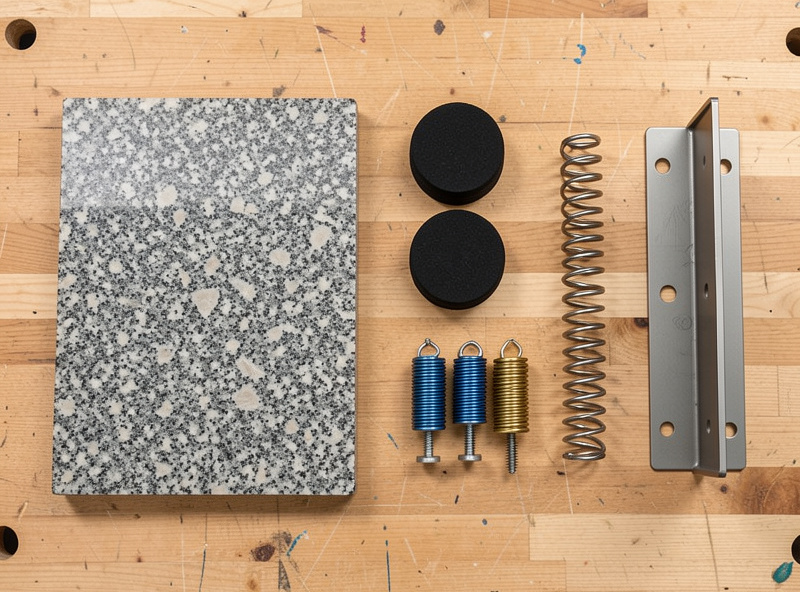
A DIY layered platform of mass, a damping sheet, and decoupling feet performs close to commercial units for a fraction of the cost. The key is the layer order: heavy on top, damping in the middle, compliant feet underneath. Stacking soft on soft just makes it bounce.
Should the turntable be near the speakers?
No. Keeping the deck away from and not between the speakers reduces airborne feedback, the energy that physically shakes the plinth at volume. If the deck must sit near them, prioritize a heavy plinth, a mass-loaded platform, and lower listening levels while playing.
Related Guides
- Turntable Upgrade Guide: Cartridges, Platters, Mats, and Tonearms
- Turntable Bearing Maintenance: Lubrication and Noise Reduction
- Belt Drive vs Direct Drive Turntables: Which Is Better?
- DIY Turntable Plinth: A CNC Project for Audiophiles
- Record Player Guide 2026: How to Choose, Set Up, and Enjoy Vinyl