Footfall and airborne vibration are the two things that ruin a turntable’s sound, and they reach the stylus by completely different paths. Footfall travels up through the floor as low-frequency structural energy and makes the stylus jump when you walk. Airborne vibration is your speakers physically shaking the plinth through the air, worst at volume. Telling them apart is the single most useful diagnosis in turntable isolation, because the fixes pull in opposite directions — and on my bench, more wasted money comes from solving the wrong one than from any other mistake.
I have chased both in real rooms across my Technics, Rega, and Pro-Ject decks, and the diagnosis takes about ten minutes and costs nothing. Once you know which source dominates, the right fix is obvious. This guide explains the physics of each, how to test for them, and where they overlap. For the full set of isolation solutions once you have your answer, see the complete turntable isolation guide.
Footfall: The Vibration That Comes Up the Floor
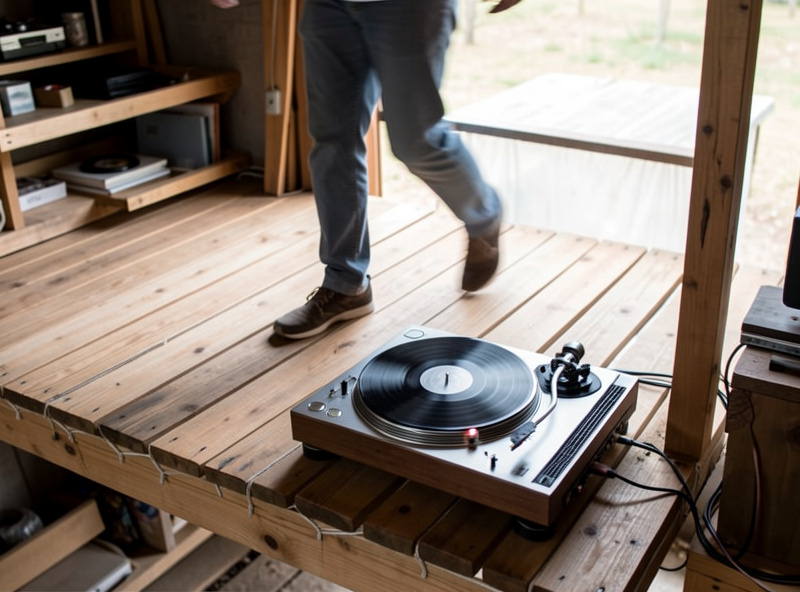
Footfall is low-frequency energy, mostly below 50 Hz, generated when you walk across a floor and transmitted through the building structure to the deck. On a suspended timber floor — joists and floorboards rather than a concrete slab — that energy arrives as a slow heave that lifts and drops the whole turntable a fraction of a millimeter. The stylus, tracking groove modulations measured in microns, reads that heave as a giant low-frequency input and can literally skip out of the groove.
Footfall is purely structural. It does not care how loud you are playing; it happens at zero volume just as badly. The giveaway is that the trouble is tied to movement — someone walking, a door closing, a washing machine spinning two rooms away — not to the music. Suspended upper floors are the classic victims; ground-floor concrete slabs rarely have a footfall problem at all.
Airborne Vibration: The Sound That Shakes the Deck
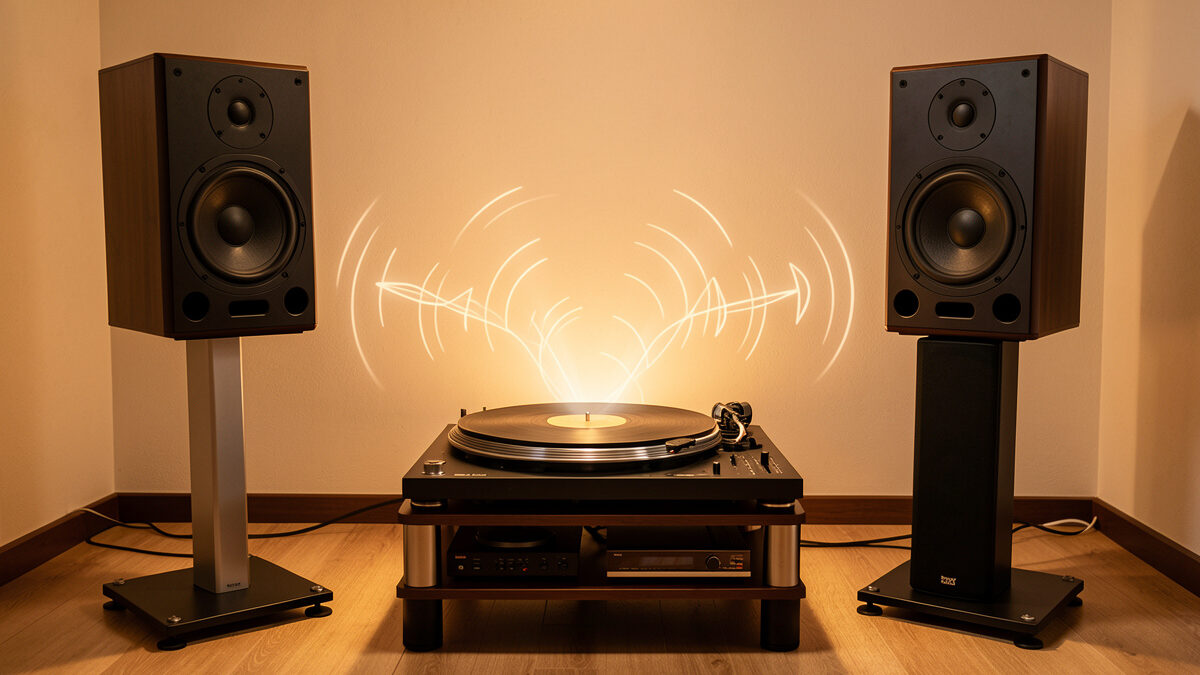
Airborne vibration is acoustic energy from your speakers traveling through the air and physically vibrating the plinth, platter, and cartridge. At normal levels it is negligible; at higher volumes, especially with the deck near or between the speakers, the bass pressure can set the whole assembly resonating. The cartridge then picks up its own system’s output, a feedback loop that thickens the bass into a boom and smears detail.
Airborne energy is volume-dependent and frequency-dependent. It gets worse the louder you play and is dominated by low bass, which carries the most acoustic power and couples most easily into a resonant plinth. The giveaway is the opposite of footfall: the deck is fine when you walk past quietly, but the bass turns muddy and uncontrolled as you turn it up, and in bad cases it howls into full acoustic feedback.
How to Tell Which One You Have
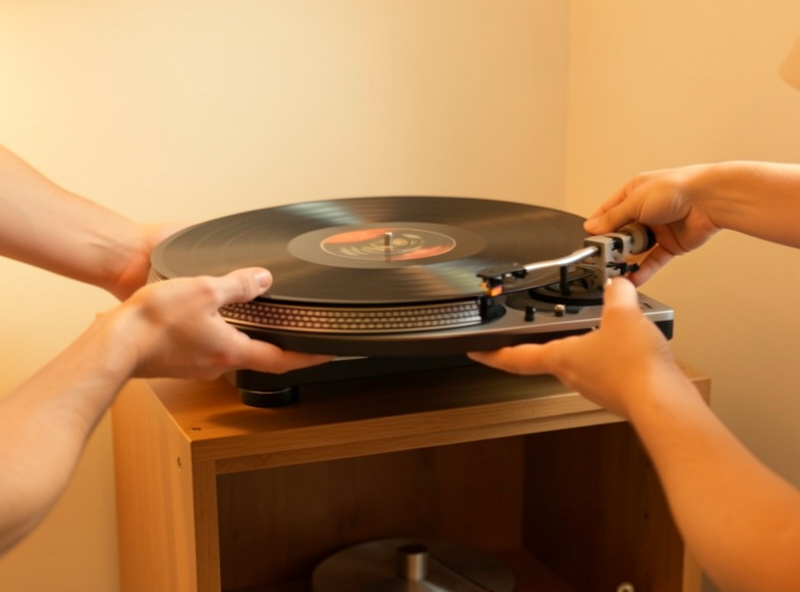
The diagnosis is two simple tests. First, the footfall test: cue a quiet lead-in groove with the volume at zero and walk firmly around the deck. If the stylus jumps or you hear thumps through headphones, you have footfall. Because the volume is off, anything you hear or see must be structural. Second, the airborne test: play music at a normal-to-loud level, then carefully lift the deck a few inches off its support while it keeps playing. If the bass tightens and the muddiness clears when the deck is in your hands away from the rack, the problem was airborne energy coupling through the support.
Run both. Many rooms have one clearly dominant source; some have both. A third quick check is the knuckle test with the system off — rap the plinth and the shelf and listen for ringing, which points to a resonant support that makes either problem worse. These tests cost nothing and point you straight at the right fix instead of letting you guess.
The Resonant Support: The Hidden Third Factor
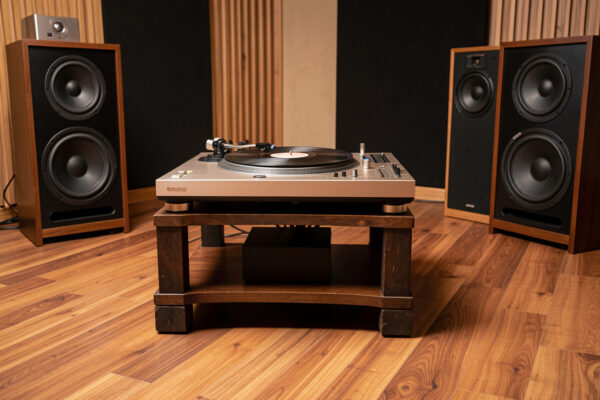
Before you decide it is footfall or airborne, rule out the support itself, because a resonant rack can masquerade as either. A flimsy glass shelf or a tall flat-pack tower behaves like a tuning fork: it has its own resonant frequency, and when footfall or airborne energy hits that frequency, the rack rings and amplifies the input rather than passing it through neutrally. You end up chasing a vibration problem that is really a furniture problem.
This is why the knuckle test matters. A short, dead thud when you rap the shelf means the support is well damped and not adding its own coloration; a long ring means the rack is storing and re-releasing energy, making whatever reaches it worse. Many people who think they have a severe footfall or feedback problem actually have a deck on a resonant stand, and simply moving it to a rigid, heavy, low support solves most of it before any specialized isolation product is even needed. Treat the furniture as the foundation and diagnose it first.
What the Stylus Is Actually Fighting
It helps to understand why such tiny inputs matter. A magnetic cartridge generates its signal from the relative velocity between the stylus tip riding the groove and the cartridge body bolted to the headshell. The system assumes the body is dead still and only the tip is moving. Footfall and airborne energy break that assumption by moving the body, so the cartridge faithfully outputs the difference as noise added to the music. Worse, low-frequency body movement intermodulates with the audio, smearing midrange detail rather than just adding a rumble you could filter out downstream.
Subsonic content below 20 Hz is the real menace. You cannot hear it directly, but it pumps the woofer cone in and out, eats amplifier headroom, and muddies the bass you can hear. A rumble filter helps after the fact, but the right place to stop this energy is at the deck, before it ever becomes signal. That is the entire justification for spending on isolation: you are protecting the one assumption the cartridge depends on.
Why the Fixes Pull in Opposite Directions
Footfall is best beaten by removing or filtering the floor path: a wall-mounted shelf on solid masonry removes it entirely, while spring absorbers and matched compliant feet filter the low frequencies before they reach the deck. These fixes prioritize low-frequency decoupling and accept a deck that may sway slightly.
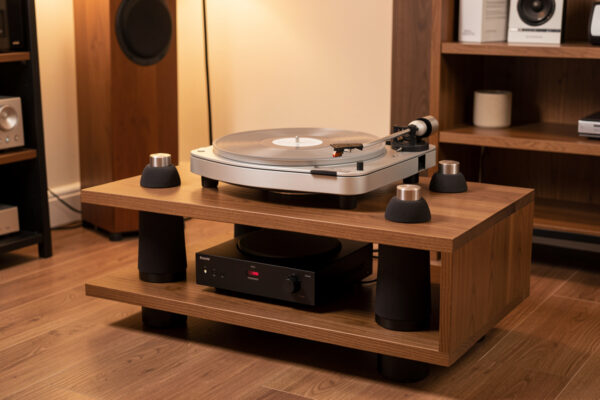
Airborne vibration is best beaten by mass, damping, and distance: a heavy plinth and a mass-loaded platform resist being shaken, a damping layer stops ringing, and simply moving the deck away from and not between the speakers cuts the energy reaching it. Notice the tension — wall-mounting fixes footfall but can worsen airborne by raising the deck nearer the speakers; a heavy slab fixes airborne but does little for severe footfall on a bouncy floor. Solve the wrong one and you can make the other worse, which is exactly why diagnosing first matters.
Two Rooms, Two Different Answers
Consider two setups I have worked through, because they show why the same symptom needs different cures. The first was a deck in an upstairs room on a suspended timber floor, where the stylus skipped every time someone crossed the room and the volume made no difference. Pure footfall. No platform settled it; only bolting an isolation shelf to the solid masonry wall removed the floor path and ended the skipping for good. Throwing a heavy slab at it would have wasted money on the wrong physics.
The second was a deck on a ground-floor concrete slab that sounded fine quietly but turned to boomy mush at volume, with the deck sitting on a low shelf between the speakers. Pure airborne. There was no footfall to fix — the concrete saw to that — so the cure was mass and distance: a damped, mass-loaded platform and moving the deck off-axis from the speakers. A wall shelf there would have helped nothing and possibly moved the deck closer to a speaker. Same complaint of bad bass, opposite diagnosis, opposite fix. That is the whole reason this article exists.
Footfall vs Airborne at a Glance
| Characteristic | Footfall | Airborne |
|---|---|---|
| Path to deck | Up through floor/structure | Through air from speakers |
| Frequency | Very low (under 50 Hz) | Low bass, volume-dependent |
| Trigger | Walking, doors, appliances | High playback volume |
| Worst on | Suspended timber floors | Deck near/between speakers |
| Best fix | Wall shelf, springs, compliant feet | Mass, damping, distance |
| Volume dependent? | No | Yes |
When You Have Both
Plenty of real setups suffer from both, especially a deck on a suspended floor that also likes to play loud. The honest approach is to handle the dominant source first, retest, then address what remains. Often a wall shelf kills the footfall and a heavy, damped platform with sensible speaker placement handles the airborne side. The order matters: fix the bigger problem, measure again with the same two tests, and only add the next layer if the tests still show trouble. That discipline keeps you from stacking fixes that fight each other. With both paths quieted, the rest of your deck — alignment, tracking force, and your platform choice — finally performs over a quiet noise floor.
Frequently Asked Questions
What is the difference between footfall and airborne vibration?
Footfall is low-frequency structural energy, mostly below 50 Hz, that travels up through the floor when you walk and is independent of volume. Airborne vibration is sound from your speakers shaking the plinth through the air, and it gets worse the louder you play.
How do I know if my turntable problem is footfall or airborne?
Run two tests. For footfall, cue a quiet groove with the volume at zero and walk firmly around the deck; if the stylus jumps it is structural. For airborne, play loud music and lift the deck off its support; if the bass tightens in your hands the problem was airborne coupling.
Why does my turntable skip when I walk past it?
That is footfall, almost always on a suspended timber floor. The fix is to remove or filter the floor path: a wall-mounted shelf on solid masonry, spring absorbers, or matched compliant feet. Adding mass alone does little for severe footfall.
Why does my turntable bass get muddy at high volume?
That is airborne feedback, your speakers shaking the plinth and platter at volume. Beat it with mass and damping, a heavy mass-loaded platform, and by moving the deck away from and not between the speakers. Volume dependence is the tell.
Can a bad rack cause turntable vibration problems?
Yes. A flimsy glass shelf or tall flat-pack tower resonates like a tuning fork and amplifies footfall or airborne energy. Use the knuckle test: a long ring means a resonant support. Moving the deck to a rigid, heavy, low stand often solves most of it first.
What if I have both footfall and airborne vibration?
Handle the dominant source first, then retest with the same two tests and only add the next layer if trouble remains. Often a wall shelf kills footfall while a heavy damped platform and sensible speaker placement handle the airborne side.