What a Phono Preamp Does
A phono preamp — also called a phono stage or phono amplifier — performs two critical tasks that make vinyl playback possible. First, it amplifies the tiny electrical signal from the turntable’s cartridge from roughly 2–5 millivolts (MM) or 0.2–0.5 millivolts (MC) up to line level, which is the standard signal strength that amplifiers and powered speakers expect. Without this amplification, music would be barely audible, even with the volume knob turned all the way up.
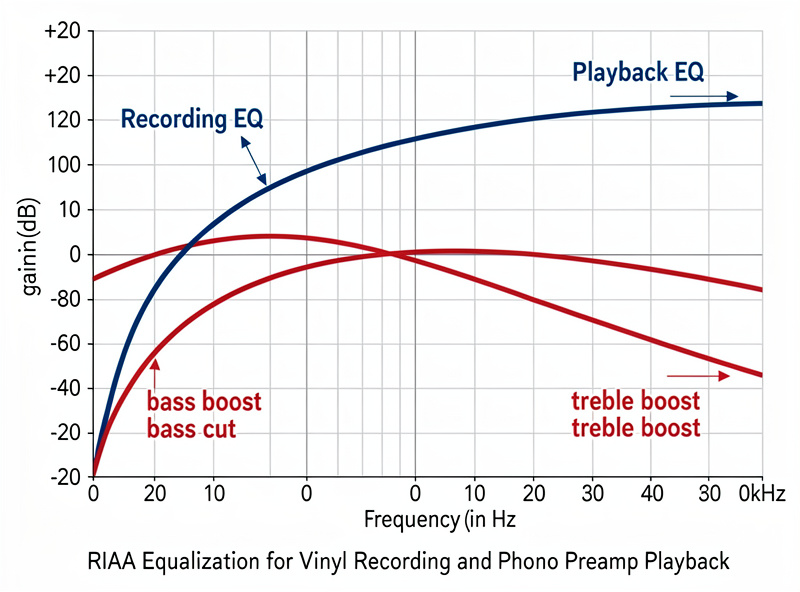
Second, and equally important, the phono preamp applies RIAA equalization. When records are cut, the mastering lathe reduces bass frequencies by 20 dB and boosts treble frequencies to fit more music onto each side and prevent the stylus from jumping out of wide bass grooves. The phono preamp reverses this curve during playback — restoring bass by 20 dB and cutting treble to produce the correct frequency balance. This RIAA equalization curve, standardized in 1954, is the reason you cannot simply plug a turntable into a line-level input.
Every turntable needs a phono preamp somewhere in the signal chain. The question is whether that preamp is built into the turntable, built into your amplifier or receiver, or a separate external box. Understanding the differences determines whether your records sound thin and noisy or full and detailed.
RIAA Equalization: The Technical Details
The RIAA curve is not optional — it is a fundamental part of how vinyl records store music. Without RIAA playback equalization, every record you play would sound overwhelmingly trebly with almost no bass. The standard specifies a precise frequency response correction: −20 dB at 20 Hz (bass cut during recording, restored during playback), 0 dB at 1 kHz (reference point), and +20 dB at 20 kHz (treble boost during recording, cut during playback).
Budget phono preamps approximate this curve with basic resistor-capacitor networks. They achieve acceptable accuracy within ±2 dB across the audible range, which is fine for casual listening. Premium phono preamps use precision components and active filter designs to achieve accuracy within ±0.2 dB, preserving subtle tonal details that budget designs smooth over.
The RIAA curve also explains why phono preamps affect sound quality so dramatically. A preamp that deviates from the curve by even 1 dB at certain frequencies will audibly alter the tonal balance — too much bass, too little treble, or a midrange emphasis that makes vocals sound nasal. This is why upgrading from a $10 built-in preamp to a $100 external unit produces such an immediately noticeable improvement.
MM vs MC: Matching the Preamp to Your Cartridge
Moving Magnet (MM) cartridges output 2–5 millivolts and require approximately 40 dB of gain from the phono preamp. Nearly every phono preamp on the market supports MM cartridges, from $20 budget units to $5,000 reference designs. MM cartridges are the default choice for turntables under $1,500 because they are affordable, durable, and compatible with every preamp.
Moving Coil (MC) cartridges output 0.2–0.5 millivolts — roughly one-tenth the signal level of MM. They require an additional 15–20 dB of gain, totaling 55–60 dB. Not all phono preamps provide this much gain. Entry-level preamps under $100 typically max out at 40–45 dB, which is insufficient for MC cartridges. If you use an MC cartridge with a preamp designed for MM, the volume will be extremely low and the signal-to-noise ratio will suffer.
MC cartridges also present a different load impedance to the preamp. MM cartridges expect a 47k ohm input impedance, which is the standard. MC cartridges perform best with specific load values — typically 100 ohms to 1,000 ohms — that the preamp must provide. Premium MC phono preamps offer adjustable loading via DIP switches or jumpers, letting you dial in the manufacturer’s recommended impedance for optimal performance.
If you are starting with an MM cartridge — which is the right choice for most first-time turntable buyers — any MM-compatible phono preamp will work. When you eventually upgrade to an MC cartridge, you will need either an MC-capable preamp or a separate MC step-up transformer that boosts the signal before feeding it into an MM preamp.
Built-In vs External Phono Preamps
Built-in phono preamps appear in two places: inside the turntable or inside the amplifier/receiver. Turntable built-in preamps are common on models under $500 and add convenience — you connect the turntable directly to powered speakers with no additional equipment. However, the preamp circuit shares the turntable’s power supply and sits inside a chassis full of electromagnetic interference from the motor, making it inherently noisier than an external unit with its own isolated power supply.
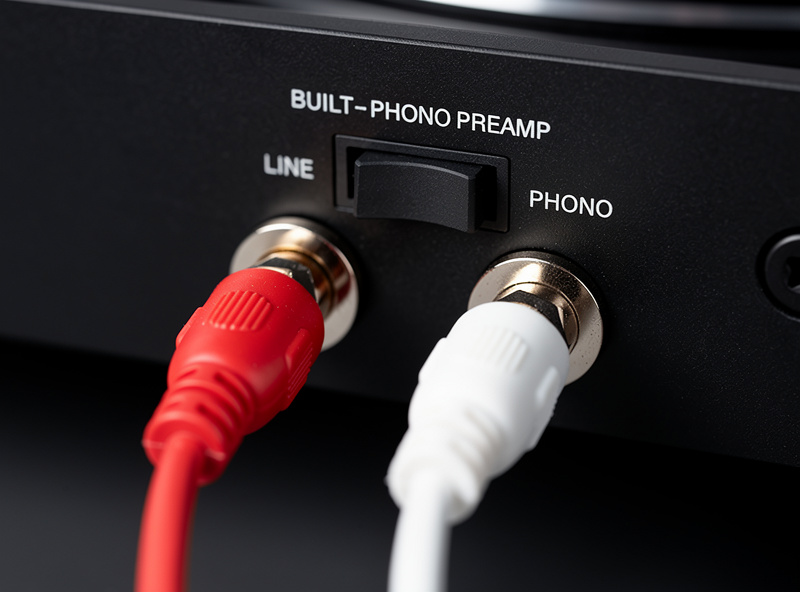
Receiver built-in preamps vary widely in quality. A $500 AV receiver might have a phono input, but the preamp section is an afterthought — a basic op-amp circuit with generic RIAA equalization that costs the manufacturer under $2 to implement. Dedicated stereo receivers and integrated amplifiers from brands like Marantz, Cambridge Audio, and Yamaha typically include better phono stages, but they still cannot match a standalone external preamp at the same total price point.
External phono preamps are the best option for anyone who cares about sound quality. They have dedicated power supplies, isolated chassis designs, precision components, and — in many cases — adjustable gain and loading for cartridge matching. Even a $100 external preamp like the Schiit Mani 2 will outperform every built-in preamp on turntables and receivers under $800.
Phono Preamp Comparison Table
| Preamp | Price | Type | MM Gain | MC Support | Adjustable Loading | Best For |
|---|---|---|---|---|---|---|
| Behringer Microphono PP400 | $25 | External | 40 dB | No | No | Ultra-budget entry |
| Art DJPre II | $50 | External | 40 dB | No | No | Budget external upgrade |
| Schiit Mani 2 | $149 | External | 30–48 dB | Yes | Yes | Best value for MM and MC |
| iFi Zen Phono | $199 | External | 36–48 dB | Yes | Yes | MC cartridge matching |
| Pro-Ject Phono Box S3 B | $249 | External | 40–60 dB | Yes | Yes | Balanced output option |
| Cambridge Audio Alva Solo | $200 | External | 39 dB | Yes | No | British sound signature |
| MoFi UltraPhono | $500 | External | 40–66 dB | Yes | Yes | High-end MM and MC |
| Lehmann Black Cube SE | $1,200 | External | 36–66 dB | Yes | Yes | Reference MC playback |
How a Phono Preamp Affects Sound Quality
The phono preamp’s impact on sound quality is disproportionate to its price. A $2,000 turntable with a $25 preamp will sound worse than a $500 turntable with a $200 preamp. This is because the preamp handles the most delicate part of the signal chain — amplifying a signal measured in millivolts while applying precise frequency correction.
Noise floor. Every electronic component adds some noise. Budget preamps use inexpensive op-amps and noisy power supplies that produce audible hiss, hum, or buzz during quiet passages. Premium preamps use low-noise components, regulated power supplies, and shielded chassis designs that drop the noise floor below audibility.
RIAA accuracy. As mentioned earlier, deviations from the RIAA curve alter tonal balance. A preamp with ±0.5 dB accuracy sounds more natural and balanced than one with ±2 dB accuracy. The difference is most audible on acoustic instruments and vocals, where tonal accuracy is immediately apparent.
Dynamic range. Good preamps handle the full dynamic range of vinyl without compression or clipping. Budget preamps can compress transients — the sharp attack of a snare drum or the initial pluck of a guitar string — making music sound duller and less engaging than it should.
Channel separation. The phono preamp must maintain stereo separation between the left and right channels. Crosstalk — where left-channel signal bleeds into the right channel — narrows the soundstage and reduces imaging precision. Premium preamps achieve channel separation exceeding 70 dB at 1 kHz, preserving the spatial information encoded in the groove.
Budget Options: Best Value at Every Price Point
$25–$50: Behringer PP400 or Art DJPre II. These basic MM preamps are dramatically better than the built-in preamps on turntables under $200. They lack adjustable settings but deliver clean RIAA equalization and adequate gain for MM cartridges. The Art DJPre II is the better choice — its signal-to-noise ratio is measurably lower and its RIAA curve is more accurate.
$100–$200: Schiit Mani 2 ($149) or iFi Zen Phono ($199). This is the sweet spot for most listeners. The Schiit Mani 2 offers adjustable gain (30–48 dB) and loading via internal DIP switches, supporting both MM and MC cartridges. The iFi Zen Phono adds subsonic filtering that removes rumble below 20 Hz without affecting audible bass. Both are significant upgrades over built-in preamps.
$200–$500: Pro-Ject Phono Box S3 B ($249) or MoFi UltraPhono ($500). These preamps offer balanced outputs, precision RIAA networks, and extensive loading options for exotic MC cartridges. The MoFi UltraPhono includes a headphone amplifier, making it a two-in-one solution for headphone listeners. Performance at this level exceeds what most systems can resolve, meaning the preamp will never be the bottleneck.
$500+: Lehmann Black Cube SE ($1,200) or iFi Pro iPhono 3 ($1,499). Reference-grade preamps for high-end MC cartridges and systems costing $5,000+. Adjustable gain in 1 dB steps, multiple loading options, and power supplies with noise floors below -100 dB. Unless your turntable and speakers are worth $3,000+, investing this much in a preamp yields diminishing returns.
How to Connect a Phono Preamp
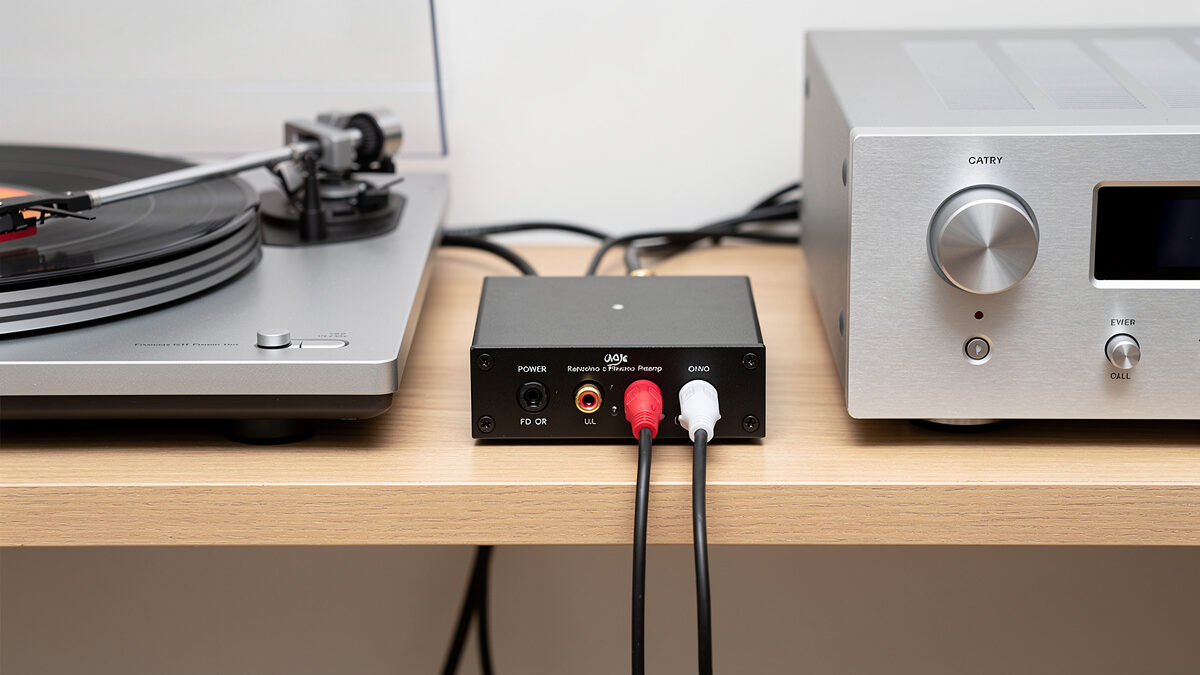
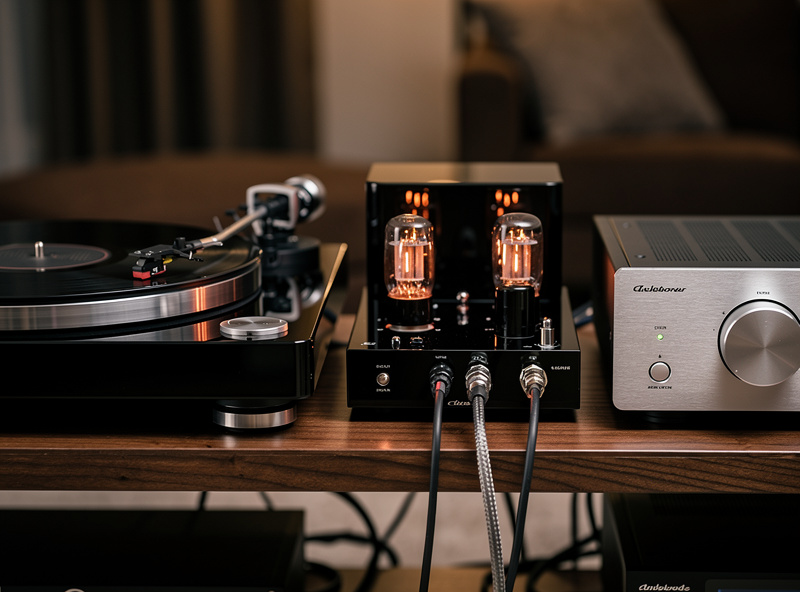
Connecting an external phono preamp is straightforward. Run RCA cables from the turntable’s output to the preamp’s input, then run another set of RCA cables from the preamp’s output to your amplifier or powered speakers. If your turntable has a ground wire, connect it to the preamp’s ground terminal to eliminate hum.
If your turntable has a built-in preamp with a phono/line switch, set the switch to “phono” when using an external preamp. This bypasses the internal preamp and sends the raw cartridge signal to your external unit. Running two preamps in series — built-in plus external — produces severe distortion because the signal gets equalized twice.
Ground loops are the most common connection problem. If you hear a 60 Hz hum (50 Hz in Europe), connect the turntable’s ground wire to the preamp’s ground terminal. If your turntable lacks a ground wire, try connecting a short wire from the preamp’s ground terminal to any screw on the amplifier chassis. In most cases, this eliminates hum completely.
Frequently Asked Questions
Can I use a turntable without a phono preamp?
No, you cannot play records without a phono preamp. The cartridge outputs a signal 100–1,000 times quieter than line level, and the RIAA equalization curve must be applied to restore correct frequency balance. Without a preamp, music is extremely quiet and sounds thin with no bass.
Is a built-in phono preamp good enough?
Built-in preamps on turntables under $500 are basic but functional. They are adequate for casual listening with budget systems. Upgrading to an external preamp like the Schiit Mani 2 ($149) produces an immediate and obvious improvement in clarity, noise floor, and tonal accuracy.
Do I need an MC phono preamp?
You need an MC-compatible preamp only if your cartridge is Moving Coil. MC cartridges output one-tenth the signal of MM cartridges and require 15–20 dB more gain. Most turntables under $1,500 ship with MM cartridges, so an MC preamp is unnecessary for the majority of setups.
What is the best budget phono preamp?
The Schiit Mani 2 at $149 is the best value phono preamp available. It supports both MM and MC cartridges with adjustable gain and loading, uses low-noise components, and outperforms every built-in preamp on turntables and receivers under $800.
How do I eliminate hum from my phono preamp?
Connect the turntable’s ground wire to the preamp’s ground terminal. If hum persists, check for ground loops by unplugging other equipment. Ensure the preamp is not sitting near a power strip or transformer. Moving the preamp 6 inches away from power sources often resolves residual hum.
Does a phono preamp affect MM and MC cartridges differently?
Yes, MM and MC cartridges have different output levels and impedance requirements. MM cartridges need 40 dB gain at 47k ohm loading. MC cartridges need 55–60 dB gain at 100–1,000 ohm loading. A preamp optimized for MM will underperform with MC, producing low volume and high noise.
Related Articles
- Turntable Buying Guide 2026: How to Choose Your First Record Player
- Belt Drive vs Direct Drive Turntables: Which Is Better for Vinyl?
- Cartridge Alignment Guide: Get the Best Sound from Your Turntable
- Vinyl Record Care Guide: Protect Your Collection for Decades
- Record Storage Tips: Keep Your Vinyl Collection Safe