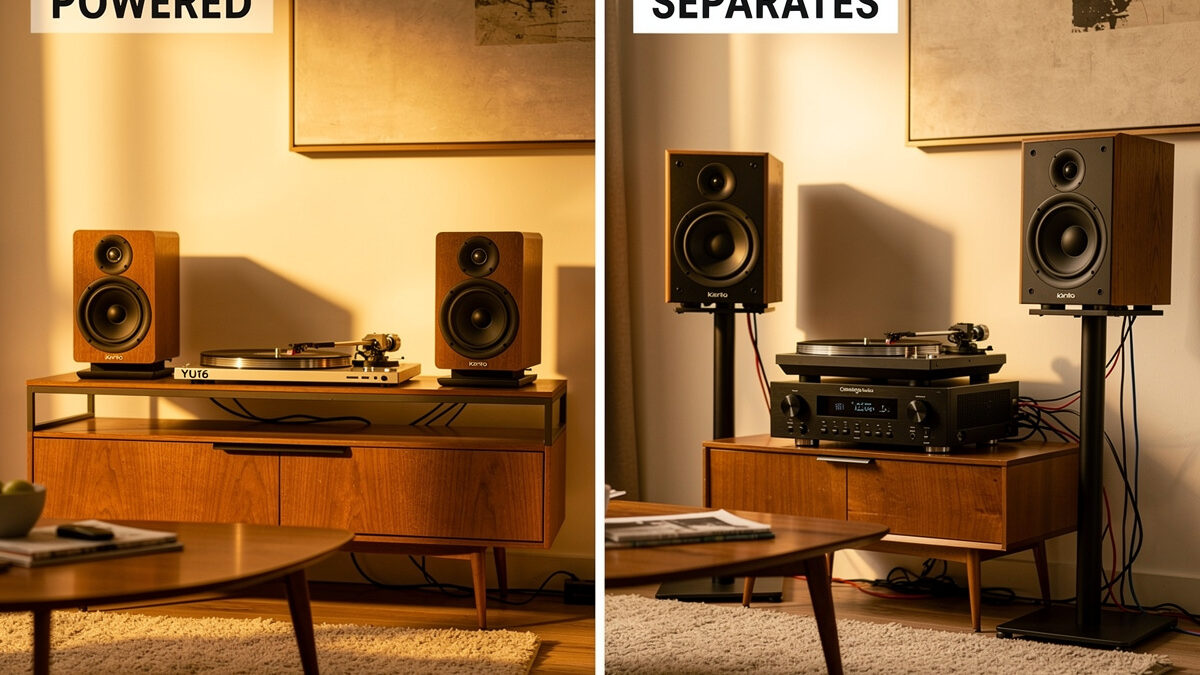
One of the first decisions vinyl-curious buyers face after the turntable: powered speakers, or a separate amplifier driving passive speakers? The marketing pitch for powered speakers is “everything in one box, plug and play.” The hi-fi argument for passive speakers + amp is “better upgrade path, better sound at every price tier.” Both have valid use cases, but the right answer depends on space, budget, and how committed you are to building a system over time. After years of A/B testing both paths in real living rooms, the decision pattern is consistent: powered speakers win at very low budgets and very small spaces; passive + amp wins at every other price point.
This guide walks the comparison: signal chain, cost-per-quality, upgrade paths, and the specific situations each approach handles best. The phono preamp decision affects both paths — see our phono preamp explained guide for why RIAA equalization matters regardless of speaker type.
The Signal Chain Difference
Powered speakers and passive speakers + amp differ in where amplification happens. Both routes need amplification — the question is whether it lives in the speaker cabinet or in a separate box.
Powered speakers signal chain:
Turntable → phono preamp (built into turntable, speaker, or external) → powered speaker (amp inside) → driver. Single power cable per speaker; usually a stereo pair share one chassis with master/slave configuration.
Passive speakers + amp signal chain:
Turntable → external phono preamp → integrated amplifier → speaker wire → passive speaker → driver. More boxes, more cables, more decisions to make individually.
The second chain is more flexible — every component can be upgraded independently. The first chain is simpler but components are coupled. A failure in any of the powered speaker’s three internal stages (DAC, amp, driver) takes the whole speaker offline and may be uneconomical to repair.
Powered Speakers: Where They Win
Three scenarios where powered speakers are clearly the right answer:
1. Total budget under $500. Below this price point, splitting the budget between separate amp and passive speakers means buying low-quality versions of both. A pair of $400 powered speakers (Kanto YU6, Audioengine A5+, KEF LSX II in some configurations) typically outperforms a $200 amp + $200 speakers. The amplification is matched to the drivers by the manufacturer.
2. Space-constrained setups. Apartments, dorms, desks, kitchens. No room for an integrated amp + speakers + cable runs. A pair of powered speakers takes one shelf and a single power outlet per side.
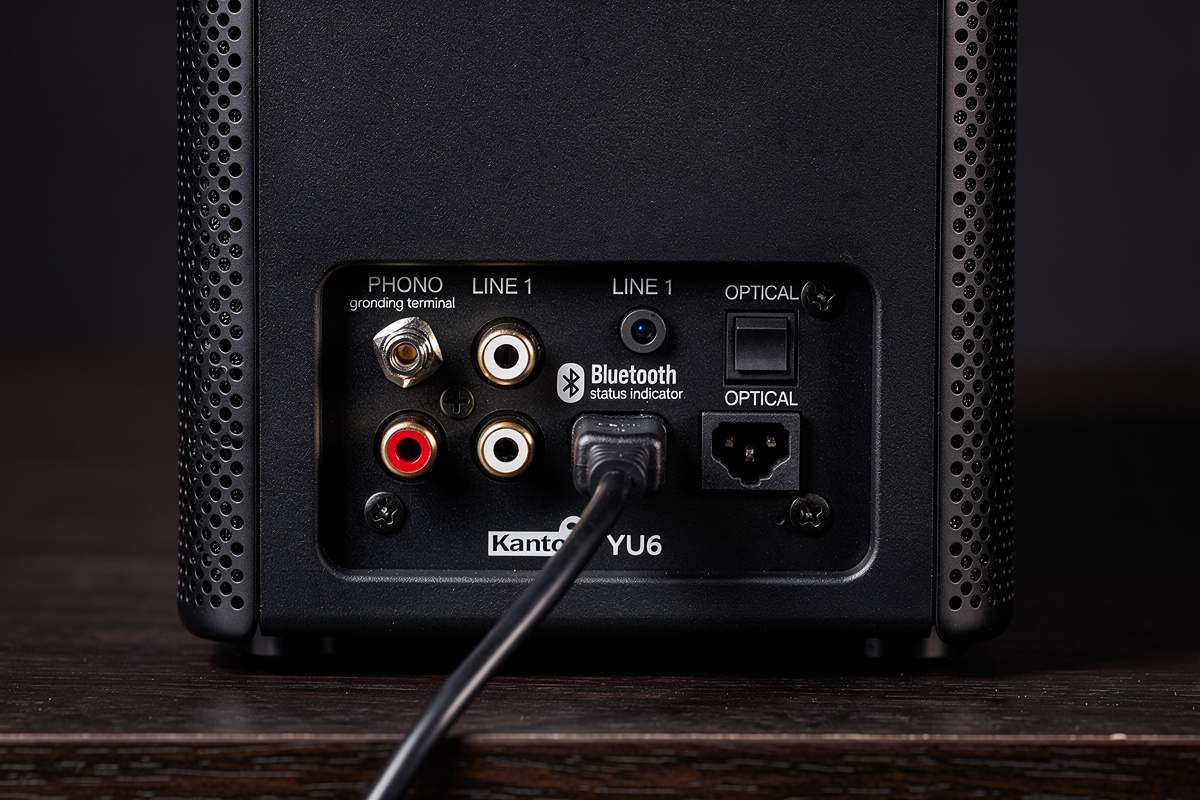
3. Multipurpose listening (TV + vinyl + phone streaming). Modern powered speakers come with multiple inputs: phono, line-level, optical, Bluetooth. Switching between vinyl, TV audio, and a phone stream is a remote-button click rather than rewiring the system.
The mid-tier and high-tier of powered speakers (Kanto YU6 at $400, Audioengine A5+ at $500, KEF LSX II Wireless at $1,500, Genelec G One at $700/each) have closed much of the historical quality gap with separates at equivalent price. For specific listening scenarios — desktop, kitchen, bedroom, multipurpose living room — they are the right tool.
Passive Speakers + Amp: Where They Win
Three scenarios where the separates approach is the better choice:
1. Budget above $1,000 total. At this price point, splitting the budget across a $400–500 amp and $500–700 speakers consistently outperforms equivalent powered speakers. The amplification quality at the $500 amp tier (Cambridge Audio AXA35, Yamaha A-S301, Marantz PM6007) exceeds what fits inside a $1,000 powered speaker pair.
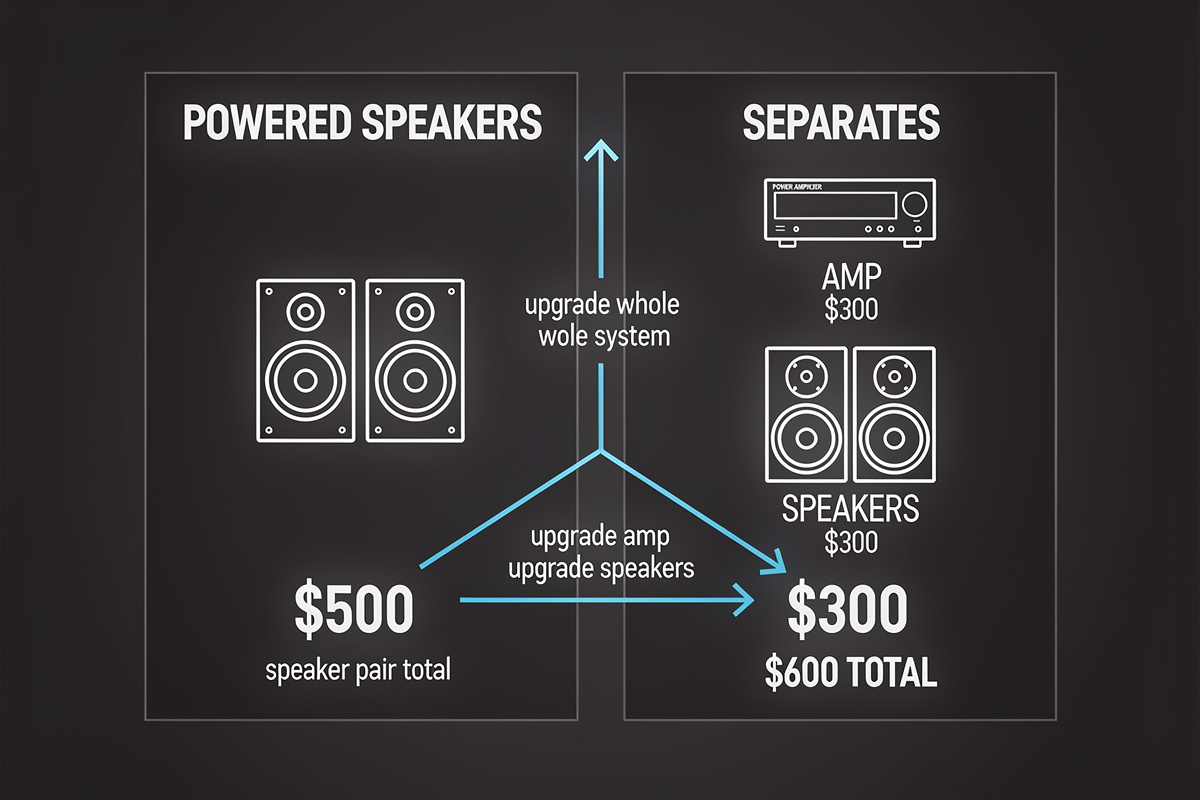
2. Long-term upgrade path matters. Want to upgrade speakers in 2 years without replacing your amp? Or upgrade the amp without replacing your speakers? Separates allow this; powered speakers do not. The system stays useful as components change. Our turntable upgrade guide covers how to plan your system’s evolution over time.
3. Specific speaker characteristics matter. If you have already heard speakers you want (specific Wharfedale, Q Acoustics, KEF, ProAc, or Spendor models), you cannot buy them as powered. The separates path keeps the speaker selection space wider.
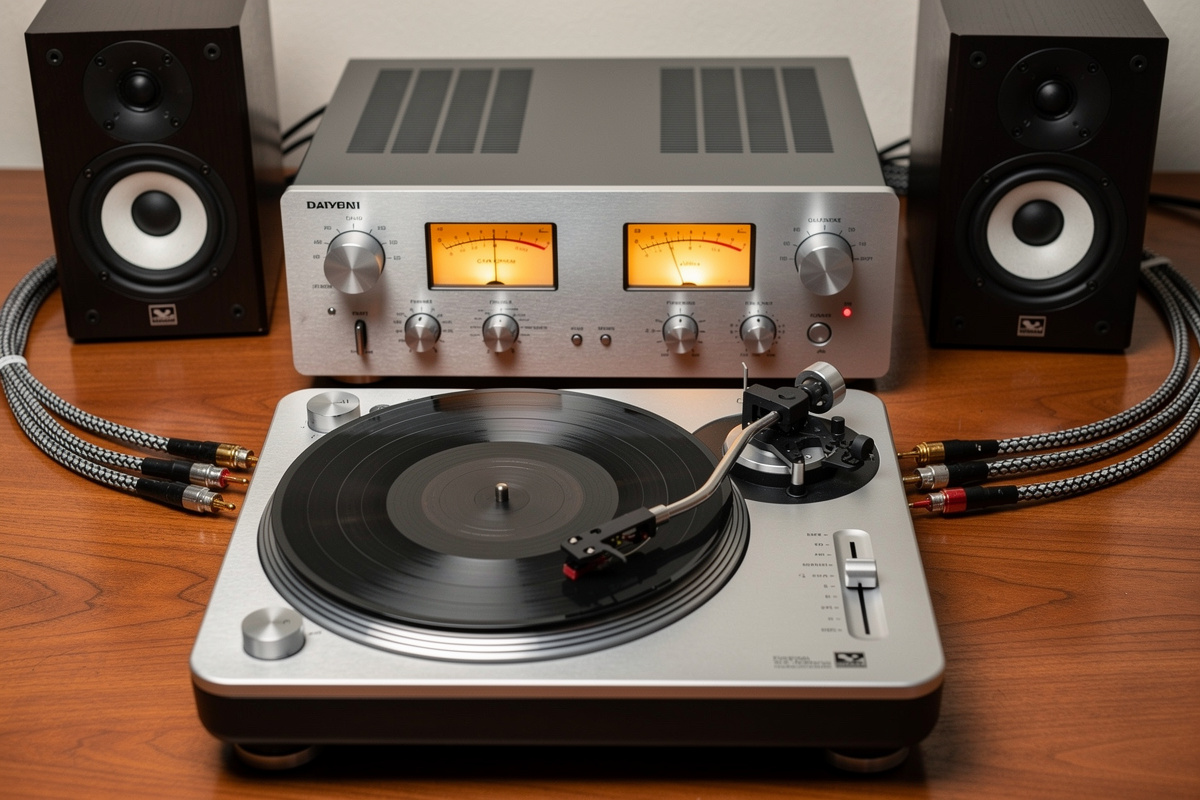
The hi-fi tradition is built on separates because the “best at each stage” approach scales further than “everything in one box.” For listeners committed to vinyl as a serious hobby, separates make sense even at the entry level.
Powered vs Passive Speakers: Comparison Table
| Factor | Powered Speakers | Passive + Amp |
|---|---|---|
| Total cost (entry) | $300–$500 | $550–$800 |
| Total cost (mid-range) | $700–$1,500 | $1,000–$2,000 |
| Setup complexity | Plug and play | Multiple cables, more decisions |
| Upgrade path | Replace entire speaker | Upgrade amp or speakers independently |
| Sound quality at $400 | Better (matched components) | Worse (budget split too thin) |
| Sound quality at $1,500+ | Good but limited | Superior (specialized components) |
| Space required | Minimal (2 speakers, 2 power cables) | More (amp + speakers + speaker wire) |
| Multi-source input | Built-in (phono, line, BT, optical) | Depends on amp (4–6 inputs typical) |
| Repairability | Difficult (integrated electronics) | Easy (replace individual component) |
| Best for | Budget setups, small spaces, casual | Serious listeners, upgrade path, quality |
Sound Quality Comparison at Equivalent Price
Real-world A/B testing at three price tiers:
$400 tier: Kanto YU6 (powered, $400) vs Yamaha A-S301 ($350) + Wharfedale Diamond 12.0 ($200) = $550. The separates total is more, but for like-for-like price, the YU6 wins on bass and convenience while the separates win on imaging and detail. Powered speakers are the better choice if total budget caps at $400–500.
$1,000 tier: Audioengine HD6 (powered, $1,000) vs Cambridge Audio CXA61 ($1,000) + Q Acoustics 3030i ($800) = $1,800. The separates total is significantly more but the quality gap widens. At this price, separates start opening a clear sound advantage. For $1,000 cap, powered. For $1,800 budget, separates.
$2,500 tier: KEF LS50 Wireless II (powered, $2,500) vs Cambridge Audio Edge A ($3,500) + KEF LS50 Meta passive ($1,500) = $5,000. Even at this premium tier, the separates option is stronger because every component is at the top of its category. The LS50 Wireless II is excellent but compromises versus the same drivers in passive form fed by a higher-end amplifier.
The pattern: as budget rises, the separates option pulls ahead because each component can be selected for its specialty. Below $500, “all-in-one” engineering closes the gap. Above $2,000, separates pull ahead decisively.
Phono Stage Considerations for Each Path
Both paths need a phono preamp somewhere. The placement differs. Our phono preamp explained guide covers RIAA equalization and MM vs MC requirements in detail.
Powered speaker setups:
- Some powered speakers (Andover Audio Model One, Kanto YU6) include a phono preamp built into the speaker. Plug turntable directly to the speaker. Simplest setup.
- Some do not (Audioengine HD6, KEF LSX II). Need an external phono preamp between turntable and speaker line input.
- Some turntables include a phono preamp with switchable line/phono output. Plug directly into any line input. Our record player guide covers turntables with built-in preamps.
Passive separates setups:
- Most integrated amps under $500 with phono input have built-in phono stages. Cambridge Audio AXA35, Yamaha A-S301, Marantz PM6007 all include MM phono inputs.
- Higher-end integrated amps may not include phono (Cambridge Audio CXA61, NAD C 316BEE) — assume audiophile users prefer external phono stages. Add a $150–300 external phono.
Cable and Setup Differences
The cable count differs significantly between the two approaches.
Powered speaker setup:
- 1× ground wire from turntable to phono preamp (or skip if internal phono)
- 1× RCA pair from turntable to speaker line input (or to phono preamp)
- 1× speaker-to-speaker cable (proprietary, supplied by manufacturer)
- 2× power cables (one per speaker, master/slave configurations)
Passive separates setup:
- 1× ground wire from turntable to phono preamp
- 1× RCA pair from turntable to amp’s phono input (or to external phono → amp’s line input)
- 2× pairs of speaker wire from amp to each speaker (4 conductors total)
- 1× power cable for amp; speakers passive (no power)
Powered speakers have fewer wires running across the room (one short link between speakers, no long speaker wire runs to amp). Passive separates have more cable management but more flexibility on speaker placement (run 25 feet of speaker wire if you want; the speaker-to-amp link is not bandwidth-constrained).
The Multipurpose Listening Question
Most home setups need to handle vinyl plus other sources. How each approach handles multi-source switching:
Powered speakers: Modern units include multiple inputs (phono, line, optical, Bluetooth, sometimes USB-C or HDMI). Source switching is on the remote. Genuinely simpler for households where vinyl is one of several listening modes.
Separates: Integrated amplifiers select between sources via front-panel selector or remote. Most have 4–6 inputs (phono, line 1, line 2, tape, sometimes optical/Bluetooth). For listening modes beyond vinyl + streaming, sometimes a separate DAC or AV switcher is needed.
For homes where the system handles vinyl + TV + phone streaming + occasional CD, modern powered speakers handle this without additional boxes. Modern integrated amps with built-in DAC and Bluetooth cover the same use cases at the separates side. Both approaches handle multipurpose use; powered is slightly cleaner for non-audiophile households.
Decision Framework
Five questions resolve the powered-vs-separates choice:
1. What is the total budget? Under $500: powered. $500–1,500: tie, depends on space and goals. Over $1,500: separates pull ahead.
2. How committed to vinyl as a long-term hobby? Casually committed: powered is fine. Seriously committed: separates allow upgrade path. See our turntable upgrade guide for planning your system’s evolution.
3. Will you upgrade speakers and amp at different times? Yes: separates. No: powered’s all-in-one design is fine.
4. How important is multipurpose use (TV, streaming, casual)? Very important: lean powered. Vinyl-only listening: lean separates.
5. Do you have specific speakers you want? Yes (Wharfedale Linton, Spendor A1, KEF LS50 Meta passive): separates required. No: either path works.
For the most common situations: a beginner spending under $500 should buy powered speakers. A serious vinyl listener spending $1,000+ should buy separates. Listeners between $500–1,000 should choose based on space and multipurpose use needs.
Recommended Pairings by Budget
$300–500 budget (powered route): Audio-Technica AT-LP60X turntable ($150) + Kanto YU6 powered speakers with built-in phono ($400) = $550. Cleaner sound than expected; the YU6’s MM phono stage works well with the AT-LP60X cartridge.
$700–900 budget (separates route): Pro-Ject Debut Carbon EVO ($600) + Yamaha A-S301 with phono ($400) + Wharfedale Diamond 12.0 ($200) + speaker wire ($30) = $1,230. Better imaging and bass extension than the powered route at this price tier.
$1,200–1,800 budget (separates): Pro-Ject Debut Pro ($800) + Cambridge Audio AXA35 with phono ($400) + Q Acoustics 3030i ($800) + cables ($60) = $2,060. The first build that delivers serious vinyl performance.
$2,500+ (separates): Rega Planar 3 with Rega Carbon ($1,100) + Pro-Ject Phono Box DS+ ($350) + Cambridge Audio CXA61 ($1,000) + KEF LS50 Meta passive ($1,500) + cables ($100) = $4,050. Full audiophile-tier performance.
Are powered speakers good for turntables?
Yes for budgets under $500 to $700 and for space-constrained setups. Above this budget, passive speakers driven by a separate integrated amplifier deliver better sound quality at the equivalent total price. The trade-off is convenience versus upgrade path.
Do I need an amp if I have powered speakers?
No, powered speakers contain their own amplification. You still need a phono preamp somewhere, either built into the powered speaker, built into the turntable, or as a separate external box between them.
Are powered speakers louder than passive speakers?
Not necessarily. Maximum volume depends on amplifier wattage and speaker sensitivity. A pair of 100W powered speakers is comparable to a 100W amp driving 88dB-sensitive passive speakers. The difference is total system efficiency, not raw volume capability.
What is the cheapest setup for vinyl with powered speakers?
Around $550 total: Audio-Technica AT-LP60X turntable at $150 plus Kanto YU6 powered speakers with built-in phono at $400. Plug and play, no additional boxes required. Sounds dramatically better than wireless turntables.
Should I buy powered speakers or an amp first?
For starter vinyl setups under $500, buy powered speakers since they include amplification at acceptable quality. For longer-term commitment, buy a quality integrated amp first at $350 to $500 and inexpensive passive speakers at $200, then upgrade speakers later.
Can I add a subwoofer to powered speakers?
Yes if the powered speakers have a sub-out jack, which most do including Kanto YU6, Audioengine A5+, and KEF LSX II Wireless. Connect via RCA to a powered subwoofer and the speakers built-in crossover handles frequency splitting.