What Makes a Phono Cartridge Good?
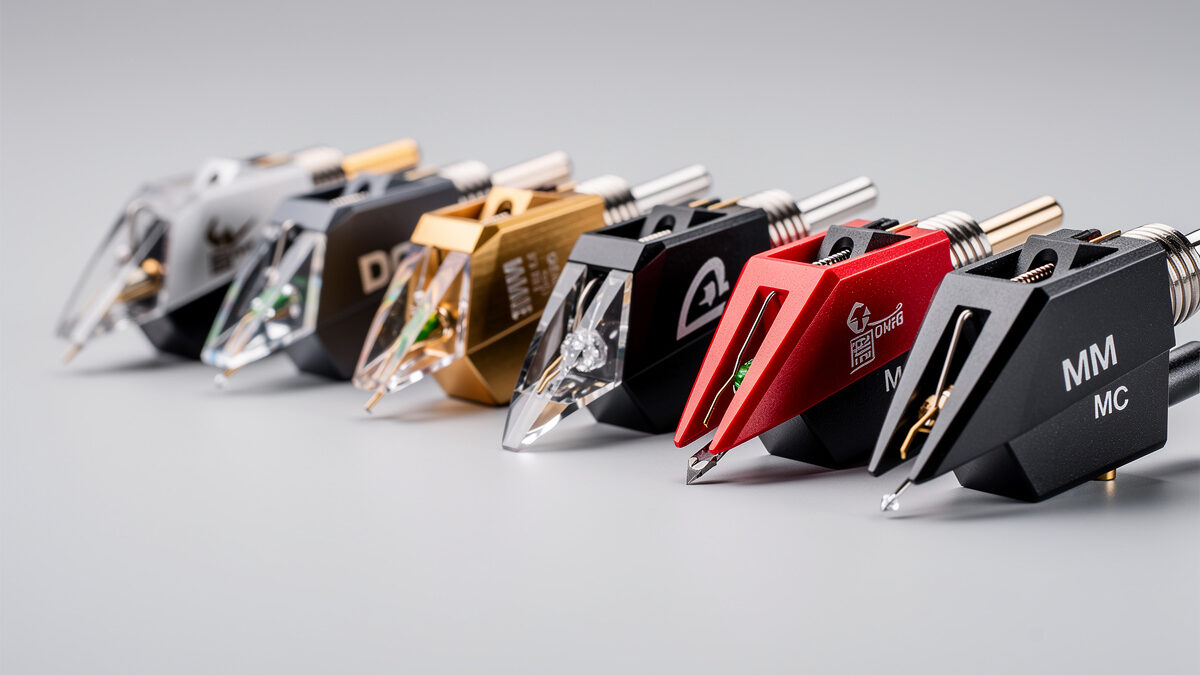
A phono cartridge converts the stylus’s physical movement in the record groove into an electrical signal. The best cartridges track complex passages without distortion, retrieve fine detail across the full frequency range, and produce a low noise floor. Key specifications include output voltage, compliance, channel separation, and stylus profile.
Output voltage determines whether the cartridge works with your phono preamp. Moving magnet cartridges output 2.5–5 millivolts, compatible with every standard phono preamp. Moving coil cartridges output 0.2–0.5 millivolts and require either an MC-capable preamp or an external step-up transformer. Compliance measures the cantilever’s flexibility—low-compliance cartridges pair with heavy tonearms, while high-compliance cartridges suit lightweight arms. Matching these specs correctly matters more than spending more money on an incompatible cartridge.
Moving Magnet Cartridges Under $150
Moving magnet cartridges under $150 offer the best value for vinyl listeners upgrading from stock conical styli. The Ortofon 2M Red at $99 is the most popular entry-level upgrade, featuring an elliptical bonded diamond that tracks noticeably better than the conical styli bundled with entry-level turntables. The Nagaoka MP-110 matches it in price and offers a warmer, more forgiving presentation that flatters worn or budget pressings.
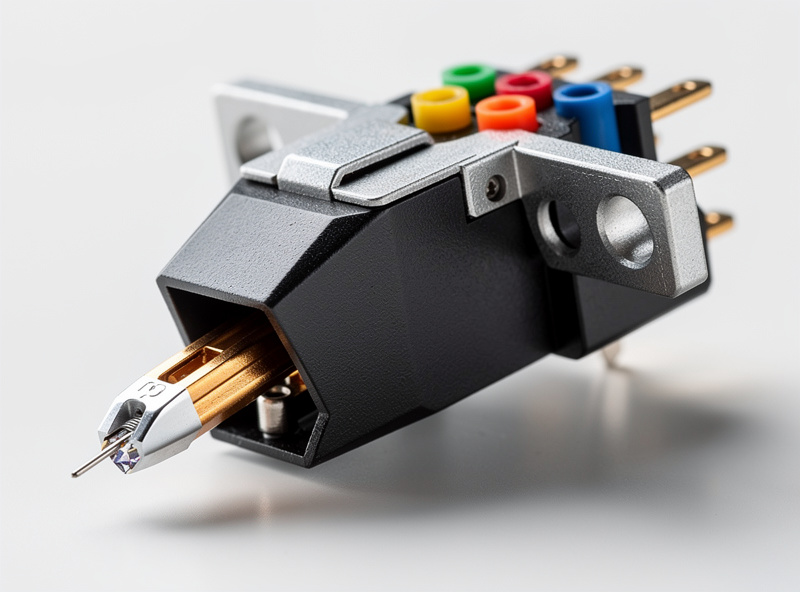
The Audio-Technica AT-VM95E ($49) is the cheapest worthwhile upgrade, using the same elliptical stylus as the discontinued AT95E but with a redesigned housing. The Goldring E3 ($99) adds a slightly more refined treble and wider soundstage. All four of these cartridges output between 3.5 and 5 mV and work with any standard phono preamp, making them true plug-and-play upgrades for turntables like the Audio-Technica LP60X, LP120X, and Fluance RT80.
For listeners who want the best sub-$150 performance and plan to upgrade the stylus later, the Ortofon 2M system is ideal. The 2M Red stylus fits the 2M Blue, Bronze, and Black housings, so you can swap in a better stylus without replacing the entire cartridge body.
Moving Magnet Cartridges $150–$400
The $150–$400 range is where moving magnet cartridges reach their peak performance. The Ortofon 2M Blue ($236) swaps the Red’s bonded elliptical for a nude elliptical diamond mounted directly to the cantilever, reducing tip mass and improving tracking. The Audio-Technica VM540ML ($199) uses a microline stylus that contacts a tiny section of the groove wall, extracting detail that rivals moving coil cartridges costing twice as much.
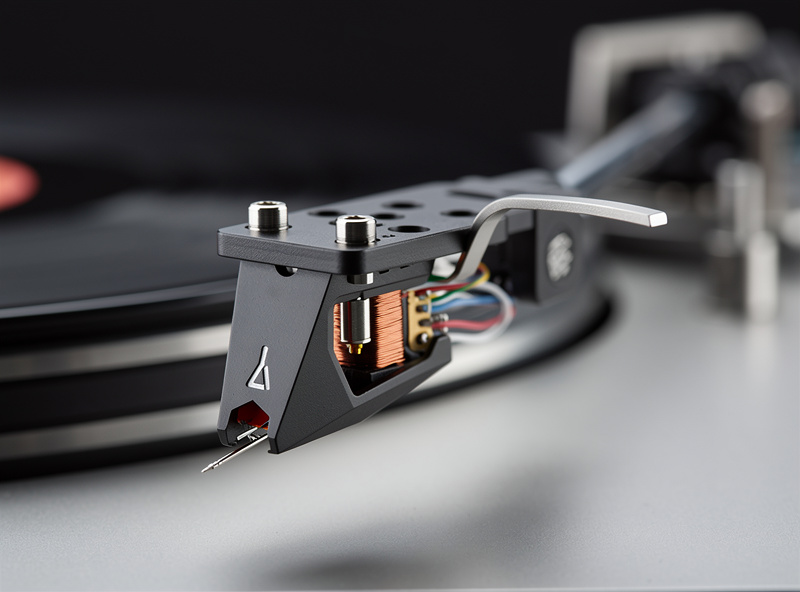
The Ortofon 2M Bronze ($440) introduces a nude Fine Line stylus on a silver-plated copper coil, delivering reference-level detail retrieval while remaining compatible with standard MM preamps. The Nagaoka MP-200 ($189) offers a warm, musical character with excellent tracking on complex orchestral passages. These cartridges pair well with mid-range turntables like the Pro-Ject Debut Carbon EVO, Rega Planar 3, and Fluance RT85.
Channel separation in this class typically exceeds 25 dB at 1 kHz, compared to 20–22 dB in budget cartridges. This wider separation creates a more convincing soundstage with better instrument placement. If you listen primarily to acoustic, jazz, or classical music, the $150–$400 MM range delivers the most noticeable improvement over budget cartridges.
Moving Coil Cartridges Under $500
Moving coil cartridges under $500 deliver lower moving mass than equivalently priced MM designs, translating to faster transient response and more precise imaging. The Hana EL ($280) is the most popular entry-level MC, outputting 0.5 mV with an elliptical stylus and tracking with exceptional precision. The Denon DL-103 ($249) is a classic broadcast cartridge with a warm, rich character and conical stylus that has remained in production since 1962.
The Sumiko Rainier ($149) is technically an MM cartridge with a user-replaceable stylus, but the Sumiko Olympia ($199) and Moonstone ($299) cartridges share the same housing and let you upgrade the stylus from elliptical to fine line without realignment. This modularity makes the Sumiko line a practical stepping stone for listeners who eventually want MC performance without the upfront cost.
All MC cartridges under $500 output between 0.3 and 0.5 mV. Your preamp must handle MC gain—check for a switch labeled MM/MC or a gain setting above 60 dB. The Schiit Mani 2 ($149) and iFi Zen Phono ($199) both support MC cartridges at this output level without a step-up transformer.
Moving Coil Cartridges $500–$1,500
The $500–$1,500 MC range targets serious analog systems with quality tonearms, preamps, and vibration isolation. The Hana ML ($1,200) uses a nude microline stylus and achieves 30 dB channel separation, producing a holographic soundstage with pinpoint imaging. The Ortofon Quintet Blue ($399) offers a balanced, neutral presentation with a Shibata stylus that retrieves extraordinary inner detail.
The Dynavector DV-20X2 ($695) is a favorite among analog enthusiasts for its lively, dynamic character and high output (0.3 mV), which avoids the need for extreme preamp gain. The Audio-Technica AT-OC9XSH ($499) brings Japanese precision with a Shibata stylus and boron cantilever at a mid-range price point.
These cartridges demand careful setup. A microline or Shibata stylus in this price range requires precise alignment within 1–2 degrees of the ideal null points. Use a protractor or alignment jig rather than relying on headshell markings. Incorrect alignment with a $1,000 cartridge sounds worse than a perfectly aligned $100 cartridge.
Stylus Profiles Explained
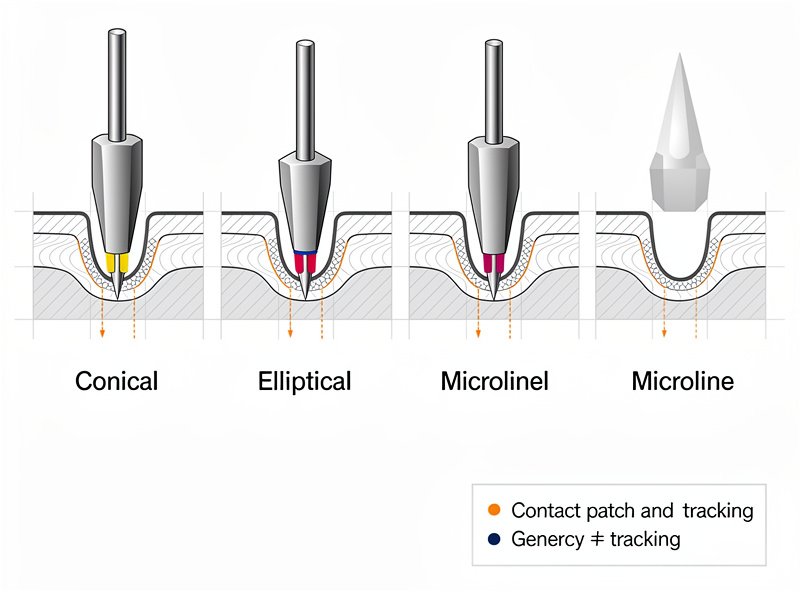
The stylus profile determines how much of the groove wall the diamond contacts, directly affecting detail retrieval, record wear, and tracking ability. Conical styli are the widest and most forgiving of alignment errors but retrieve the least high-frequency information. Elliptical styli narrow the contact area to improve tracking of complex modulations. Microline, Shibata, and line-contact styli follow the groove contour almost exactly, maximizing detail but requiring precise alignment and clean records.
Stylus profiles also affect record wear. A conical stylus distributes force over a wider area, causing less wear per play but smearing fine detail. A microline stylus concentrates force on a tiny contact patch, which means less total wear because it rides deeper in the groove without bouncing—provided tracking force is set correctly. A misaligned microline stylus will damage records faster than a conical one, so setup precision is non-negotiable with advanced profiles.
| Profile | Typical Output | Detail Level | Alignment Tolerance | Record Wear | Best For |
|---|---|---|---|---|---|
| Conical | 2.5–5 mV (MM) | Basic | ±4° | Moderate | DJs, worn records |
| Elliptical | 2.5–5 mV (MM) | Good | ±2° | Low | General listening |
| Nude Elliptical | 2.5–5 mV (MM) | Very Good | ±2° | Low | Serious listeners |
| Microline | 2.5–5 mV (MM) | Excellent | ±1° | Very Low | Detail-focused systems |
| Shibata | 0.2–0.5 mV (MC) | Excellent | ±1° | Very Low | High-end analog |
| Fine Line | 2.5–4 mV (MM) | Reference | ±1° | Minimal | Near-reference systems |
Cartridge Compliance and Tonearm Matching
Cartridge compliance measures how easily the cantilever deflects under force, measured in micrometers per millinewton (µm/mN). This value must be matched to the tonearm’s effective mass to produce a resonant frequency between 8 and 12 Hz—below the audible range but above the record warp frequency of 0.5–2 Hz.
A high-compliance cartridge (20+ µm/mN) on a heavy tonearm (20+ grams effective mass) produces a resonant frequency below 8 Hz, causing audible mistracking on warped records. A low-compliance cartridge (10 µm/mN or less) on a lightweight arm (10 grams or less) pushes the resonance above 15 Hz, causing peaky bass and potential resonance in the audible range. The formula is: resonant frequency equals 159 divided by the square root of compliance times effective mass.
Most modern MM cartridges have compliance between 15 and 25 µm/mN and pair well with medium-mass tonearms (12–16 grams). Low-compliance MC cartridges like the Denon DL-103 need heavy arms (18+ grams) or added headshell weight. Always check both specifications before purchasing a cartridge for an existing turntable.
How to Install a New Cartridge
Installing a cartridge requires removing the headshell from the tonearm, unscrewing the old cartridge, mounting the new cartridge with the supplied hardware, reconnecting the four color-coded leads, aligning the cartridge using a protractor, and setting tracking force and anti-skate. The entire process takes 20–45 minutes with basic tools.
The four leads connect to color-coded pins: white (left channel positive), blue (left channel negative/ground), red (right channel positive), and green (right channel negative/ground). Reversing the left and right leads swaps the stereo image. Reversing positive and negative within a channel causes phase cancellation and a thin, hollow sound. Always photograph the old cartridge’s wiring before disconnecting it.
After physical installation, use a two-point protractor to align the cartridge so the stylus tip sits precisely at both null points. Then set tracking force with a digital gauge and anti-skate to match. Detailed alignment instructions are at Cartridge Alignment Guide.
Cartridge Break-In and Maintenance
Most cartridges require 20–40 hours of play before the suspension and cantilever fully break in. During break-in, the sound may seem bright, tight, or lacking bass. This is normal—the rubber suspension needs time to loosen and reach its designed compliance. Do not adjust tracking force or alignment during break-in unless you hear audible distortion or mistracking.
After break-in, the stylus should be cleaned every 10–20 hours of play using a stylus brush or gel pad. Never use a cloth or your finger on the stylus—the diamond is mounted on a thin cantilever that bends easily. A stylus guard should be in place whenever the turntable is not in use to protect the diamond from accidental contact.
Stylus life varies by profile: conical styli last 500–800 hours, elliptical styli last 300–500 hours, and microline or Shibata styli last 800–1,000 hours due to their more precise groove contact. Replace the stylus when you notice increased sibilance, loss of high-frequency detail, or audible distortion on records that previously played clean.
Frequently Asked Questions
What is the best phono cartridge under $150?
The Ortofon 2M Red at $99 is the most popular budget upgrade, featuring an elliptical bonded diamond. The Nagaoka MP-110 matches it in price with a warmer character, and the Audio-Technica AT-VM95E at $49 is the cheapest worthwhile upgrade from a conical stock cartridge.
Do moving coil cartridges sound better than moving magnet?
Not inherently. MC cartridges have lower moving mass for faster transient response, but high-end MM cartridges like the Ortofon 2M Black rival entry MCs in detail. The preamp quality and cartridge-to-tonearm matching matter more than MM vs MC.
How long does a phono cartridge stylus last?
Conical styli last 500–800 hours. Elliptical styli last 300–500 hours. Microline and Shibata styli last 800–1,000 hours because their precise contact pattern distributes wear more evenly across the groove wall.
Can I upgrade just the stylus without replacing the cartridge?
Yes, on certain cartridge families. The Ortofon 2M Red stylus fits the 2M Blue, Bronze, and Black bodies. The Audio-Technica VM95 series and Nagaoka MP series also allow stylus-only upgrades within their product lines.
Do I need a different preamp for a moving coil cartridge?
Yes. MC cartridges output 0.2–0.5 mV versus 2.5–5 mV for MM. Your preamp must have MC gain capability, a switchable MM/MC setting, or an output above 60 dB. Budget options include the Schiit Mani 2 ($149) and iFi Zen Phono ($199).
How do I know if my cartridge is compatible with my tonearm?
Compare the cartridge compliance (µm/mN) with the tonearm effective mass (grams). Their combined resonant frequency should fall between 8–12 Hz. Most MM cartridges (15–25 µm/mN) pair with medium-mass arms (12–16 g). Low-compliance MC cartridges need heavier arms.
Related Articles
- Turntable Upgrade Guide: Cartridges, Platters, Mats, and Tonearms
- Cartridge Alignment Guide: Get the Best Sound from Your Turntable
- Phono Preamp Explained: Why You Need One for Vinyl
- Turntable Tonearm Guide: Types, Counterweights, and Upgrades
- Turntable Buying Guide 2026: How to Choose Your First Record Player