How Belt Drive Turntables Work
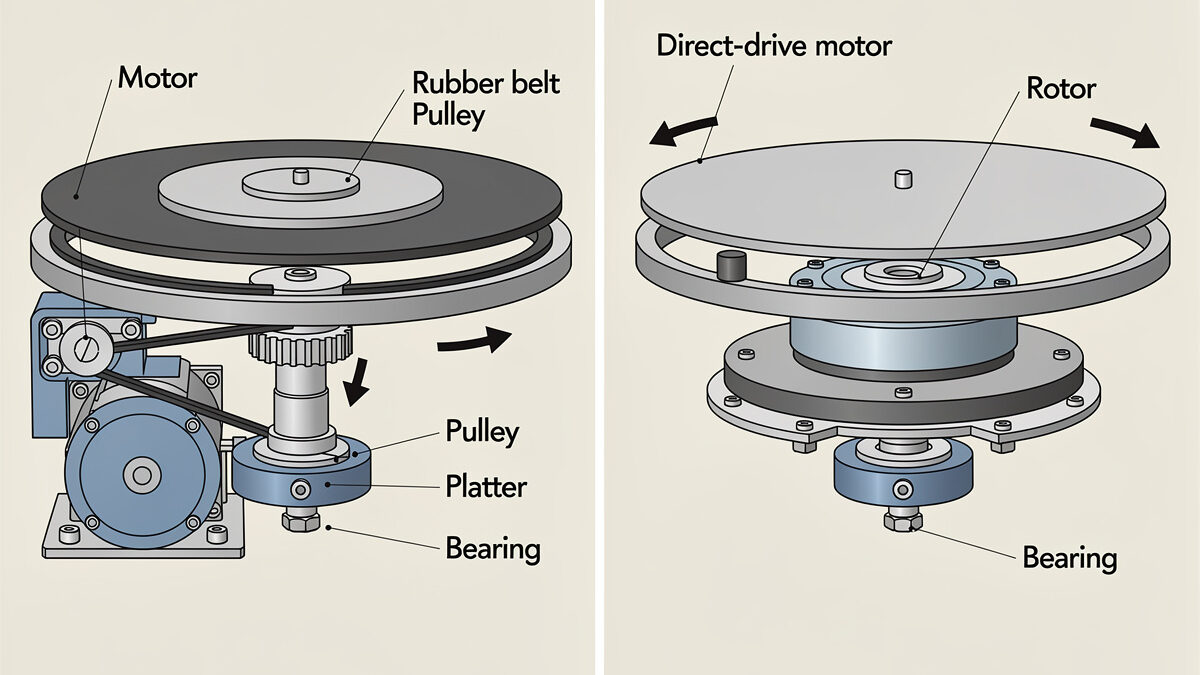
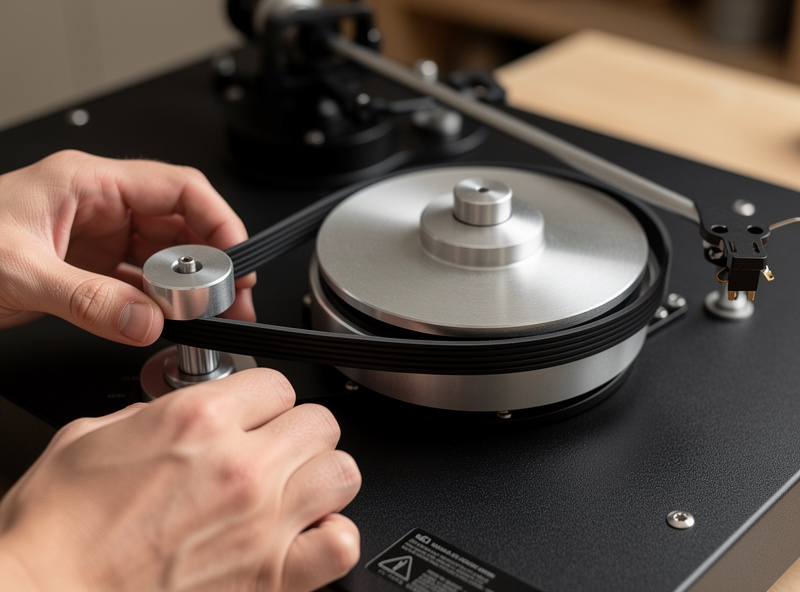
Belt drive turntables use an elastic rubber or silicone belt to transfer motor rotation to the platter. The motor sits off to the side or beneath the plinth, connected only by this flexible belt. This indirect connection is the entire design philosophy — the belt absorbs and dampens motor vibrations before they reach the stylus, resulting in a cleaner, quieter signal with a lower noise floor.
The motor spins a small sub-platter or pulley, and the belt wraps around both the pulley and the main platter’s outer rim. Because the belt stretches and flexes, it naturally filters out the tiny speed inconsistencies that every motor produces. Belt drive designs dominate the audiophile market because this vibration isolation translates directly to lower wow and flutter readings and higher signal-to-noise ratios.
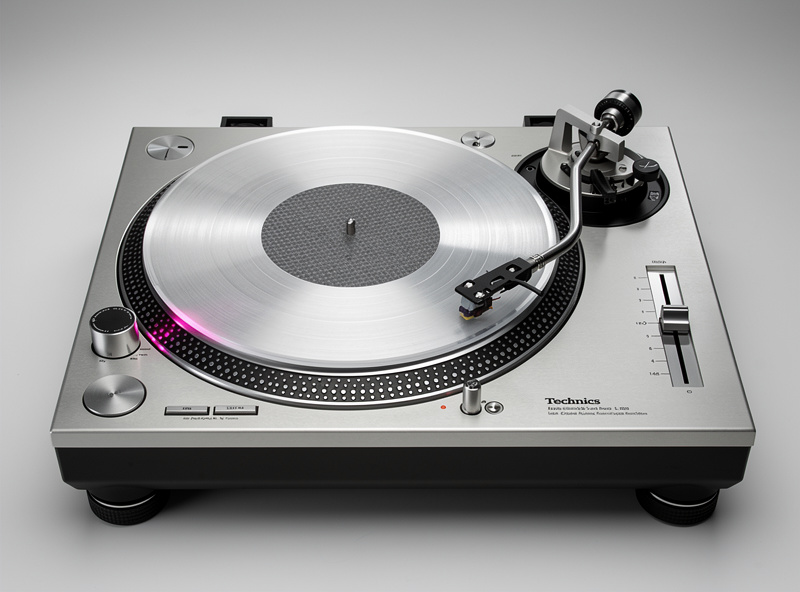
Rega, Pro-Ject, and Fluance build almost exclusively belt drive turntables. The Rega Planar 3, Pro-Ject Debut Carbon EVO, and Fluance RT85 are all belt drive models that exemplify this approach. These turntables achieve wow and flutter ratings of 0.1–0.13% and signal-to-noise ratios above 63 dB, figures that direct drive turntables at the same price point rarely match.
However, belt drive has mechanical limitations. The belt stretches over time — typically after 3–5 years of regular use — requiring replacement. A stretched belt causes speed drift, where the platter runs slightly slow. Replacement belts cost $10–$20 and take 2 minutes to install, so this is maintenance rather than a design flaw. Belt drive turntables also reach full speed more slowly because the belt must grip and accelerate the heavy platter, taking 3–8 seconds to stabilize.
How Direct Drive Turntables Work
Direct drive turntables mount the motor directly beneath the platter, with the platter acting as the motor’s rotor. There is no belt, no sub-platter, and no intermediary connection. The motor’s shaft connects directly to the platter’s center, providing instant torque and precise speed control through electronic feedback circuits.
This design excels at speed accuracy. Electronic speed-sensing circuits monitor platter rotation hundreds of times per second, correcting any deviation instantly. The Technics SL-1200MK7 achieves a wow and flutter rating of 0.025% — four times better than most belt drive turntables — because its motor control system compensates for variations that belt drive designs simply absorb.
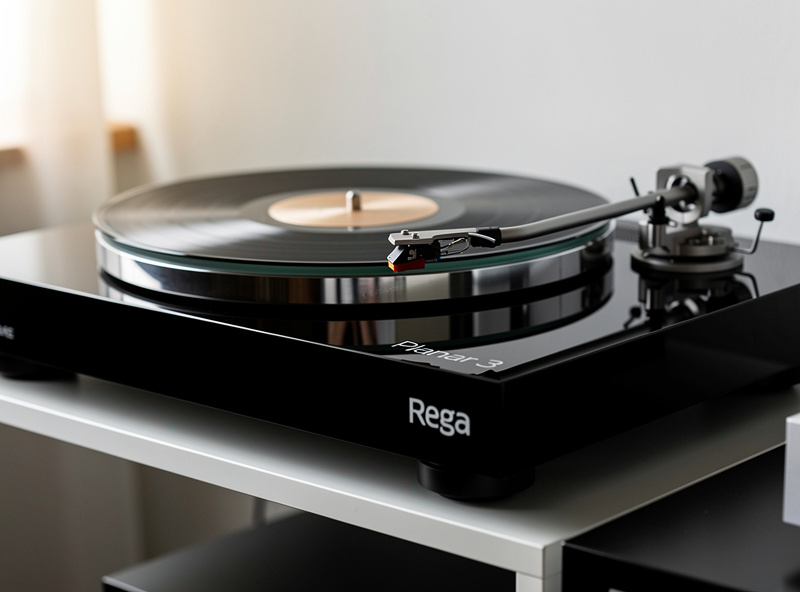
Direct drive turntables reach full speed almost instantly. Press start, and the platter is at 33⅓ RPM within one revolution. This is essential for DJ use where cueing a record to a specific beat requires immediate platter response. The high torque also prevents the stylus from dragging the platter backward during back-cueing or scratching.
The trade-off is motor noise. Without a belt to filter vibrations, the motor’s electromagnetic hum can transmit directly to the stylus. Budget direct drive turntables under $300 often produce audible rumble during quiet passages. Premium direct drive models like the Technics SL-1500C and SL-1200MK7 solve this with advanced motor design, heavy platters, and sophisticated electronic filtering that virtually eliminates motor noise — but these solutions cost more than belt drive achieves at lower price points.
Belt Drive vs Direct Drive: Side-by-Side Comparison
| Feature | Belt Drive | Direct Drive |
|---|---|---|
| Motor vibration isolation | Excellent — belt filters noise | Requires advanced motor design |
| Speed accuracy (budget) | 0.15–0.25% wow & flutter | 0.1–0.2% wow & flutter |
| Speed accuracy (premium) | 0.05–0.1% wow & flutter | 0.02–0.05% wow & flutter |
| Torque | Low — slow platter start | High — instant start |
| Start-up time | 3–8 seconds | Under 1 second |
| Maintenance | Belt replacement every 3–5 years | Virtually maintenance-free |
| DJ suitability | Poor — belt slips under back-cueing | Excellent — industry standard |
| Audiophile preference | Standard choice below $1,500 | Competitive above $1,000 |
| Price sweet spot | $300–$1,500 | $250–$1,200 |
| Typical signal-to-noise | 60–72 dB | 55–70 dB (budget to premium) |
Noise Isolation: Why It Matters
The stylus tracks grooves measuring 40 microns wide. Any vibration that reaches it — from the motor, the room, or foot traffic on the floor — modulates the signal and adds noise. Belt drive’s primary advantage is passive noise isolation. The belt’s elasticity creates a mechanical low-pass filter that attenuates vibrations above 2–3 Hz before they reach the platter.
Direct drive turntables must solve noise isolation through engineering rather than physics. The Technics SL-1200 series uses a coreless motor that eliminates the cogging effect (magnetic detents that cause speed ripple). The result is motor vibration levels comparable to belt drive, but achieving this requires precision manufacturing that budget direct drive turntables lack.
In practice, belt drive turntables under $500 consistently produce lower motor noise than direct drive turntables under $500. The crossover point occurs around $800–$1,000, where direct drive designs incorporate enough engineering to match belt drive’s passive isolation. Above $1,000, both designs are essentially equal in noise performance, and the choice comes down to other factors.
Speed Accuracy: Wow, Flutter, and Drift
Speed accuracy is where direct drive holds a measurable advantage at every price point. The electronic feedback loop in a direct drive motor corrects speed deviations in real time, achieving wow and flutter ratings that belt drive designs struggle to match.
However, wow and flutter is only one component of speed accuracy. Belt drive turntables experience drift — a gradual slowdown as the belt stretches and the motor bearing wears. A 2-year-old belt drive turntable may run 0.5–1% slow without the owner noticing, because the drift is gradual and consistent. Direct drive turntables do not drift because there is no belt to stretch.
For most listeners, the audible difference between 0.1% and 0.05% wow and flutter is imperceptible. Where speed accuracy matters most is with sustained tonal content — solo piano, bowed strings, and synthesizer pads. If you primarily listen to rock, pop, or electronic music with percussive transients, speed accuracy differences between belt and direct drive are largely irrelevant to your enjoyment.
DJ vs Audiophile: Which Drive Type Fits Your Use Case
The belt drive vs direct drive debate is clearest when you consider the intended application.
DJ use demands direct drive. There is no debate here. Scratching, back-cueing, beat-matching, and pitch control all require high torque and instant speed response. A belt drive turntable cannot handle the physical stress of a DJ pulling the platter backward — the belt slips or snaps. Every professional DJ turntable in history, from the Technics SL-1200 to the Pioneer PLX-1000, is direct drive.
Audiophile listening favors belt drive below $1,500. At this price, belt drive turntables deliver better noise isolation and build quality for the money. The Rega Planar 3 ($945) and Pro-Ject Debut Carbon EVO ($499) outperform similarly priced direct drive models in quietness and musicality.
Above $1,500, both designs compete equally. The Technics SL-1200G ($4,000) and SL-1000R ($12,000) prove that direct drive can match any belt drive turntable in sound quality. The engineering investment required to achieve this places it beyond most budgets, but for buyers with no price limit, the choice is genuinely about preference rather than physics.
Specific Model Recommendations
Best belt drive for beginners: Pro-Ject Debut Carbon EVO ($499). Carbon fiber tonearm, Ortofon 2M Red cartridge, and a heavy steel platter with TPE damping. The motor is decoupled from the plinth to minimize vibration transfer. This turntable sounds significantly better than anything under $300 and has a clear upgrade path through cartridge swaps.
Best belt drive for serious listening: Rega Planar 3 ($945). The RB330 tonearm is one of the best in its price class, with precision bearings and minimal friction. The Elys 2 cartridge is a capable MM design that reveals detail in well-mastered pressings. The Rega’s 24V low-noise motor and float-glass platter deliver 0.1% wow and flutter with a 67 dB signal-to-noise ratio.
Best direct drive for home listening: Technics SL-1500C ($1,199). This turntable uses Technics’ coreless direct drive motor with electronic speed control, achieving 0.025% wow and flutter. It includes a built-in phono preamp and ships with an Ortofon 2M Red cartridge. The S-shaped tonearm is well-damped and tracks accurately across the entire record.
Best direct drive for DJs: Audio-Technica AT-LP120X ($249). A budget direct drive turntable with pitch control, reverse playback, and a sturdy tonearm suitable for light scratching. The built-in phono preamp adds convenience. While it cannot match the Technics SL-1200 in build quality, the LP120X performs well for home DJ practice and casual mixing.
Common Myths About Belt Drive and Direct Drive
Myth: Belt drive always sounds better. At price points under $500, belt drive generally has a noise advantage. Above $1,000, premium direct drive designs like Technics close the gap entirely. The drive type alone does not determine sound quality — tonearm quality, cartridge selection, and plinth construction matter more.
Myth: Direct drive turntables damage records. A direct drive turntable with properly set tracking force and a good cartridge treats records identically to a belt drive turntable. The drive mechanism has no effect on groove wear — tracking force, stylus condition, and cartridge alignment determine record wear.
Myth: Belt replacement is a hassle. Replacing a belt takes under 2 minutes: remove the platter, loop the new belt around the sub-platter, stretch it onto the motor pulley, and replace the platter. Belts cost $10–$20. It is less maintenance than changing the oil in a car and needs doing far less often.
Myth: Direct drive is only for DJs. Technics designed the SL-1200 for broadcast studios, not nightclubs. DJs adopted it because of its durability and torque, but the underlying engineering — coreless motor, heavy platter, precision bearings — serves audiophile applications equally well. The modern Technics SL-1200G is a $4,000 reference turntable that happens to be direct drive.
How to Decide: A Simple Framework
Use this decision framework to settle the belt drive vs direct drive question for your specific situation.
Choose belt drive if: You listen at home, prioritize sound quality per dollar, enjoy the ritual of manual turntable operation, and do not need pitch control or instant start. Belt drive turntables from $300–$1,500 offer the best value for pure music listening.
Choose direct drive if: You DJ, need pitch control for matching beats, want zero maintenance, or are shopping above $1,000 and prefer Technics engineering. Direct drive also makes sense if you listen to a lot of 45 RPM records and change speeds frequently — the instant speed switching is more convenient than adjusting a belt drive’s manual speed change.
If you still cannot decide: Buy a belt drive turntable. The $300–$700 range is where belt drive designs have the largest advantage over direct drive competitors. The Fluance RT85 or Pro-Ject Debut Carbon EVO will satisfy 95% of listeners. You can always upgrade to a Technics direct drive later if your needs change.
Frequently Asked Questions
Is belt drive better than direct drive for sound quality?
Belt drive has a noise isolation advantage below $1,000 because the belt filters motor vibration. Above $1,000, premium direct drive designs like Technics match belt drive noise performance. Sound quality depends more on tonearm, cartridge, and plinth design than drive type alone.
How long does a turntable belt last?
A turntable belt typically lasts 3–5 years with regular use. Signs of a worn belt include slow speed, pitch drift, and the platter not reaching full RPM. Replacement belts cost $10–$20 and take under 2 minutes to install on most belt drive turntables.
Can you scratch on a belt drive turntable?
Belt drive turntables are not suitable for scratching. The belt slips when you pull the platter backward, making precise cueing impossible. Scratching requires the high torque and instant response of a direct drive turntable with a slipmat.
Why do all DJ turntables use direct drive?
DJ turntables use direct drive because the motor provides high torque for instant start-stop, the platter resists speed changes during back-cueing, and there is no belt to wear out from the physical stress of scratching and mixing.
Do direct drive turntables have more motor noise?
Budget direct drive turntables under $500 can produce audible motor rumble. Premium models like the Technics SL-1200MK7 use coreless motors that eliminate cogging and achieve signal-to-noise ratios above 70 dB, matching or exceeding belt drive designs.
Can I convert a belt drive turntable to direct drive?
No, converting a belt drive turntable to direct drive is not practical. The motor mounting, plinth design, speed control electronics, and bearing assembly are fundamentally different. If you want direct drive performance, purchase a purpose-built direct drive turntable.
Related Articles
- Turntable Buying Guide 2026: How to Choose Your First Record Player
- Phono Preamp Explained: Why You Need One and How to Choose
- Cartridge Alignment Guide: Get the Best Sound from Your Turntable
- Vinyl Record Care Guide: Protect Your Collection for Decades
- Record Storage Tips: Keep Your Vinyl Collection Safe