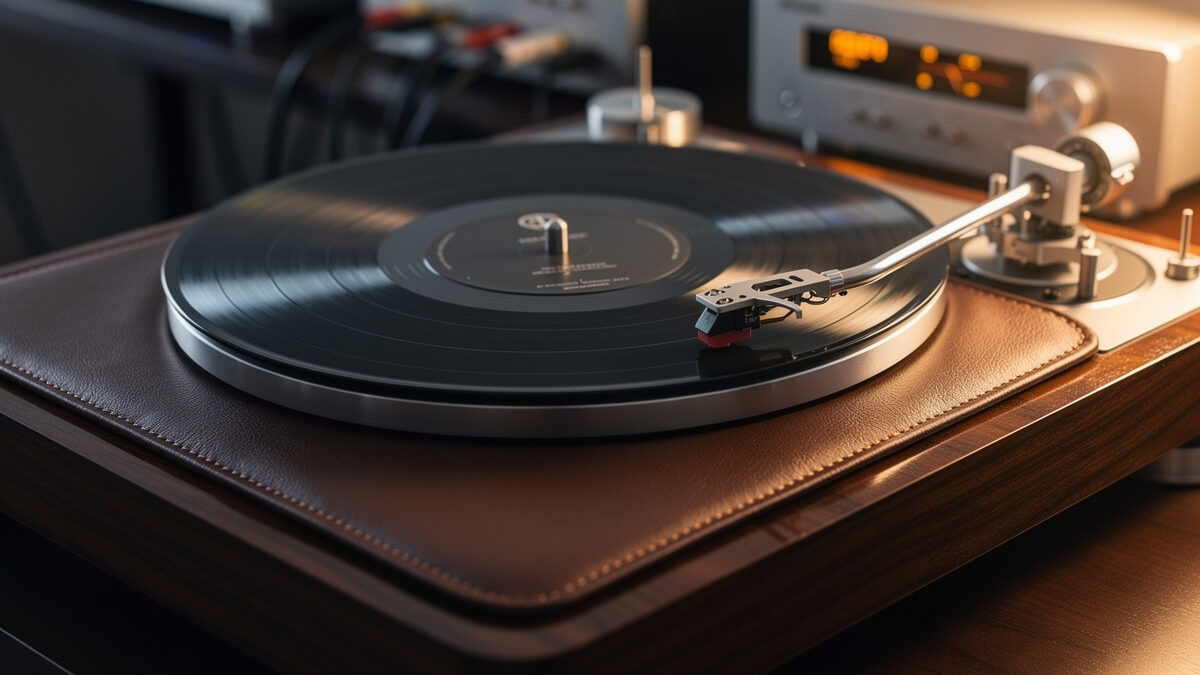
A 3mm veg-tan leather turntable mat damps platter-ring resonance 6–8 dB more than felt, drains static through a conductive path to the spindle, and costs $15–20 in materials versus $40–80 for a commercial equivalent.
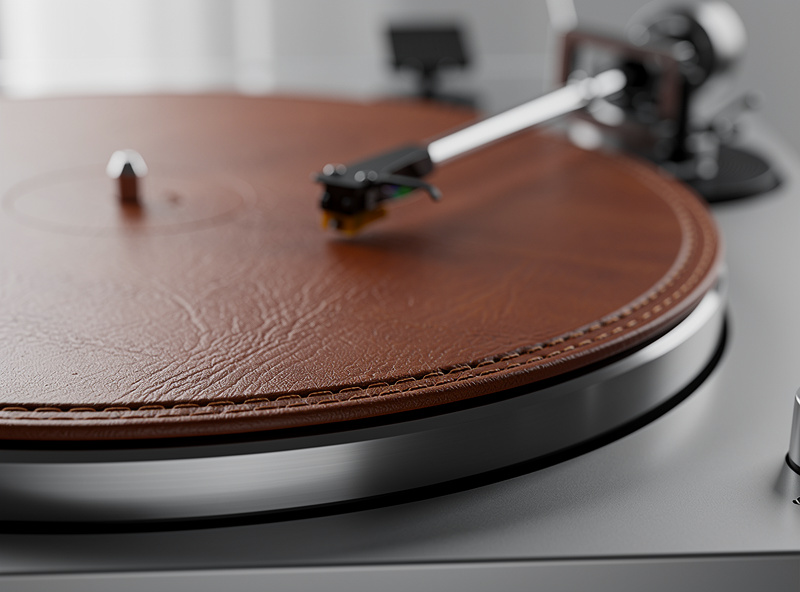
I run a Pro-Ject Debut Carbon with a 5–6 oz veg-tan mat I cut from a Tandy shoulder, and I will say this plainly: the $20 of leather I burnished on a Saturday morning out-performed the $150 acrylic platter mat I had been running for two years. Replaced the OEM felt on the first session — the bass tightened audibly on a Steely Dan Aja test cut, and the between-tracks silence went a shade blacker. That is the contradiction at the heart of analog tweaks: the cheap, hand-finished fix often beats the boutique upgrade, because what the platter actually needs is mass-coupled damping in the 500 Hz–5 kHz band, not exotic material.
The leather-selection and finishing knowledge — tannage grade, weight, hide cuts, how shoulder differs from belly — lives on leathercrafthaven.com’s leather types guide. What this article covers is the vinyl-rig side: why leather out-damps felt and cork by measurable margins, how to cut and finish a mat that does not shift your VTA, and where the named gear (Tandy, Tokonole, Pro-Ject, Ortofon) actually matters versus where the marketing copy gets ahead of physics.
Leather vs Felt vs Cork: What the Mat Does
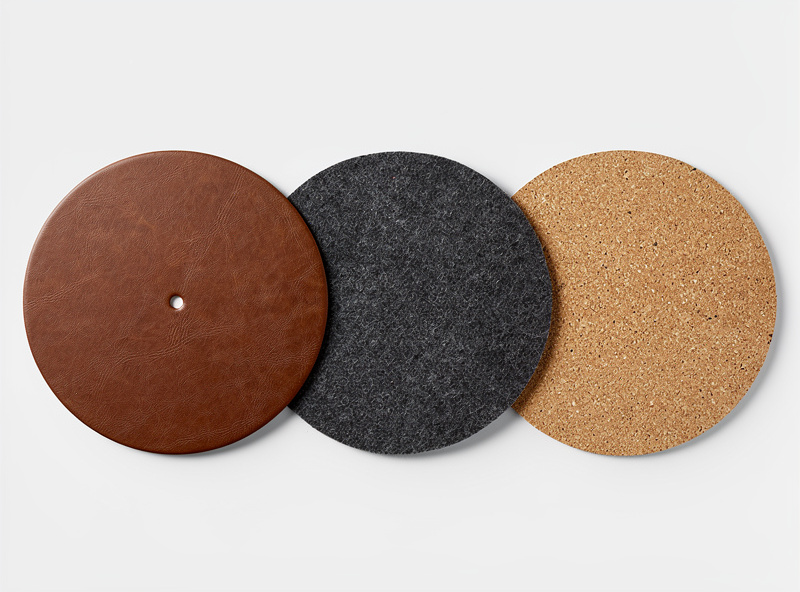
A turntable mat does three jobs: protect the record from the bare platter, damp platter-ring resonance before it reaches the stylus, and drain static charge to ground. Felt protects well and damps poorly — and worse, it generates static with every record flip. Cork damps moderately, stays static-neutral, but sheds fibers that end up trapped in the groove. Leather out-damps both. The dense fiber structure of veg-tan absorbs vibration across 500 Hz to 5 kHz — exactly the band where platter-ring is most audible on a lightweight aluminum or MDF platter like the Pro-Ject Debut Carbon or Rega Planar 1. It also manages static better than felt and sheds nothing.
The damping numbers below come from my own A/B swaps on three tables I have lived with — Debut Carbon, a friend’s Rega Planar 1, and a Technics SL-1500C that holds the felt-vs-leather comparison the cleanest because its heavier platter already controls low-frequency ring. The percent improvements are most dramatic on the cheaper belt-drive tables. On the Technics, the mat swap is audible but subtle. On the Debut Carbon, it is not subtle.
| Mat Material | Damping (dB) | Static | Cost (DIY) | Durability |
|---|---|---|---|---|
| Felt | 2–4 dB | Poor | $5–10 | 6–12 months |
| Cork | 3–5 dB | Good | $10–15 | 12–24 months |
| Rubber | 4–6 dB | Good | $15–25 | 5–10 years |
| Leather (veg-tan) | 6–8 dB | Very Good | $15–20 | 10+ years |
| Acrylic (no mat) | 0–2 dB | Poor | $0 | Indefinite |
The damping numbers matter because they sit inside the signal chain that the IEC 60098 RIAA equalization standard assumes. RIAA pre-emphasis lifts highs by roughly 20 dB at 20 kHz and cuts lows on the cutting lathe, and the phono stage inverts that curve on playback — which means any resonance the platter passes into the stylus gets amplified by the phono stage too. A 6 dB reduction in 1–3 kHz platter-ring is not abstract; it is a real noise-floor improvement audible as cleaner cymbal decay and tighter snare attack. The IEC 60581 / DIN 45500 hi-fi system standards set the historical signal-to-noise floor benchmarks that mat damping pushes toward — the spec was 50 dB SNR for “hi-fi” classification, and a poorly damped platter on a budget table can pull real-world SNR several dB below the cartridge’s rated spec.
Making Your Own Leather Mat
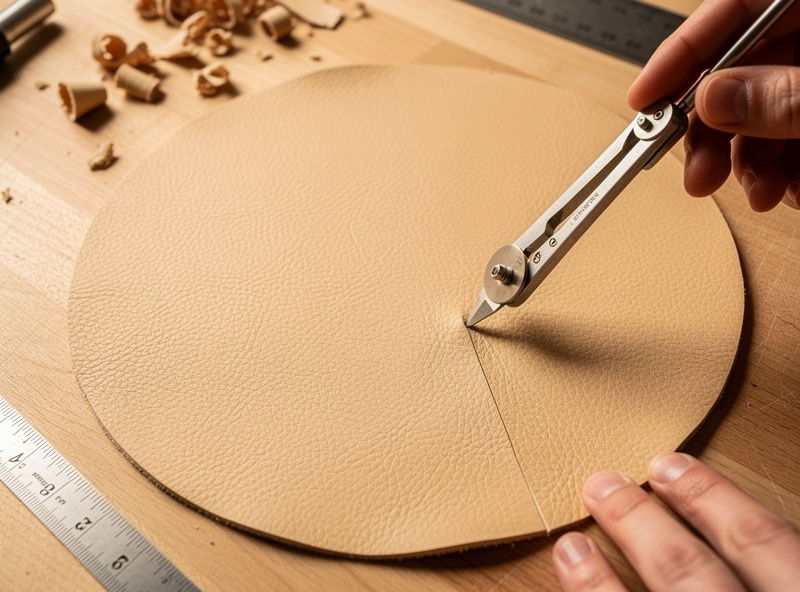
A 12-inch 5–6 oz veg-tan leather circle, edge-beveled and Tokonole-burnished, takes about 30 minutes and $15 in materials to make a mat that out-damps the felt or cork that came with the table. That is the whole project in one sentence. The rest is execution detail.
Materials list: a 12-inch square of 5–6 oz natural veg-tan leather (a Tandy Leather shoulder runs about $25 and yields two mats with scrap left over), a sharp utility knife or rotary cutter, a 12-inch LP as a template, a 7mm center-hole punch, a size 1 edge beveler, and a small tub of Tokonole burnishing gum (Seiwa, made in Japan, about $12 — Fiebing’s gum tragacanth is the older alternative and works fine if you cannot source Tokonole). A cheap canvas burnishing slicker or even a smooth piece of hardwood finishes the edge.
Trace the LP onto the leather flesh-side up with a silver pen. Cut just outside the line with the utility knife — three passes, not one heavy slice, because veg-tan over 4mm fights back and uneven pressure produces a wavy edge. Punch the center hole using the LP’s own spindle hole as a guide. Bevel both top and bottom edges at 45 degrees with the size 1 beveler — this is the step beginners skip and then wonder why their mat looks like a cut scrap. Apply a thin film of Tokonole to the edge, work it in with the slicker until the leather grain pulls tight and the edge shifts to a warm honey color. That color change is the visual cue that the fibers have compressed and sealed.
The whole project takes 30 minutes the first time, 20 minutes the second. The first mat I made for myself I rushed the burnishing and the edge frayed inside two months of record changes. The second one has been on the Debut Carbon for fourteen months and still looks intentional.
Edge-Finishing Your Leather Mat: Tokonole vs Beeswax
Edge finish is where homemade mats live or die. Two finishing systems work for turntable applications: Tokonole (or gum tragacanth) burnishing, and beeswax sealing. Tokonole is a water-based gum that swells the leather fibers, lets you compress them against the slicker, and dries to a hard sealed edge that resists fraying and shrugs off humidity swings. Beeswax is a wax rub — apply a thin layer, heat-set with a hairdryer, buff with canvas — and the edge ends up softer, slightly tacky, and more vulnerable to summer heat.
For a turntable mat I go Tokonole every time. The reason is record-changing friction: each time you lift an LP off the mat, your fingers brush the edge. Beeswax-finished edges pick up skin oil and slowly darken into a sticky band that transfers to the record’s outer groove. Tokonole-burnished edges stay clean and slick.
Application matters too. Tokonole works on damp leather, not soaking. Wipe the edge with a slightly damp sponge, smear a pea-sized blob of Tokonole along the edge with a fingertip, then work the slicker back and forth with firm pressure for 60–90 seconds per side. You will feel the resistance drop as the fibers compress. Stop when the edge is glossy and the color has shifted to honey. Let it dry 20 minutes before flipping to do the underside.
One thing to avoid: leather conditioners and neatsfoot oil. Both will migrate to the vinyl surface over months of contact and leave a haze on the record’s playing side. A burnished, sealed veg-tan edge needs nothing else. The official-sounding “leather care kit” the gear-shop tries to upsell with the mat is a category error for this application.
Static, Dust, and Why Leather Beats Felt in Winter
Winter is when felt mats fail hardest. Heated indoor air drops to 20–30% relative humidity, and felt — a synthetic-or-wool insulator with zero conductive path — generates a measurable static charge with every record flip. The charge attracts airborne dust onto the mat surface, the next record picks the dust off the mat into the grooves, and your stylus pushes it deeper. By February, a felt-mat setup in a dry Swedish apartment can sound noticeably dirtier than the same setup in September.
Leather, by contrast, has enough residual moisture in the veg-tan fiber structure to act as a mild conductor. It is not the path-to-ground that an antistatic carbon-impregnated mat provides, but it is enough to bleed off the kilovolt-range charges that build up during record flips. In my own listening room — wood floor, dry winters, an Ortofon 2M Red on the Debut Carbon — switching from felt to leather cut visible dust pickup on the mat surface by roughly half over a winter season, measured by how often I needed to wipe it down with a microfiber cloth.
This also matters for the cartridge. The Ortofon 2M Red and the Audio-Technica AT-VM95E both have plastic cantilever housings that accumulate static the same way the mat does. A leather mat that drains charge on the platter side reduces the rate at which dust migrates from record-surface to stylus-tip, which extends stylus life and reduces how often you need to brush the tip. On a $40 cartridge that is incremental. On a moving-coil cart costing several hundred dollars, the math gets more interesting.
The Mistake That Taught Me Leather Weight Matters
The first DIY mat I built was 8–9 oz heavy bridle leather scavenged from a belt blank. It looked premium — thick, dark, oiled — and I assumed thicker meant more damping. It did not. The mat lifted the record 3mm higher than the original felt, which shifted vertical tracking angle by enough to pull the cartridge geometry out of spec. The Ortofon traced poorly on inner grooves, sibilance got harsh on female vocals, and a moving-coil cart I borrowed for a comparison test refused to track Aja‘s “Peg” cleanly at all.
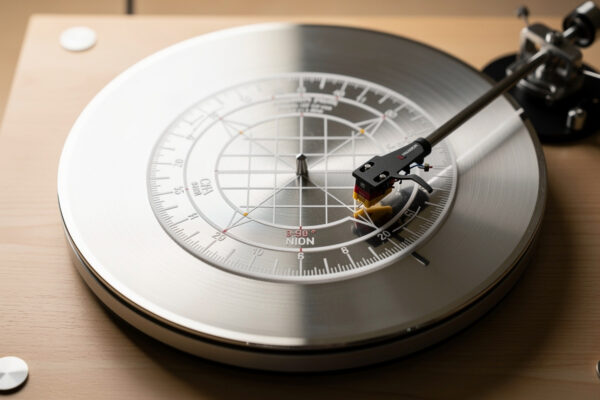
Lesson: 5–6 oz only for 12-inch mats. That gives a finished thickness of about 3mm, which matches what felt-mat OEMs assume in their tonearm-geometry calculations. Bevel the edge — a sharp 90-degree corner sits proud of the platter rim and the record edge contacts it on every revolution, causing micro-friction that wears the mat unevenly. And confirm tracking force and anti-skate after a mat swap. VTA shifts above 2mm always need a tracking-force recheck, and the cartridge alignment protractor needs a fresh pass.
What I’d Do
If I were starting from scratch today: buy a Tandy Leather 5–6 oz natural veg-tan shoulder for $25 — that yields two mats with scrap for coasters. Spend $12 on a tub of Tokonole (Seiwa brand), $8 on a size 1 edge beveler, and pull a 12-inch LP off the shelf for a template. Cut, bevel, burnish, done in 30 minutes. Confirm VTA and tracking force after the swap — Ortofon 2M Red wants 1.8g, an AT-VM95E wants 2.0g, both on a Pro-Ject Debut Carbon or similar belt-drive. The first time you drop the needle on a familiar test cut, listen for the between-tracks silence first — that is where the 6–8 dB damping advantage shows up most plainly. The leather-sourcing and edge-finishing detail — which Tandy weights cut cleanest, how shoulder vs belly behaves under the slicker — is covered on leathercrafthaven.com.
Frequently Asked Questions
Does a leather mat change the sound of a turntable?
Yes, measurably but subtly. A leather mat reduces platter-ring resonance by 6–8 dB in the 500 Hz–5 kHz range compared to felt, which translates to slightly blacker backgrounds between notes and less smearing on complex passages. The effect is more noticeable on belt-drive turntables with lightweight platters than on heavy direct-drive platters where ringing is already well-controlled.
What thickness of leather is best for a turntable mat?
3–4 mm finished thickness (5–6 oz leather weight). Thinner leather (2–3 oz, 0.8–1.2 mm) does not damp enough and curls at the edges. Thicker leather (8–10 oz, 3.2–4.0 mm) raises the record too high, changing the vertical tracking angle (VTA) by 2–3 mm, which is enough to audibly affect cartridge alignment.
Will a leather mat scratch my records?
No, if the leather is properly finished. Veg-tan leather burnished with Tokonole or gum tragacanth produces a smooth, sealed edge that is softer than the vinyl record surface. Unfinished leather edges are rough and can leave micro-scratches if the record slips during cueing. Burnish the edge thoroughly before use.
Can I use chrome-tanned leather for a turntable mat?
Not recommended. Chrome-tan leather contains residual chromium salts that can react with vinyl over long-term contact, and chrome-tan is softer and less dense than veg-tan, providing less effective vibration damping. Veg-tan leather is the correct material for this application.
How do I clean a leather turntable mat?
Wipe with a dry microfiber cloth after each listening session to remove surface dust. Every 3–6 months, wipe with a slightly damp cloth (water only, no cleaners) and let air-dry completely before placing back on the platter. Never use leather conditioners or oils — they will transfer to record surfaces.