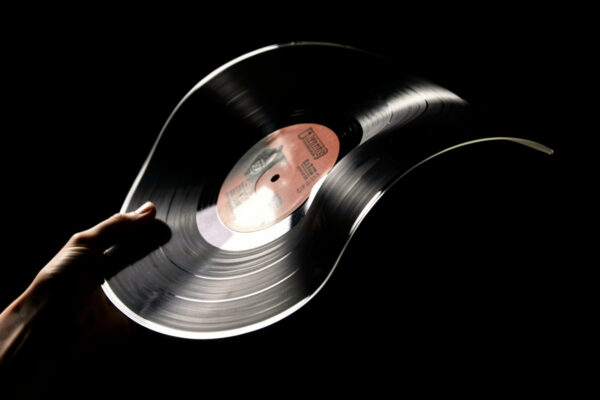
I have lost records to bad storage. Not many, but enough to remember each one: a warped pressing left flat on a windowsill, a sleeve that grew a bloom of mildew in a damp Swedish basement, a stack of LPs at the bottom of a crate that came out dished from the weight above them. Every one of those losses was preventable, and every one of them taught me that storage is not the boring afterthought it gets treated as. It is the single biggest factor in whether the records you buy today still play clean in twenty years.
I have spent years dialing in turntable setup with a protractor and a stylus-force gauge, but a perfectly aligned cartridge cannot save a record that has been stored wrong. So this is the guide I wish someone had handed me when my collection outgrew a single shelf. It covers how to store vinyl records properly from the ground up: orientation, shelving, sleeves, organization, climate, moving, and display. Every recommendation here is what I actually do in my own listening space, not theory copied off a forum.
Why Storage Is the Cheapest Upgrade You Will Ever Make
Spend enough time around this hobby and you notice a strange inversion: people will agonize over a $400 cartridge upgrade while keeping the records that cartridge plays in conditions that are slowly destroying them. The deck is the part you can always replace. A great original pressing that has gone warped or moldy is gone for good, or at least gone until you pay collector prices to replace it.
Vinyl is polyvinyl chloride, and PVC has three enemies: heat, pressure, and time. Heat softens the disc and lets gravity pull it out of flat. Pressure from poor orientation or overloaded shelves dishes or edge-warps it. Time lets static-attracted dust grind into the groove and lets paper sleeves shed acidic fibers and trap moisture against the surface. Good storage neutralizes all three for the price of some sleeves and a properly built shelf. There is no other place in this hobby where so little money buys so much protection.
The mental model I use is simple. The record itself is fragile in exactly two ways: its flatness and its groove. Everything in this guide protects one or both of those. Once you internalize that, the dozens of competing storage opinions out there sort themselves into “this protects flatness or grooves” and “this is somebody selling furniture.”
Orientation: Vertical, Always Vertical
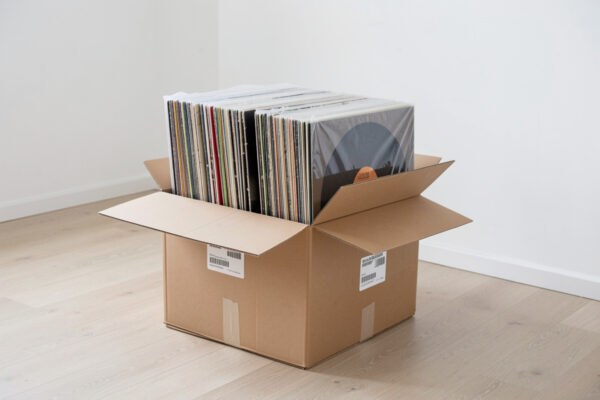
If you take one thing from this entire guide, take this: store records standing upright, vertical, like books on a shelf. Never stack them flat in a pile. This is the most common and most damaging mistake I see, and it is the one I made myself early on.
The physics is unforgiving. A single LP plus its jacket weighs a few hundred grams. Stack thirty of them flat and the bottom record carries the weight of everything above it, concentrated unevenly because no stack is perfectly level. Add a little ambient warmth and the bottom discs slowly dish. Stored vertically, each record bears only its own weight straight down through its edge, which is the strongest part of the disc.
The caveat that matters: vertical storage only protects records if they are held truly upright, not leaning. A record stored at a slant is under constant sideways bending stress, and over months that produces a lean-warp every bit as real as a heat warp. This is why packing density and proper dividers matter, and why the question of whether to store vinyl records vertical or horizontal deserves its own careful answer rather than a one-line rule. The short version is here: vertical, held truly upright. There is exactly one narrow case where brief flat storage is acceptable, and I will get to it below.
The one legitimate exception is short-term flat stacking of a handful of records during active use, or boxing for a move where you genuinely cannot keep them upright. Even then it is a temporary tolerance, not a storage method. For anything longer than a day, upright is the rule.

Shelving: What Actually Holds a Collection Safely
Once you commit to vertical storage, the shelf becomes the load-bearing decision, literally. A growing record collection is heavy. A single full cube of LPs can run past 25 kilograms, and people routinely underestimate this until a cheap particleboard shelf sags into a frown or, worse, lets go entirely.
The non-negotiable specs for vinyl shelving are: a shelf depth of at least 33 to 34 cm so a 31.5 cm jacket sits fully supported with airflow behind it; a clear internal height that lets records stand without the top edge of the jackets catching; and crucially, a span between vertical supports of no more than about 35 to 40 cm. That last one is why the cube format is so popular for records and why it works so well. Each cube braces its own load, so nothing sags. This is exactly why the ubiquitous square-cube units have become the default for the best vinyl record shelf builds: real options differ mostly in weight rating and depth, and the cheap units benefit enormously from a couple of bracing modifications I will detail in a moment.
Avoid floating shelves and any long unsupported span for serious storage. They look clean in photos and they bow under records within a year. If you love the floating look, limit it to a display row of a dozen sleeves, not the bulk of the collection.
| Shelving Type | Typical Capacity | Sag Risk | Best For |
|---|---|---|---|
| Square cube unit (e.g. 4×4 grid) | ~65-70 LPs per cube | Very low (self-braced) | The default for bulk storage |
| Purpose-built record cabinet | Varies, often 150-700+ | Low | Centerpiece collections, looks |
| Long open bookshelf | High per shelf | High on spans over 40 cm | Only with added center supports |
| Floating wall shelf | Low (12-20 sleeves) | High under full load | A display row only, not bulk |
| Storage boxes / crates | ~40-60 per box | Low if not stacked deep | Overflow, moving, archive |
For overflow and archive, sturdy LP storage boxes or crates are excellent, with one rule: never stack boxes so deep that the bottom box bears crushing weight, and never store records flat inside them. Good boxes hold records upright just like a shelf does.
Sleeves: The Two-Layer System
Every record in my collection wears two layers, and they do completely different jobs. Getting this distinction right is where a lot of beginners go wrong, because the advice online blurs them together.
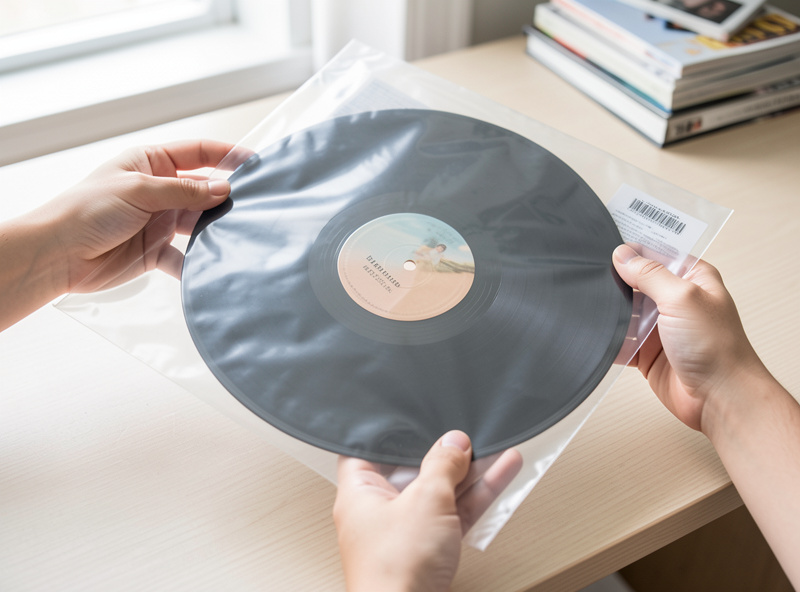
The inner sleeve sits directly against the vinyl and protects the groove from static and abrasion. Paper inners shed fibers and hold moisture, so I swap every paper inner for an anti-static, poly-lined inner the moment a record comes in. That groove-protection layer belongs to the cleaning-and-care side of the hobby rather than the storage side, so I treat inner-sleeve selection as part of my record cleaning and care guide instead of repeating it here. The one-line version: anti-static, poly-lined or HDPE inners, never the bare paper inner a record ships in.
The outer sleeve is what concerns us for storage. It is a clear plastic jacket that slips over the entire album cover, protecting the cardboard from ring wear, shelf abrasion, dust, and humidity. The jacket is half of what you paid for, especially on collectible pressings, and an outer sleeve is the single cheapest way to preserve its value. There is real nuance in material and thickness when it comes to vinyl record outer sleeve protectors — from thin flexible polyethylene that is cheap and fine for the bulk of a collection, to crystal-clear thicker poly and rigid sleeves for the pressings whose covers you most want to preserve.
The mistake to avoid: do not seal a record inside an airtight outer sleeve while there is any chance of trapped moisture, and do not store the inner sleeve outside the jacket where it can flop. Record in inner sleeve, inner sleeve in jacket, jacket in outer sleeve, all upright. That is the whole system.
Organization: Finding the Record You Want
A protected collection you cannot navigate is only half useful. Organization is partly preservation, too, because a well-organized collection gets handled less roughly, which is when scratches and ring wear happen.
There is no universally correct filing system, only the one that matches how your brain reaches for music. Alphabetical by artist is the default for good reason, but I know collectors who file by genre, by label, by decade, or even by mood. The right answer is whichever one lets you put a record back without thinking, because the system you actually maintain beats the elegant one you abandon. There are plenty of workable schemes to organize a vinyl record collection, each with its own way of handling dividers, cataloging apps, and the awkward cases like compilations and box sets, but they all share one test: can you reshelve a record without stopping to think about where it goes.
Two organizing habits do double duty as preservation. First, use rigid dividers every 25 to 30 records so the section never collapses into a lean. Second, never overstuff a shelf to the point where pulling one record means yanking it past tight neighbors; that friction is exactly what wears jackets. Leave a few centimeters of breathing room and the whole collection both browses better and lasts longer.
Climate: Heat and Humidity Are the Silent Killers
This is the part people skip, and it is the part that quietly does the most damage. Vinyl wants what a comfortable human wants: stable, moderate temperature and middling humidity. The target I aim for is a steady temperature in the high teens to low twenties Celsius and relative humidity somewhere in the 35 to 50 percent band.
Heat is the enemy of flatness. PVC starts to soften and creep well below the temperature most people assume is safe, and the danger is not a single hot afternoon but repeated cycling and any sustained warmth. A record left in a car, against a radiator, in an attic, or in direct sun through a window can warp in a way no shelf can prevent. The single most important storage rule after “store them vertically” is “keep them away from heat sources and direct sunlight.” Knowing how to avoid warping vinyl records comes down to the same physics every time: keep the disc cool, keep it upright, and keep weight off it, because a record that has already dished is extremely hard to truly flatten back to dead-flat without specialist gear.
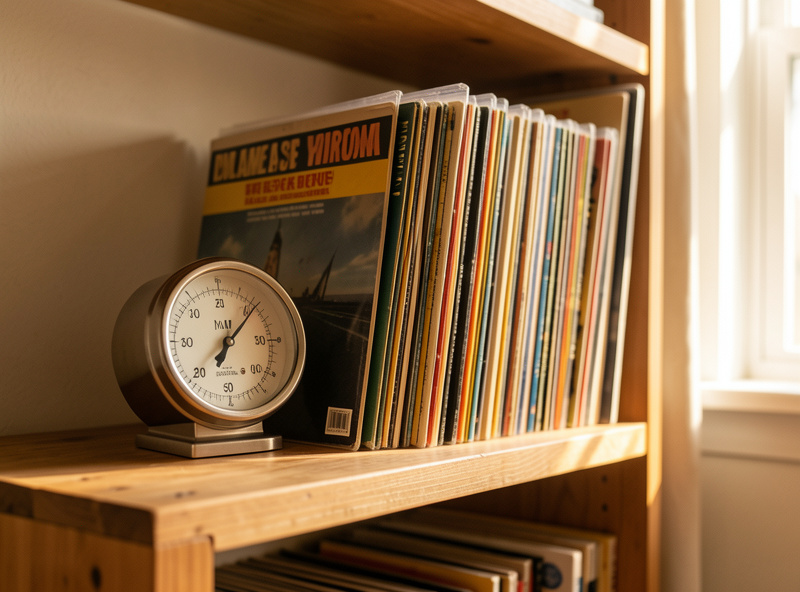
Humidity attacks differently. Too damp and you invite mildew on jackets and inner sleeves, plus the slow degradation of cardboard. Too dry and static becomes relentless, pulling dust into every groove. A damp basement or an unheated outbuilding is the worst common storage spot in a Scandinavian climate; if that is your only option, a small dehumidifier and getting the records up off a cold concrete floor are worth far more than any fancy shelf. Stable beats perfect: a closet in the heated living space will outperform a climate-controlled space that swings wildly.
Moving and Transporting Without Damage
Every collector eventually moves, and a move is when years of careful storage can be undone in a single afternoon. The forces in transit are different from the ones on a shelf: now it is shock, vibration, and the temptation to overpack.
The rules invert slightly for transit. Records still travel best upright, packed snugly enough that they cannot shift but not so tight that they bind. Boxes must be small enough that a full one stays liftable, because an overloaded box is a dropped box. And the climate rule becomes acute: a moving truck or a storage unit in summer is a warping oven, so records should be the last thing loaded and the first thing into a stable indoor space. Moving a vinyl record collection safely is mostly about three decisions: box selection and packing density so nothing shifts, whether to pull valuable discs out of their jackets to spare the seams, and protecting the load from heat and vibration in the vehicle.
Display: Showing Records Without Risking Them
Album art is some of the best graphic design of the last seventy years, and there is a real case for putting it on the wall. The catch is that the methods that show a record off are often at odds with the methods that protect it, so display has to be done deliberately.
My firm rule: never wall-display a record you care about with the disc still inside, anywhere it can catch sun or heat. A south-facing wall is a slow warp machine and a fade machine for the artwork. For records I rotate onto the wall, I use proper flip-frames that hold the jacket securely and let me swap art without handling the vinyl, and I keep the genuinely valuable pressings filed safely while displaying common copies or duplicates. The full method to display vinyl record album art on a wall comes down to choosing frames that hold the jacket securely, using lighting that will not fade the artwork, and arranging a gallery wall that looks deliberate without ever putting a record somewhere it can warp.
Handling: The Part of Storage Nobody Calls Storage
There is a part of preservation that happens in the seconds between the shelf and the platter, and it gets ignored because it does not involve buying anything. How you take a record out, hold it, and put it back is storage too, just in motion. Most of the avoidable wear I have seen on otherwise well-kept collections came from careless handling, not from the shelf.
The discipline is simple and worth making automatic. Pull a record by easing it out from the top, never by clamping the shelf neighbors and yanking. Handle the disc by the edges and the label only; fingerprints in the groove are oils that attract dust and need a wet clean to remove. Cue the arm down gently, and never set a record back into its inner sleeve while it is still spinning warmth from play. These habits cost nothing and they are the reason my oldest records still look and play like the day I sleeved them. If you do leave a fingerprint or pick up a thrift find that needs work, my step-by-step cleaning walkthrough covers the recovery, and the record cleaner comparison covers the tools.
Handling also intersects with the rest of the playback chain. A record that is yanked or mishandled near a delicate stylus risks the cartridge as much as the disc, which is one more reason setup discipline and storage discipline are really the same habit. If you are building the deck side of that habit, the turntable upgrade guide and the cartridge buying guide are where I would start, and the platter mat comparison covers the surface your records actually rest on during play.
Putting the System Together
If you are starting from a shoebox of records and a vague sense of guilt, here is the order I would tackle it in, because it spends effort where it protects most first. Get everything upright and off the floor today; that alone stops the worst damage. Next, get the bulk of the collection onto self-braced shelving rated for the weight. Then sleeve methodically, outers for jacket protection and anti-static inners for the groove, working through the collection a stack at a time. Finally, settle on an organization scheme and add climate awareness, because those pay off over years rather than instantly.
None of this is expensive relative to the records it protects, and most of it is a one-time effort. I treat my own storage the way I treat turntable setup: get the fundamentals geometrically right once, and then the system just works while I get on with the actual point, which is listening. For the groove side of preservation, my full record cleaning and care guide picks up where storage leaves off, and the foundational vinyl record care guide ties cleaning and storage together. If you also want the quick-reference version, my older record storage tips piece is the condensed checklist. And once your records are safe, the rest of the chain matters too: a properly set up deck, starting with cartridge alignment and tracking force, is what turns a well-preserved record into great sound. A clean groove also needs a clean stylus, which is where my record cleaner comparison and step-by-step cleaning walkthrough come in.
Frequently Asked Questions
How should vinyl records be stored, vertically or flat?
Always vertically, standing upright like books, never stacked flat. Stacking flat puts the full weight of the pile on the bottom records and dishes them over time. The only acceptable flat storage is brief, temporary handling during use or unavoidable boxing for a move.
What temperature and humidity is best for storing records?
Aim for a stable temperature in the high teens to low twenties Celsius and relative humidity around 35 to 50 percent. Stability matters more than hitting an exact number. Keep records away from heat sources, radiators, attics, and direct sunlight, which cause warping.
Do I really need both inner and outer sleeves?
Yes, they do different jobs. The inner sleeve protects the groove from static and abrasion, so paper inners should be swapped for anti-static poly-lined ones. The outer sleeve is a clear jacket that protects the album cover from ring wear, dust, and humidity, preserving its value.
What kind of shelf is best for a record collection?
A self-braced square-cube unit is the safe default because each cube carries its own load and will not sag. Look for at least 33 cm of depth and avoid long unsupported spans or floating shelves for bulk storage, since they bow under the heavy weight of records.
Can sunlight damage vinyl records?
Yes, badly. Direct sunlight both heats the record, which warps it, and fades the album artwork. Never store or wall-display records anywhere they catch direct sun, especially on a south-facing wall, even if they are behind glass in a frame.
How tightly should records be packed on a shelf?
Snug enough that they stand upright without leaning, but loose enough to leave a few centimeters of breathing room. Overstuffing forces you to yank records past tight neighbors, which wears the jackets, while too loose lets the row collapse into a damaging lean.