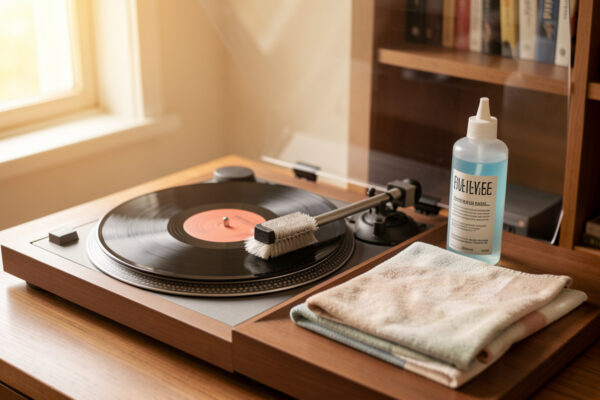
Loud pops on vinyl that jump out in quiet passages are almost always dust or a pinpoint of damage sitting in a low-modulation groove — a section where there is little or no music to mask them. The same speck that would be inaudible under a loud chorus becomes a sharp crack in a soft intro. In my experience roughly three out of four clean away; the rest are physical and stay.
The reason these pops feel so much worse than general crackle is masking. During loud, densely modulated music, low-level noise disappears under the signal — your ear simply cannot pick it out. But in a quiet passage, a fade, or the silent run-in before a track, there is nothing to hide behind, so a single particle or a tiny nick pops out at full prominence. Understanding that is half the diagnosis: the noise was probably always there, you just only hear it when the music gets out of its way.
Why Quiet Passages Expose Pops
A record groove is modulated by the music — louder passages cut wider, more complex wiggles into the vinyl. In those loud sections the signal energy is high and any dust-induced pop is small by comparison, so masking hides it. In quiet passages the groove is nearly straight and the signal energy is low, so the same physical defect produces a pop that now stands well above the music. Nothing about the defect changed; the ratio of noise to music did.
This is why people swear a record “only pops in the quiet bits.” It is not that the quiet bits are more damaged — it is that they reveal what the loud bits conceal. The practical upside is that quiet passages are the best place to test whether your cleaning worked, because they are the most revealing part of the record. If a soft intro is clean, the whole side is clean. This scenario is a specific slice of the broader surface-noise diagnosis, where the general four-family framework applies.

Is It Dust or Is It Damage?
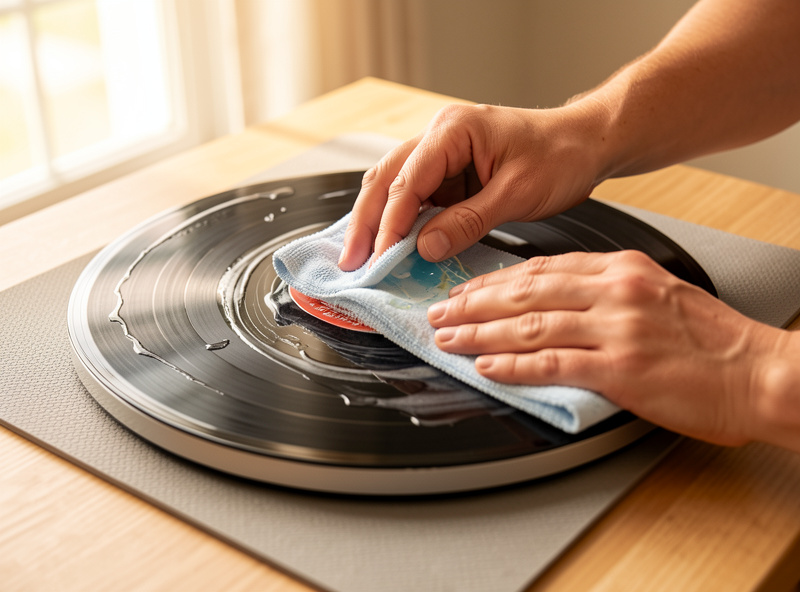
The test is the same one that resolves most noise questions: clean the record and replay the quiet passage. If the pop disappears, it was a particle of dust or debris lodged in that low-modulation groove — the most common cause by far, and completely fixable. A proper wet clean flushes particles that a dry brush just skates over, and quiet passages are exactly where embedded specks that survive brushing tend to sit.
If the pop survives a thorough clean and lands in the same spot every time, it is physical: a pinpoint scratch, a tiny gouge, or an embedded particle fused into the vinyl. Check whether it repeats on the platter’s rotation — a pop that recurs every 1.8 seconds is a scratch, which I cover in rhythmic ticking and spotting a scratch. A pop that happens once at a fixed musical moment but not on a rotation beat is usually a single embedded defect at that point in the groove. Either way, if cleaning does not shift it, the noise is structural and you are choosing between living with it and replacing the disc.
The “Both” Answer Is Common
Very often the honest answer is both, layered on the same record. A used disc can carry general dust that a clean removes, plus one or two permanent pinpoint defects that do not budge — so after cleaning you go from many pops to a couple of stubborn ones. That is a success, not a failure: you have removed everything removable, and what remains is the irreducible physical condition of that copy. I have cleaned plenty of thrift finds down from a constant crackle-and-pop to a single fixed tick I have made peace with.
This is where realistic expectations matter. A record is not binary — perfect or ruined — it is a physical object with a condition, and cleaning moves it as far toward quiet as its physical state allows and no further. For badly contaminated records, escalate the cleaning before you give up: an ultrasonic clean or vacuum machine pulls embedded grime that hand washing leaves behind, and my guide to cleaning used records handles mold and deep grime specifically. A good cleaning routine is the highest-leverage thing you can do about quiet-passage pops. A record cleaning kit with fluid and lint-free cloths is the cheapest way to knock out the dust-based pops. As an Amazon Associate I earn from qualifying purchases.
Ruling Out the Setup and the Stylus
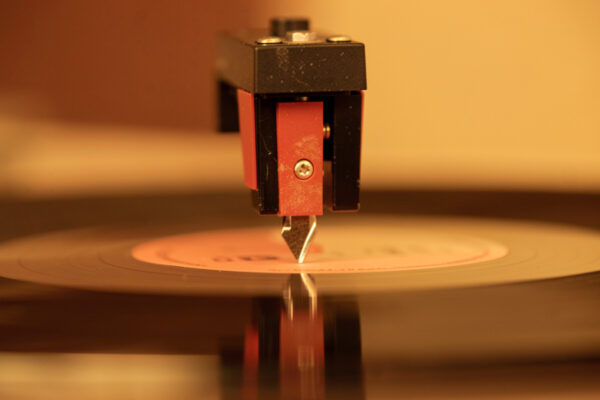
Before you condemn the record, make sure your deck is not manufacturing the pops. A worn or damaged stylus can produce sharp ticks as it mistracks, worst where the groove geometry is most demanding — and a mis-set tracking force makes it worse. If pops in quiet passages appear on many different records at similar points, suspect the stylus and setup rather than the individual discs. A stylus with a chip or a flat drags and cracks through grooves that a healthy tip would ride cleanly.
The confirming test is cross-checking records. If a particular quiet-passage pop is unique to one disc, it is that disc; if the same kind of popping shows up across your whole collection, the common factor is the stylus, the alignment, or the tracking force — check those with the setup and calibration guide. Correct anti-skate also matters here, because an imbalanced stylus favors one groove wall and can generate ticks that read as record defects. Rule out your own gear before you blame — or bin — the vinyl.
Preventing New Pops
Since most quiet-passage pops start as dust, prevention is mostly dust and static control. Brush every side before play with a carbon-fiber brush, store records in anti-static inner sleeves rather than bare paper, and keep them upright in proper sleeves so airborne dust and grit stay off the surface. A clean record played on a clean stylus in a not-too-dusty room simply accumulates far fewer of the specks that cause these pops in the first place.
Handle records by the edges and label only — the oils from fingerprints attract and hold dust in exactly the low-modulation grooves where it will later pop. And clean your stylus gently with a proper brush, because a dust bunny on the tip drags debris into every groove it touches. None of this is exotic; it is the same handling discipline that keeps a collection quiet for decades, and it is far easier than cleaning the same record repeatedly because the dust keeps coming back. A dust cover on the deck helps too — an open platter in a lived-in room collects airborne grit on the disc and the stylus between plays, and every speck that lands is a potential pop waiting for the next quiet passage. Treat dust as something to keep off the record in the first place, not just something to wash off after it has already worked its way into the groove.
A Bench Example: Cleaning a Popping Thrift Find
Here is how this plays out in practice. I pulled a used jazz record off the shelf that sounded fine through the busy horn sections but cracked and popped through every soft piano passage — the textbook quiet-passage complaint. Following the sequence, I first confirmed the pops were on the record: lifting the arm gave dead silence, so no electrical noise was involved. Then I checked rhythm on the worst pop; it landed at a fixed musical moment but not on the 1.8-second rotation beat, which pointed at embedded debris rather than a radial scratch.
A carbon-fiber brush did almost nothing — expected, because embedded particles sit below where a dry brush reaches. A full wet clean with fluid and a lint-free cloth changed everything: the constant crackle vanished and about three-quarters of the quiet-passage pops went with it, confirming they were dust flushed out of the low-modulation grooves. What remained were two fixed pops in the quietest passage that survived a second clean, so those are physical — a pair of pinpoint defects fused into the vinyl. The record went from unlistenable in its soft sections to genuinely enjoyable with two small pops I now barely notice. That is the realistic outcome: cleaning removed everything removable, and the disc’s physical condition set the floor for the rest. Chasing those last two pops with aggressive “repair” tricks would have risked the whole record for no gain.
The takeaway is that quiet-passage pops are usually a mix, and the wet clean is what separates the fixable majority from the permanent minority. If you only ever dry-brush, you will keep hearing pops that a proper clean would have flushed out — and wrongly conclude the record is damaged when most of the noise was just dust hiding where the music could not cover it.
Related Guides
- Vinyl Surface Noise: Causes and How to Diagnose It by Ear
- Rhythmic Ticking on a Record: Spotting a Scratch
- Does Surface Noise Go Away After Cleaning?
- Wet Cleaning Vinyl Records: The Method That Works
- Crackle on Every Record: Static, Dust, or Worn Stylus?