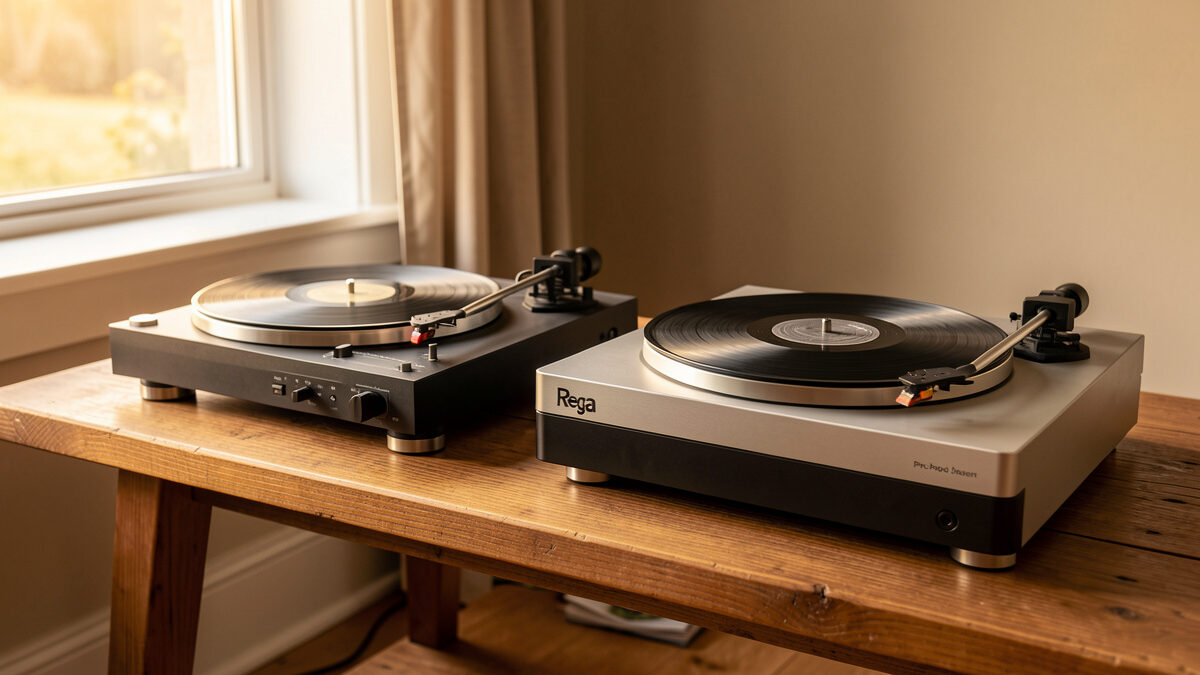
The Rega Planar 1 and the Pro-Ject Debut Carbon EVO sit within about $220 of each other, yet they’re built on opposite beliefs. The Planar 1 gives you a superb fixed arm and a factory-aligned cartridge you never touch. The Debut gives you an adjustable arm, a heavier platter, and an upgrade path. One is a finished instrument; the other is a platform.
I’ve had both on the bench, aligned both, and the honest answer to “which is better” is that they’re not really competing for the same buyer. The Planar 1 is for the person who wants to play records and forget the mechanics. The Debut is for the person who already suspects they’ll be swapping cartridges and dialing VTA by next winter. Pick the wrong one for your temperament and you’ll either feel boxed in or overwhelmed. Let me show you exactly where the money goes on each, because the spec sheets bury the differences that actually matter at the stylus.
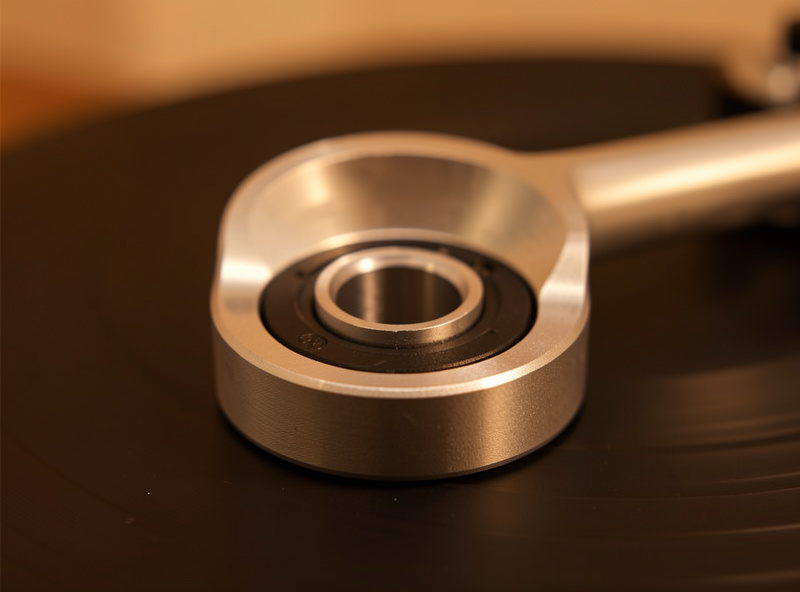
What’s the Real Difference Between the Planar 1 and the Debut?
The core difference is philosophy: Rega builds a rigid, low-mass deck with a fixed, excellent arm and no adjustments; Pro-Ject builds a configurable deck with an adjustable arm and a heavier, damped platter. Rega optimizes the factory result; Pro-Ject optimizes your ability to change it. Everything else follows from that split.
The Planar 1’s RB110 tonearm is a one-piece design with bearings tuned to a tolerance you don’t expect at $375, and the deck ships with Rega’s own Carbon cartridge aligned to the arm’s fixed geometry. There’s no VTA tower, no azimuth adjustment, and anti-skate is handled by a simple, effective mechanism. That sounds like a limitation until you realize it’s a decision: Rega assumes you’ll use its cartridge at its geometry, and within that assumption the deck is close to perfect out of the box. The Rega engineering brief has always been mass reduction plus rigidity, and the Planar 1 is that brief at its cheapest. If the arm and the sticker price are the whole question for you, I weigh that trade-off directly in Are Rega Turntables Worth the Price?
The Debut Carbon EVO answers with an 8.6-inch carbon-fiber arm that lets you set VTA at the pillar, a two-piece platter with thermoplastic-elastomer damping to kill ringing, height-adjustable feet, and electronic speed switching between 33 and 45. It ships with a Sumiko Rainier cartridge that you can move, upgrade, or replace, and the arm will accommodate the height change. The Pro-Ject catalog is enormous precisely because the company believes in giving you knobs, and the Debut is where that belief starts. If the Debut is where you’re leaning, the next question is which Debut, which is its own comparison in Pro-Ject Debut Carbon vs EVO.
Which Has the Better Tonearm?
The Rega RB110, on pure bearing quality. Rega’s arms are the benchmark the whole industry measures against, and even the entry RB110 holds azimuth and effective mass more consistently than the Debut’s carbon arm. But the Debut’s arm is adjustable where Rega’s is fixed, and that flexibility matters the moment you fit a taller cartridge.
Here’s the nuance I’ve felt on the bench. The RB110 tracks beautifully with the cartridge it’s designed around, and its rigid bearing means it won’t wander or add its own resonance to the groove. That’s real engineering, not marketing. But the instant you want to mount a cartridge that isn’t the Rega Carbon — a taller moving-magnet, say — the Planar 1 gives you no way to correct the resulting VTA error short of shimming the cartridge, which is a hack. The Debut’s arm just adjusts. So “better arm” splits: better bearing and out-of-box tracking goes to Rega; better adaptability goes to Pro-Ject. If you’ll never change the cartridge, the RB110 wins outright. If you’re a tinkerer, the Debut’s arm is the one that grows with you. Either way, the arm only performs if the rest of the setup is right — start with tracking force and anti-skate before you blame the deck.
Rega Planar 1 vs Pro-Ject Debut: Spec Comparison
Every row here is something I actually check when one of these lands on the bench, not a marketing bullet. Prices are 2026 street figures and drift.
| Feature | Rega Planar 1 | Pro-Ject Debut Carbon EVO |
|---|---|---|
| Street price | ~$375 | ~$599 |
| Tonearm | RB110, fixed bearings | 8.6in carbon, adjustable |
| Cartridge | Rega Carbon (aligned) | Sumiko Rainier |
| Platter | Phenolic, single-layer | Steel with TPE damping |
| VTA adjustment | No (fixed) | Yes, at pillar |
| Speed change | Manual belt move | Electronic 33/45 |
| Feet | Fixed | Height-adjustable |
Read the table and the split is obvious: Rega wins the arm-and-cartridge-alignment rows, Pro-Ject wins every adjustability and convenience row. The Debut also costs more, and part of that gap is the electronic speed switch and the damped platter — genuine hardware, not fluff. Whether those are worth $220 to you is the entire decision.

Do You Have to Set Either One Up Yourself?
The Planar 1 arrives essentially ready — cartridge fitted and aligned, so you only confirm tracking force and level the deck. The Debut needs a bit more: you fit the counterweight, set tracking force to the Rainier’s spec, set anti-skate, and can dial VTA. Neither is hard, but the Debut assumes you’ll participate.
This is the practical fork most buyers miss. On the Planar 1 I level it, drop the platter on, confirm the factory tracking force with my digital gauge (it reads to 0.01g), and I’m playing records in five minutes. The one time I skipped the gauge check on a “pre-set” deck years ago, I later measured the force a full 0.5g over spec — enough to accelerate stylus wear noticeably. I gauge everything now, Rega included. On the Debut you’re setting the counterweight from scratch, which takes ten minutes and a protractor if you want the overhang perfect. If that sounds like a chore, the Planar 1 is your deck. If it sounds like the fun part, the Debut hands you the tools. My full walkthrough lives in the turntable setup and calibration guide, and if this is your first table, setting up a turntable for the first time covers the whole sequence step by step.
Which One Sounds Better?
Out of the box, they’re closer than the price gap suggests, and the difference is character, not tier. The Planar 1’s rigid arm and Rega Carbon cartridge give a tight, rhythmically confident sound. The Debut’s damped platter and Rainier cartridge lean slightly warmer and fuller. Neither is “better” — they’re voiced differently, and setup narrows the gap further.
What I hear on my own system: the Planar 1 is the more honest tracker, especially through busy passages where a lesser arm smears. The Debut’s heavier, damped platter gives a marginally quieter background and a fuller low end, which some listeners prefer immediately. But here’s the thing that undercuts the whole “which sounds better” question — past a certain point, the phono stage and your cartridge choice matter more than the difference between these two decks. Feed either one through a weak built-in preamp and you’ve bottlenecked both. That’s why I tell people to read the phono stage guide before agonizing over the table. The sensory tell that either deck is set up right is the same: a crowded inner groove that stays clean instead of turning to gritty haze near the label.
How Do They Compare on Speed Stability and Noise Floor?
Both are quiet, competent belt decks, but they get there differently. The Planar 1 uses a low-mass phenolic platter and a 24V motor tuned for stable speed; the Debut leans on a heavier steel platter with TPE damping to sink resonance. In practice, wow and flutter on both sits below the level a human ear registers as pitch wobble.
The Debut’s heavier, damped platter does give a marginally lower noise floor — you notice it as a slightly blacker background between notes on quiet passages. The Planar 1 counters with lower rotating mass, which some argue lets the motor hold speed more nimbly. Honestly, on my bench the difference is small enough that room and isolation swamp it. A springy shelf under either deck will inject far more rumble and footfall noise than the gap between their platters. That’s why I tell people to solve placement before splitting hairs on platter mass — a wall shelf or a proper platform does more than either deck’s engineering. If your floor bounces when you walk, start with a DIY isolation platform before you spend another dollar on the table itself. The best belt drive in the world turns to mush on a shelf that flexes.
Speed change is the one clear win for the Debut: it switches 33 to 45 electronically at the press of a button, while the Planar 1 makes you lift the platter and move the belt by hand. If you play a lot of singles, that convenience adds up fast.
Which Should You Buy?
Buy the Planar 1 if you want the best fixed arm at the price and zero interest in tinkering — it’s the more foolproof, set-and-forget deck. Buy the Debut Carbon EVO if you want to adjust, upgrade cartridges, and grow into the hobby. The extra $220 buys adjustability and convenience, not a clear sound-quality tier.
If I’m handing a deck to a friend who “just wants records to sound great,” it’s the Planar 1 every time — the fixed geometry is a feature for someone who won’t fiddle. If I’m handing it to someone who’s already asking about MicroLine styli and VTA, it’s the Debut, because boxing that person into a fixed arm is cruel. Both sit inside the broader modern belt-drive picture I map out in the Rega vs Pro-Ject vs Fluance showdown, which is the place to start if you’re still deciding between brands rather than models. And if you’d rather see how the Debut’s bigger sibling stacks up against Fluance’s best, that’s the Fluance RT85 vs Pro-Ject X1 matchup.
As an Amazon Associate I earn from qualifying purchases.
Shop them directly here: Rega Planar 1 and Pro-Ject Debut Carbon EVO. Add a digital stylus gauge to the cart either way — it’s the cheapest upgrade that protects your records on both decks.
Is the Rega Planar 1 or Pro-Ject Debut easier to set up?
The Rega Planar 1 is easier. It arrives with the cartridge fitted and aligned, so you only level the deck and confirm tracking force. The Pro-Ject Debut Carbon EVO needs you to set the counterweight, anti-skate, and optionally VTA, which takes about ten minutes with a gauge and protractor.
Does the Pro-Ject Debut have a better cartridge than the Planar 1?
They are different rather than clearly better. The Debut Carbon EVO ships with a Sumiko Rainier you can upgrade or replace, while the Planar 1 comes with a Rega Carbon aligned to its fixed arm. The Debut wins on upgradeability because its arm adjusts to a new cartridge’s height.
Is the extra money for the Debut worth it?
Only if you value adjustability, an electronic speed switch, and a damped platter. The extra roughly 220 dollars does not buy a clear sound-quality tier over the Planar 1. It buys the ability to tinker and upgrade, which matters to hobbyists and not to set-and-forget listeners.
Can you upgrade the cartridge on a Rega Planar 1?
You can, but the fixed arm has no VTA adjustment, so a cartridge much taller or shorter than the Rega Carbon will sit at a non-ideal angle unless you shim it. The Planar 1 is happiest with cartridges close to its designed geometry.
Further Reading
- Rega vs Pro-Ject vs Fluance: A Setup Tech’s Belt-Drive Showdown
- Are Rega Turntables Worth the Price? An Honest Assessment
- Pro-Ject Debut Carbon vs EVO: What the Upgrade Buys You
- Turntable Setup and Calibration: The Complete Guide
- Phono Stage Guide: Gain, Loading, MM/MC, and Where to Spend