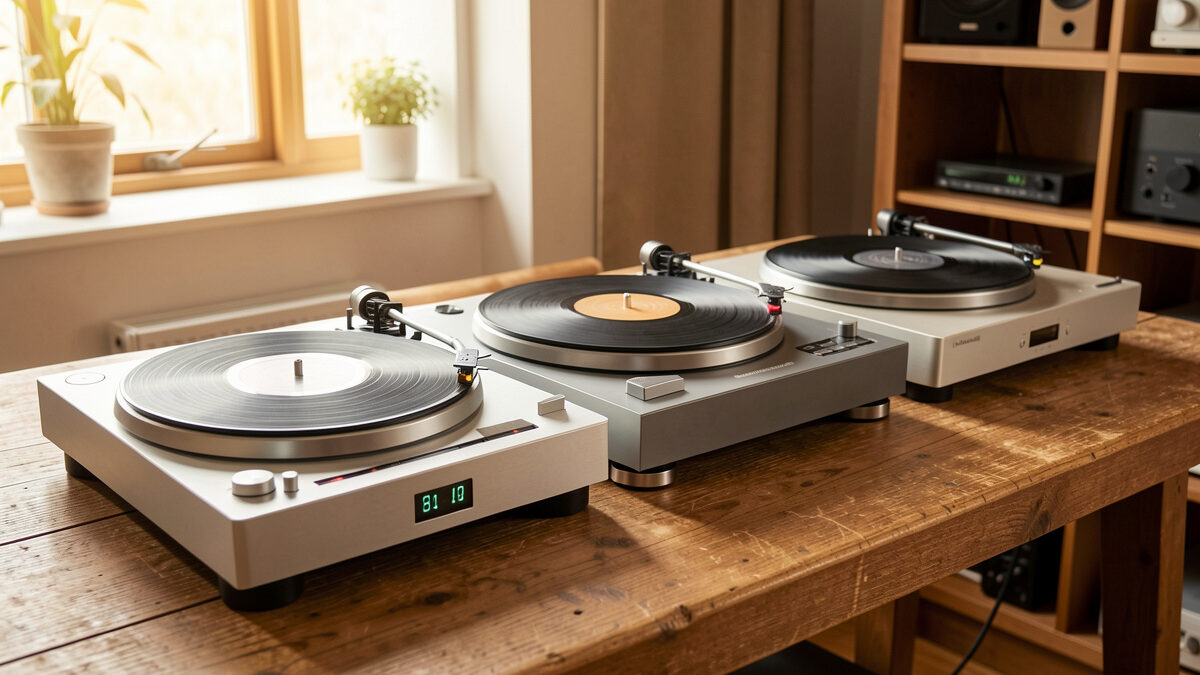
Buying a modern belt-drive turntable in 2026 comes down to three houses: Rega, Pro-Ject, and Fluance. Rega sells rigidity and a legendary arm, Pro-Ject sells configurability, and Fluance sells the most hardware per dollar. I’ve mounted cartridges on all three, and the deck that wins depends entirely on how much setup you’re willing to do.
That last clause is the whole game, and it’s the part the unboxing videos skip. A Fluance RT85 that arrives with the counterweight untouched and anti-skate on a guess will lose to a $299 Rega that was aligned on a protractor. The brand on the plinth matters less than the geometry under the stylus. So this comparison isn’t a spec beauty contest — it’s a setup tech’s read on which platform rewards the work you’ll actually do, and where each one quietly cuts a corner to hit its price.
I run a Rega Planar 3 with the RB330 arm as my belt-drive reference, a Pro-Ject in the X2/Debut family on the bench beside it, and I’ve had Fluance’s RT8x decks through here for the same tests. What follows is the map of the whole cluster: the head-to-head matchups, the price-tier shortlists, and the honest “is Rega worth it” question everyone asks after they see the sticker.
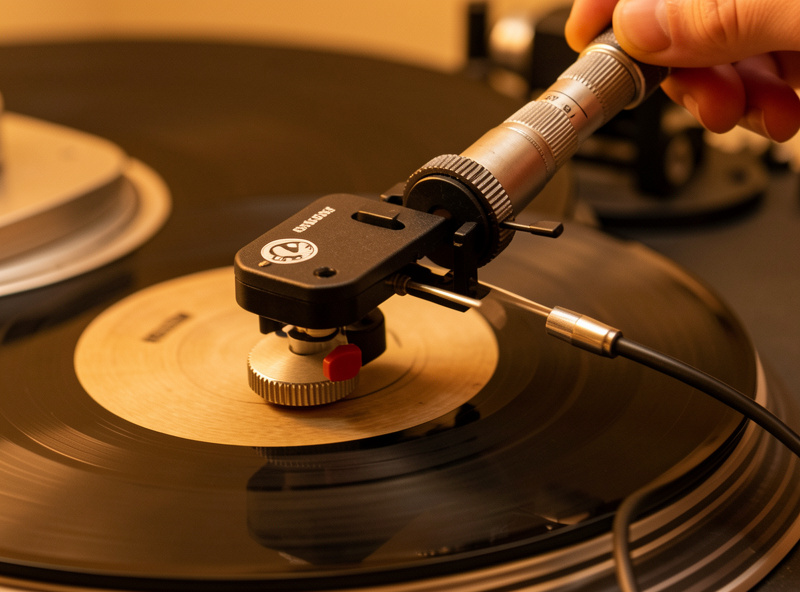
What Actually Separates Rega, Pro-Ject, and Fluance?
The three brands solve the same problem — spin a record at a stable 33.3 RPM with minimal added noise — from three different philosophies. Rega chases mass reduction and rigidity, Pro-Ject chases modularity and options, Fluance chases hardware value. Each choice shows up at the stylus in a way you can measure.
Rega’s whole engineering religion is “low mass, high rigidity.” Their plinths are deliberately light, their platters are designed to spin without storing energy, and the RB220/RB330 tonearms are one-piece castings with famously tight bearings. The trade is that Rega gives you almost nothing to adjust — no VTA tower, often no anti-skate dial beyond a simple mechanism, and a fixed cartridge alignment that assumes you’ll use a Rega cart. That’s a feature if you trust the factory and a frustration if you’re a tinkerer.
Pro-Ject is the opposite instinct. Their Debut and X-line decks hand you a proper adjustable counterweight, dialed anti-skate, an azimuth-adjustable arm on the pricier models, and in some cases height-adjustable feet. The Pro-Ject Audio Systems catalog is enormous precisely because they believe in giving the user knobs. That flexibility is why I keep one on the bench — it’s the easiest brand to demonstrate an alignment change on.
Fluance takes a third road: pack in the heavy acrylic platter, the Ortofon cartridge, the auto-stop, and the isolation feet, then price it below what the parts usually cost. An RT85 ships with an acrylic platter and an Ortofon 2M Blue for money that gets you a bare Rega or Debut with a cheaper cart. The catch is quality control variance and an arm that’s competent but not in the RB330’s league. You’re buying components, not a bearing pedigree.
Rega vs Pro-Ject vs Fluance: The Spec Showdown Table
Here’s where the three houses land at comparable price points. Every row is something I check on the bench, not a marketing bullet. Prices are 2026 street figures and drift; treat them as tiers, not quotes.
| Model (tier) | Drive / platter | Tonearm | Included cartridge | Adjustable VTA / azimuth | Best for |
|---|---|---|---|---|---|
| Rega Planar 1 (~$375) | Belt / phenolic | RB110 (fixed bearings) | Carbon MM | No / No | Set-and-forget accuracy |
| Rega Planar 3 (~$1,150) | Belt / float-glass | RB330 | None (add Elys/Exact) | No / No | Arm-first purists |
| Pro-Ject Debut Carbon EVO (~$599) | Belt / steel+TPE | 8.6in carbon, VTA-set | Sumiko Rainier | Yes / Yes | Tinkerers on a budget |
| Pro-Ject X1 B (~$799) | Belt / acrylic | 9in carbon/alu, adj. | Pick-it MM | Yes / Yes | Upgrade-path buyers |
| Fluance RT81 (~$250) | Belt / aluminum | Metal S-arm | AT-VM95E | No / No | Best cheap starter |
| Fluance RT85 (~$500) | Belt / acrylic | Metal S-arm | Ortofon 2M Blue | No / No | Most hardware per dollar |
Read that table as three columns of truth. Rega wins the tonearm and bearing rows. Pro-Ject wins the adjustability rows outright — it’s the only house here that lets you set VTA and azimuth without shimming. Fluance wins the “what came in the box” rows, stapling an acrylic platter and a 2M Blue onto a $500 deck. None of them wins every row, which is exactly why this cluster needs seven articles instead of one verdict.
Which Belt-Drive Brand Has the Best Tonearm?
Rega, and it isn’t close at the price. The RB220 and RB330 arms use a one-piece aluminum casting and hand-tuned bearings that hold azimuth and give consistent effective mass, which is why the whole industry benchmarks against them. Pro-Ject’s carbon arms are good; Fluance’s S-arm is fine. Neither is a Rega.
The tonearm is the part I’d spend on first, because it’s the component doing the mechanical work of tracking a groove wall that’s moving at audio frequencies. A sloppy bearing lets the stylus wander, and you hear it as smeared inner grooves and inconsistent tracking. On my RB330 I can set tracking force with the gauge, know the arm won’t drift, and trust that azimuth is square because the casting made it square. That confidence is what Rega actually sells. If the arm is your priority, my full take is in Are Rega Turntables Worth the Price? — the short version is that you’re paying for the arm and the bearing, not the plinth.
Pro-Ject’s counter-argument is that their arm is adjustable where Rega’s is fixed. On a Debut Carbon EVO or an X1 you can set VTA at the pivot and dial azimuth, which matters the moment you fit a cartridge that isn’t the exact height Rega assumes. I’ve watched a tall moving-coil turn a fixed-geometry Rega into a compromise that a Pro-Ject arm would have absorbed with a two-minute adjustment. The two houses are arguing about different things — Rega about how good the arm is out of the box, Pro-Ject about how much you can change it later.
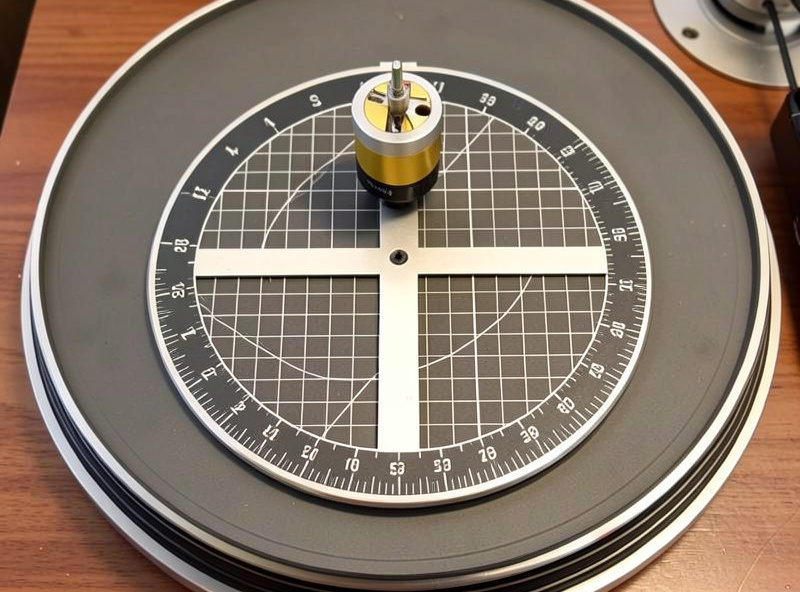
Do You Need to Set Up a Belt-Drive Turntable Yourself?
Yes, on all three brands, and it’s the single biggest variable in how they sound. Even a factory-cartridge Rega benefits from a tracking-force check; a Fluance or Pro-Ject with a bundled cart absolutely needs one. Ten minutes with a stylus gauge and a protractor outranks any brand-loyalty argument.
Here’s the order I set every one of these decks up in, and it’s the same order I tell everyone to spend money in: level the plinth, set tracking force to the cartridge’s spec with a digital gauge (the AT-VM95E wants 2.0g, the Ortofon 2M Blue wants 1.8g), set anti-skate to match, then align overhang and offset on a two-point protractor using the Baerwald nulls. VTA and azimuth come last, and on a fixed-arm Rega or Fluance you mostly accept what the geometry gives you. The mistake I made early — and it cost me a stylus — was trusting a bundled deck’s “pre-set” tracking force. I measured it later at 2.6g on a cartridge rated for 2.0g. That’s a groove-shredding overshoot, and it’s exactly the kind of thing no unboxing catches.
This is why the “which brand is best” question is half a trap. A meticulously aligned Fluance RT81 will out-track a carelessly assembled Pro-Ject X1 every time. If you’re new to this, start with the cheapest deck that has a good cartridge and learn the setup, because the skill transfers to every table you’ll ever own. I walk beginners through the first-table decision in U-Turn Orbit vs Fluance RT81, which is the truest entry-tier fork in this whole comparison.
Rega Planar 1 vs Pro-Ject Debut: The Entry Head-to-Head
At the ~$375–$599 entry tier the real fight is Rega Planar 1 versus Pro-Ject Debut. The Planar 1 gives you a better arm and a factory cartridge you never touch; the Debut gives you adjustability and an upgrade path. Neither is wrong — they’re aimed at different owners.
The Planar 1 is the deck I hand someone who wants to play records and never think about it again. It’s rigid, the RB110 arm is excellent for the money, and the bundled Carbon cartridge is aligned at the factory to Rega’s fixed geometry so it works out of the box. The Debut, by contrast, is for the person who suspects they’ll be swapping cartridges and dialing VTA within a year. I break the full matchup down — arm, cartridge, isolation, and who each one is for — in Rega Planar 1 vs Pro-Ject Debut: The Real Differences. And if the Debut is where you’re leaning, the next question is which Debut, which is its own rabbit hole covered in Pro-Ject Debut Carbon vs EVO.
Fluance RT85 vs Pro-Ject X1: The Mid-Tier Value Fight
Step up to ~$500–$800 and the interesting matchup is Fluance RT85 versus Pro-Ject X1. The RT85 stacks an acrylic platter and an Ortofon 2M Blue into the box for less money; the X1 answers with an adjustable arm, an acrylic platter of its own, and Pro-Ject’s upgrade ecosystem. This is where “hardware per dollar” meets “platform you can grow.”
The RT85 is genuinely astonishing on a parts-cost basis. An acrylic platter alone runs real money as an upgrade, and the 2M Blue is a cartridge people buy separately for $200-plus. Fluance sells you both, mounted, for around $500. The X1’s rebuttal isn’t parts — it’s the arm’s adjustability and the fact that you can climb Pro-Ject’s ladder without changing decks. Which one wins depends on whether you’re a set-it-and-enjoy-it listener or a serial upgrader, and I settle it in Fluance RT85 vs Pro-Ject X1: Which Belt Table Wins?. Spoiler that isn’t really a spoiler: the acrylic-platter, better-cartridge value of the RT85 is hard to argue with if you’re disciplined about setup.

How Much Should You Spend on a Belt-Drive Turntable?
Spend in the right order, not the biggest number. My rule: a clean cartridge and a careful setup on a $300 deck beats a sloppy $900 one. Once the fundamentals are covered, the two tiers worth targeting are around $500 (the value sweet spot) and around $1,000 (where the arm and speed stability get serious).
The $500 tier is where the best value-per-dollar decks live — a Fluance RT85, a Pro-Ject Debut Carbon EVO, a Rega Planar 1 with a cartridge upgrade. It’s enough deck that the limiting factor becomes your records and your phono stage, not the table. I lay out the exact shortlist, with the setup priorities that make each one sing, in Best Turntable Around $500: A Setup Tech’s Shortlist.
The $1,000 tier is a genuine step up, not a diminishing-return luxury — this is Rega Planar 3 territory, Pro-Ject X2, and the point where a real tonearm bearing and better speed stability start to matter. But it’s also where people overspend on the table and underspend on the phono stage, which is the actual mistake. Where that money should go — and where it shouldn’t — is the whole subject of Best Turntable Around $1,000: Where the Money Goes.
Direct-Drive vs Belt-Drive: Does the Motor Type Matter Here?
For this comparison, no — all three brands are belt-drive, and belt drive at this price is a solved problem. The direct-vs-belt war is fought harder online than it matters in a listening room. What actually moves the needle is speed stability and isolation, and a well-made belt deck delivers both.
I run a direct-drive Technics-class deck as my speed-stability reference precisely because it’s the benchmark — but I don’t pretend my belt-drive Rega or Pro-Ject is broken because it isn’t a DD motor. A good belt table isolates the motor’s vibration from the platter through the compliance of the belt itself, which is a real advantage. Wow and flutter figures on all three of these brands sit well below the threshold where a human ear notices pitch instability. If someone tells you belt drive “can’t keep speed,” they’re quoting a 1970s argument about 1970s belts. The thing to actually worry about at this tier is footfall isolation on a springy floor, which is a shelf-and-feet problem, not a motor problem.
Which Cartridge Comes in the Box — and When Do You Upgrade It?
The bundled cartridge is where these three brands diverge most in value. Fluance ships the best carts for the money — an Audio-Technica VM95E on the RT81, an Ortofon 2M Blue on the RT85. Rega bundles its own Carbon or leaves the arm bare. Pro-Ject fits a Sumiko Rainier or Pick-it. The cartridge, not the plinth, is what you’ll hear first.
Cartridges are where I’ve spent the most bench time, because the stylus profile changes the sound more than any other single swap. The AT-VM95E that comes on a Fluance RT81 uses an elliptical stylus that tracks the groove far better than the conical tips on the cheapest decks — that’s a real, audible upgrade Fluance hands you for free. Step to the 2M Blue on the RT85 and you get a nude elliptical that pulls more detail out of the inner grooves, which is exactly where cheaper styli smear. Rega’s counter is that its arm is so good it makes a modest cartridge track cleanly, which is true, but you’re supplying the cartridge budget yourself on a bare Planar.
When do you upgrade? Not until the stylus is worn or you’ve maxed the phono stage and setup. A common mistake is bolting a $400 moving-coil onto a $300 deck whose arm can’t resolve the difference. The AT-VM95 family is a masterclass here because the bodies share a mount — you can go from the E (elliptical) to the ML (MicroLine) stylus for a fraction of a new cartridge and hear a genuine jump in inner-groove clarity. That upgrade path is one reason I keep recommending decks that ship with a VM95 body: the ceiling is high and cheap to reach. The manufacturer’s own stylus compatibility chart on Audio-Technica is the reference I check before telling anyone a swap will drop in.
Do You Need an External Phono Stage With These?
Maybe — and it depends on the deck and your amp. Fluance’s RT81 and RT85 include a switchable built-in preamp, so you can plug straight into powered speakers. Rega and most Pro-Ject decks assume you’ll supply a phono stage. Past a certain quality point, the phono stage matters more than stepping up the table.
This is the hill I’ll die on, and it’s the one beginners get backwards. The phono stage does two hard jobs: it applies the RIAA equalization curve that every record is cut with, and it amplifies a tiny signal — a moving-magnet cartridge puts out around 5mV, a moving-coil a fraction of that — without adding noise. A cheap built-in preamp does this adequately; a good external stage does it with lower noise, better channel separation, and the right loading. On my bench I run a switchable MM/MC stage that lets me set loading from 47kΩ down to 100Ω, and swapping from a deck’s internal preamp to a decent external one is often a bigger jump than swapping the whole table. The RIAA curve itself is a published standard — the RIAA defines it — and getting it applied cleanly is worth more than another few hundred grams of platter.
So if you’re weighing a $500 Fluance against a $700 Pro-Ject, my honest advice is often to buy the cheaper deck and spend the difference on an outboard phono stage. That’s the “spend in the right order” logic that runs through this whole cluster, and it’s why the $1,000 buyers who put it all into the table so often plateau.
How Do You Set Up Any of These Decks Correctly?
Same procedure on all three brands, in this order: level the plinth, set tracking force with a digital gauge, set anti-skate to match, then align overhang and offset on a two-point protractor. VTA and azimuth come last. The whole thing takes 15–20 minutes and outranks any brand choice for final sound.
Let me walk it the way I do it on the bench. First, a bubble level across the platter and the plinth — an unlevel table drags the stylus toward one groove wall and skews anti-skate. Next, tracking force: I zero the arm floating, then set the counterweight and confirm with a digital gauge that reads to 0.01g, dialing to the cartridge’s spec (2.0g for the AT-VM95E, 1.8g for the 2M Blue, per each maker’s datasheet). Too light and the stylus mistracks and skips; too heavy and it grinds the groove and wears fast. Then anti-skate to match the tracking force, countering the inward pull the pivoted arm generates. Then the protractor: I set overhang and offset angle to the Baerwald nulls so the cartridge sits tangent to the groove at the two points where distortion is lowest. On a fixed-arm Rega you accept factory VTA; on an adjustable Pro-Ject I set arm height so the cartridge body sits parallel to the record with the stylus in the groove.
The sensory tell that it’s right: put on a busy inner groove — massed strings, a crowded mix — and listen for it staying clean instead of turning to gritty haze as the stylus nears the label. That grit is mistracking, almost always from tracking force or anti-skate being off, not from the record. When I get anti-skate dialed on a blank groove and the arm sits still instead of drifting inward, I know the geometry is honest. No brand buys you out of doing this; it just changes how much the deck lets you adjust while you do it.
What About Isolation and the Plinth?
Isolation is the upgrade almost everyone skips and it’s nearly free. A belt-drive turntable is a resonance instrument — footfalls, speaker bass, and a springy shelf all feed vibration into the platter and smear the sound. A solid wall shelf, decent feet, and a rigid plinth do more than the next tier of table on a bad surface.
Here’s the crossover that makes this site what it is: the same CNC that routes wall panels for a smart-home build routed the plinth blank on my bench, because making a slab of wood hold its shape under a turning platter is a workshop problem before it’s a hi-fi one. Constrained-layer damping — two stiff layers bonded around a lossy middle — kills the ringing a single-material plinth stores. Sorbothane feet or a proper isolation platform decouple the deck from the shelf. I’ve measured the difference by tapping the plinth mid-play and listening for the thump through the speakers: on a well-isolated setup it’s barely there; on a wobbly IKEA shelf it’s a drum. Fluance and Pro-Ject both fit isolation feet from the factory, which is genuinely thoughtful at their prices, but none of it saves you from mounting the deck on a bouncy floor near the speakers. Fix the shelf first. U-Turn, for its part, builds its Orbit in the US and leans into the minimalist-plinth philosophy — the U-Turn Audio design brief is a low-mass acrylic or MDF plinth much like Rega’s thinking, which is why it lands in the entry-tier conversation against Fluance.
Which Brand Should You Buy?
Buy Rega if the arm and set-and-forget accuracy matter most and you won’t tinker. Buy Pro-Ject if you want to adjust, upgrade, and grow into the deck. Buy Fluance if you want the most platter, cartridge, and isolation for the fewest dollars and you’ll do the setup yourself. All three are honest; they just answer different questions — and if the Rega sticker still stings, read my honest take on whether Rega turntables are worth the price before you rule them out.
If I’m being blunt about my own bench: the Rega is the one I trust to be right, the Pro-Ject is the one I reach for when I want to demonstrate a setup change, and the Fluance is the one I’d hand a friend who wants great sound and doesn’t care about the pedigree. Start from how much you enjoy the mechanical side of this hobby. If turning knobs and reading a protractor sounds like fun, Pro-Ject rewards you most. If it sounds like a chore, Rega’s fixed geometry is a feature. And if the budget is the hard constraint, Fluance quietly gives you the most to listen to.
Whichever you choose, the deck is only the start. The plinth under it and the shelf it sits on matter more than most buyers think — I route my own plinth blanks on a CNC over at desktopcncforge, because making wood hold its shape under a turning platter is half the isolation battle. The same room, the same ears, a different source: that’s the whole point of doing this properly.
The Mistakes I See Buyers Make With All Three Brands
The same three errors cost people sound quality regardless of which brand they bought. Overspending on the table while running a cheap phono stage. Never checking the factory tracking force. And mounting a good deck on a bouncy shelf next to the speakers. Fix those before you argue about Rega versus Pro-Ject.
The first mistake is budget order — I’ve watched someone stretch to a Planar 3 and feed it through a $30 preamp, then wonder why it doesn’t blow away their old deck. It’s the phono stage bottlenecking a good source. The second is trust: bundled cartridges ship with a “close enough” tracking force, and close enough on a stylus rated to 0.01g tolerances is how records get worn. I gauge every deck that crosses the bench, factory-fitted or not. The third is placement — the best belt table in the world turns to mush on a shelf that flexes when you walk past it, because the platter is picking up your footfalls through the plinth. None of these is a brand problem. They’re setup problems, and setup is the one variable entirely in your hands. Get those three right and the Rega, the Pro-Ject, and the Fluance all sound like far more table than you paid for.
As an Amazon Associate I earn from qualifying purchases.
If you want to shop the three houses directly, here are clean search links: Rega turntables, Pro-Ject Debut decks, and Fluance RT85. A cheap two-point protractor and a digital stylus gauge belong in the same cart — they’ll do more for your sound than the next deck up.
Is Rega, Pro-Ject, or Fluance better for a beginner?
Fluance offers the most value for a first deck because it bundles a good cartridge and heavy platter cheaply, but it needs you to check tracking force. Rega Planar 1 is the most foolproof out of the box. Pro-Ject fits beginners who want to learn to adjust their table.
Do belt-drive turntables keep speed as well as direct drive?
At this price tier, yes. Wow and flutter on modern Rega, Pro-Ject, and Fluance belt decks sits below the level a human ear detects as pitch instability. The belt actually helps by isolating motor vibration from the platter. Direct drive is the speed benchmark, but belt drive is not broken.
Why is Rega more expensive for similar specs?
You pay for the RB-series tonearm and its bearings, which are the industry benchmark, plus Rega’s low-mass rigid plinth design. Rega spends its budget on the arm and structure rather than on bundled extras like acrylic platters, so the value shows up in mechanics rather than the spec sheet.
Does a bundled cartridge need setup?
Almost always. Even factory-fitted cartridges benefit from a tracking-force check with a digital gauge, and any cartridge you mount yourself needs overhang and anti-skate set on a protractor. Trusting a pre-set force is the fastest way to damage a stylus and your records.
What should I upgrade first on any of these decks?
Spend in this order: record cleaning, careful setup, phono stage, cartridge, then the table itself. Most beginners buy a bigger table when a better phono stage or a proper alignment would have bought more actual sound quality for less money.
Keep Building
- Rega Planar 1 vs Pro-Ject Debut: The Real Differences
- Fluance RT85 vs Pro-Ject X1: Which Belt Table Wins?
- U-Turn Orbit vs Fluance RT81: Best First Belt-Drive Table
- Are Rega Turntables Worth the Price? An Honest Assessment
- Pro-Ject Debut Carbon vs EVO: What the Upgrade Buys You
- Best Turntable Around $500: A Setup Tech’s Shortlist
- Best Turntable Around $1,000: Where the Money Goes