For a small apartment or dorm, the best travel turntable is the Audio-Technica Sound Burger if you need something genuinely tiny and movable, or a compact home deck like the Audio-Technica AT-LP60X or Fluance RT80 if you have a shelf’s worth of space. All three track a safe moving-magnet cartridge and fit where a full-size deck won’t. The right pick depends on one question: do you need to move it, or just fit it?
Small-space vinyl has its own rules. Footprint, whether you can avoid external speakers, and — the part everyone forgets — isolation from footsteps on a shared floor all matter more than they do in a dedicated listening room. I’ve set decks up in cramped rooms and learned the traps the hard way, including the one that made my stylus skip every time someone walked past. Here’s how to choose, and how to set it up so it actually works in a tight space.
What Makes a Turntable Right for a Small Space?
A small-space turntable needs a compact footprint, a simple signal chain, and a safe cartridge — in that order. Footprint is obvious: a dorm desk or apartment shelf can’t spare the two feet a full audiophile deck wants. The simple signal chain is the part people underestimate: in a small room you don’t want a separate phono stage, amplifier, and speakers eating space, so a deck with a built-in preamp and either powered speakers or Bluetooth keeps the whole system tiny.
The cartridge requirement is the same everywhere, and it’s the one I never bend on. A moving-magnet cartridge tracking under about 3.5 grams protects your records; a ceramic suitcase deck at 6 grams wears them out. Small space is no excuse for a record-grinder — the good compact decks are barely bigger than the bad ones. The Sound Burger, for instance, is the smallest option here and still tracks a proper cartridge at a safe 3.5 grams, per Audio-Technica’s published specifications.
The last consideration, unique to shared buildings, is vibration. A light deck on a wobbly desk or a wall-shared shelf picks up footfalls and bass, which makes the stylus skip. I’ll come back to that, because it’s the small-space problem nobody warns you about and the one I got burned by first.
Truly Portable vs Compact Home Deck: Which Do You Need?
Decide this first: if you actually move the turntable — dorm to home, apartment to apartment, room to yard — buy a true portable; if it just needs to fit on a shelf and stay there, buy a compact home deck, which sounds better for the money. The two readers who land on “best travel turntable for a small apartment” usually want different things, and the wrong choice wastes money.
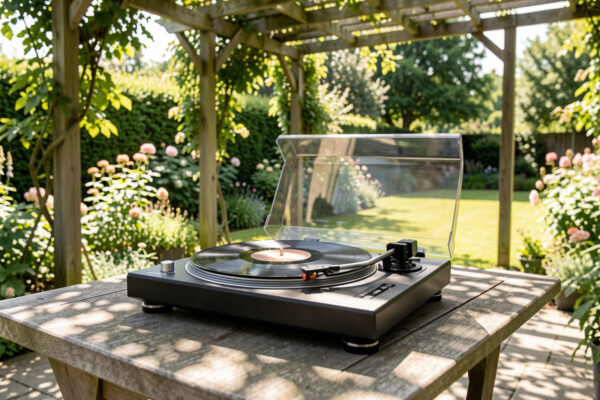
A true portable like the Sound Burger is flat, battery-powered, and streams over Bluetooth, so it stores in a drawer and comes out anywhere. You trade some sound quality — a light platter means more wow and flutter — for the freedom to move it, a tradeoff I measured in portable turntable speed stability. If you travel with your records or your living situation changes often, that freedom is worth the compromise, and its battery even lets you carry it outside, which I covered in can you play records outside.
A compact home deck — the AT-LP60X, the Fluance RT80 — is bigger but delivers a heavier platter, steadier speed, and better sound for the same money, because it isn’t paying for a battery and Bluetooth radio. If your turntable is going to live on one shelf for the next few years, that’s the smarter buy. Think of it as the difference between a travel setup and a small permanent setup; the honest answer for most dorm students who stay put is the compact home deck.
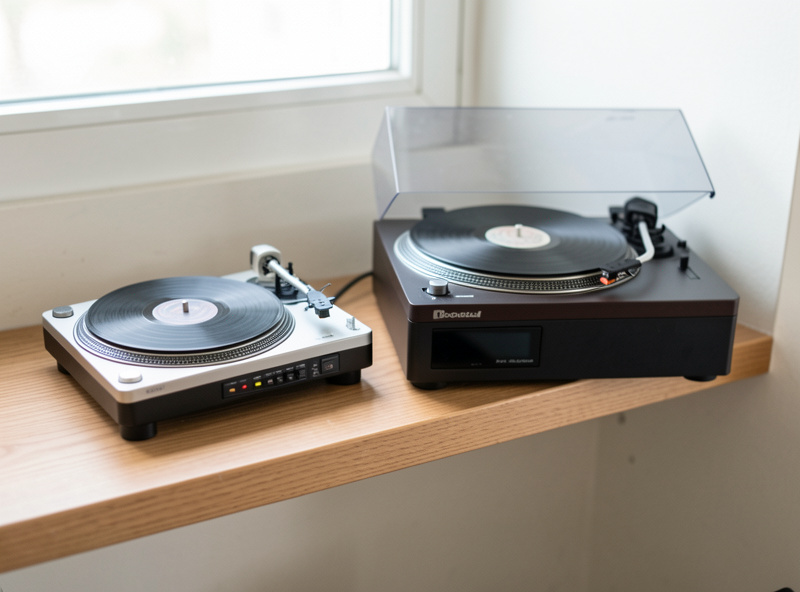
The Best Small-Space Turntables Compared
Here’s how the compact options I’d actually recommend line up, judged on footprint, cartridge safety, and how self-contained the system is. The “best for” column is the use case each one genuinely fits, not a spec paraphrase.
| Model | Footprint | Cartridge & VTF | Preamp / Bluetooth | Best for |
|---|---|---|---|---|
| Audio-Technica Sound Burger (AT-SB2022) | Tiny (flat, drawer-size) | AT3600L MM, 3.5g | Built-in; Bluetooth out | Truly movable / travel |
| Audio-Technica AT-LP60X | Compact, automatic | ATN3600L MM, ~3.5g | Switchable built-in preamp | Cheapest safe real deck |
| Fluance RT80 | Compact | Audio-Technica MM | Built-in preamp | Best sound for a small shelf |
| House of Marley Stir It Up Wireless | Medium-compact | Audio-Technica MM | Preamp; Bluetooth in & out | Wireless shelf system |
| U-Turn Orbit | Small full-size deck | Ortofon OM MM | Optional built-in preamp | Upgrade path in a small room |
Every deck here tracks a safe moving-magnet cartridge — that’s the entry price to be on this list at all. The Sound Burger wins on pure size and movability; the AT-LP60X is the cheapest genuine record player that won’t wear your vinyl, with a wow-and-flutter figure around 0.2%; the Fluance RT80, at roughly 0.25%, gives the best sound of the compact home decks. The U-Turn Orbit is the one you buy if the small room is temporary and you want a deck you can upgrade — I compared it directly to the Fluance in U-Turn Orbit vs Fluance RT81. For the full portable field beyond these, see my best portable turntable guide.
Do You Need Built-In Speakers in a Dorm?
No — you want Bluetooth or a line output feeding a small pair of powered speakers, not built-in speakers. Built-in speakers seem perfect for a tiny room, but they’re the worst-sounding option and they cause a specific problem in a small space: their vibration is inches from the platter, so at any real volume the cabinet resonates and the stylus chases its own output into a muddy feedback loop.
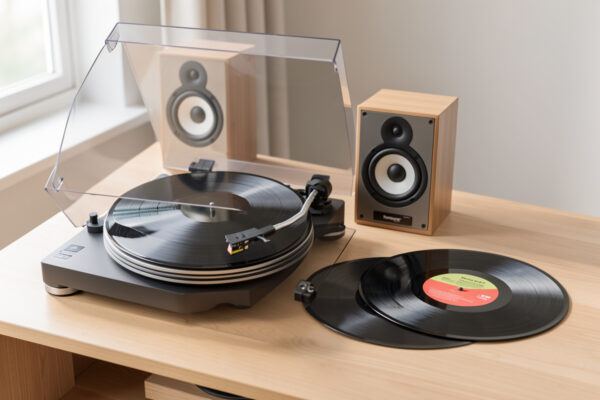
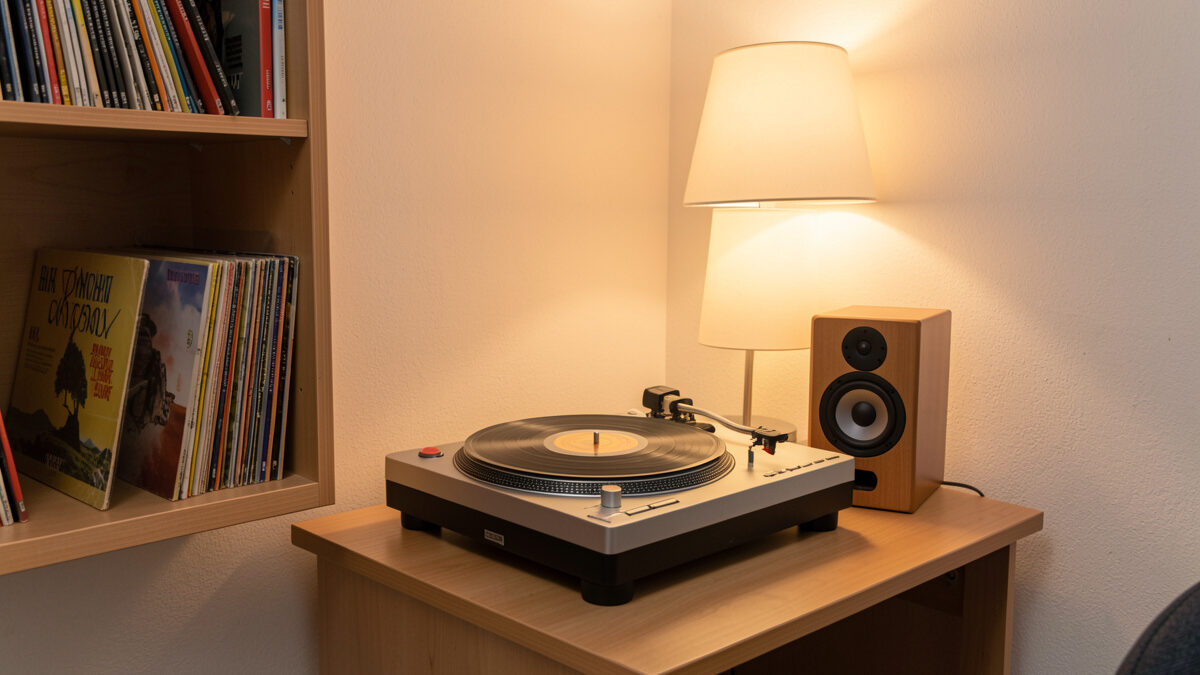
A cleaner small-space system is a compact deck with a built-in phono preamp feeding a pair of powered bookshelf speakers, or a Bluetooth portable streaming to a single powered speaker. Both keep the sound source away from the stylus and sound dramatically better than any built-in driver. The AT-LP60X and Fluance RT80 both have built-in preamps, so you can run them straight into powered speakers with no extra box — ideal when shelf space is the constraint. If you go the wireless route, the speaker matters more than the turntable, the same lesson I laid out for outdoor use in the best Bluetooth portable turntable guide.
The exception is the House of Marley Stir It Up Wireless and similar decks that pair a real cartridge with better onboard sound — they’re a step above suitcase speakers. But even there, sending the signal out to a separate speaker beats the built-ins. In a dorm, a compact deck plus two small powered speakers is the sweet spot: tiny, safe for records, and genuinely enjoyable.
How Do You Stop a Turntable Skipping in an Apartment?
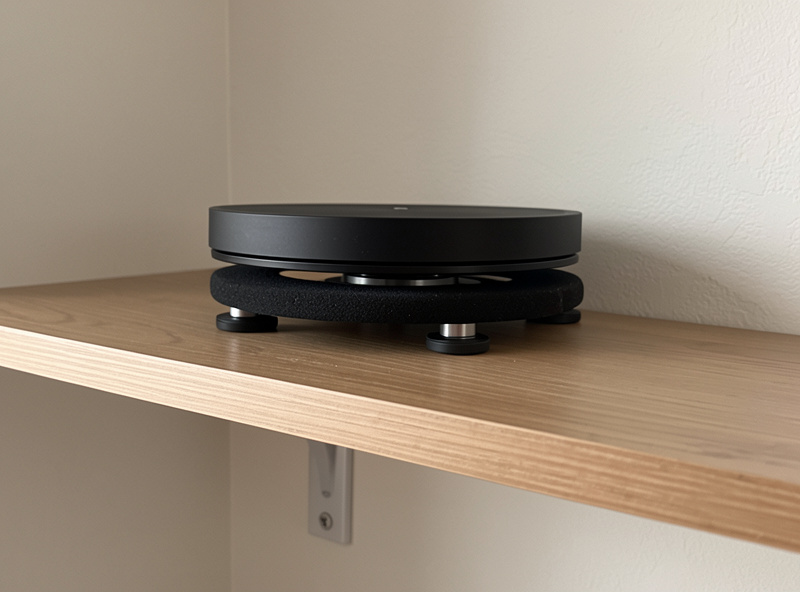
Isolate the deck: put it on a solid, decoupled surface away from the speakers and off any wall-shared shelf, and use anti-vibration feet or a heavy pad. In a small space the turntable, the speakers, and your footsteps are all crammed together, and a light deck picks up every one of those vibrations as skips and rumble. This is the small-apartment problem nobody warns beginners about.
I got burned by it early. In one cramped room I set my deck on the same particle-board desk as my powered speakers, and every time the bass hit — or a roommate walked past — the stylus jumped the groove. I could watch the tonearm twitch on a heavy kick drum. The fix was pure setup discipline: I moved the deck off the desk onto a wall-anchored shelf, then set it on sorbothane feet to decouple it from the shelf itself. The skipping stopped completely. It’s the same isolation logic I use under my main table, just scaled to a dorm.
The cheap, effective moves are a solid shelf (ideally wall-mounted so it doesn’t share the floor’s footfall path), sorbothane or spiked feet under the deck, and distance between the turntable and the speakers. A wobbly desk is the enemy; a decoupled shelf is the cure. Getting the basics of leveling and placement right matters even more in a small room, which is why I always point beginners to my first-time turntable setup guide before they blame the deck.
What I’d Buy for a Dorm or Studio Apartment
If you move often or space is truly minimal, buy the Sound Burger and a single powered Bluetooth speaker — it disappears into a drawer and goes anywhere. If you have one shelf and you’re staying put, buy the Fluance RT80 or the AT-LP60X with a pair of small powered speakers; you’ll get better sound for the money and a real record player you can live with for years. Both paths keep your records safe, which is the only non-negotiable.
Independent testing backs the portable pick within its limits — What Hi-Fi rates the Sound Burger the class leader for genuine portability — and my own bench experience agrees. But if the small room is a stepping stone and you know you’ll want more later, the U-Turn Orbit is the deck that grows with you, and it’s the one I’d steer an ambitious beginner toward; I make that case in my shortlist of the best turntables around $500.
Whatever you pick, spend two minutes on isolation before you blame anything on the deck. In a small space, footfalls and feedback cause more “bad turntable” complaints than the turntable ever does. Get the cartridge safe, the signal chain simple, and the deck decoupled from the floor, and a dorm room or studio apartment is a perfectly good place to fall deeper into vinyl — cramped quarters and all.
Compact turntables for small spaces on Amazon. As an Amazon Associate I earn from qualifying purchases.
Keep Building
- Best Portable Turntable: What Won’t Wreck Your Records
- Best Bluetooth Portable Turntable for the Backyard
- U-Turn Orbit vs Fluance RT81: Best First Belt-Drive Table
- Setting Up a Turntable for the First Time
What is the best turntable for a small apartment or dorm?
For genuine portability, the Audio-Technica Sound Burger is best; it is drawer-size, battery-powered, and streams over Bluetooth. For a compact deck that stays on one shelf, the Fluance RT80 or Audio-Technica AT-LP60X sound better for the money. All three track a safe moving-magnet cartridge and fit small spaces.
Do I need a portable turntable or a compact home deck for a small room?
Choose a portable if you actually move the turntable between places or want to carry it outside. Choose a compact home deck if it will live on one shelf, since it gives a heavier platter, steadier speed, and better sound for the same price. Most students who stay put are better served by a compact home deck.
Should a dorm turntable have built-in speakers?
No. Built-in speakers sound poor and their vibration feeds back into the stylus in a small room. A compact deck with a built-in preamp feeding two small powered speakers, or a Bluetooth portable paired to a powered speaker, sounds far better and keeps the sound source away from the platter.
How do I stop my turntable from skipping in an apartment?
Isolate it. Place the deck on a solid, decoupled surface away from the speakers, ideally a wall-mounted shelf rather than a shared floor, and add sorbothane or spiked anti-vibration feet. In small spaces, footfalls and speaker vibration cause most skipping, not the turntable itself.