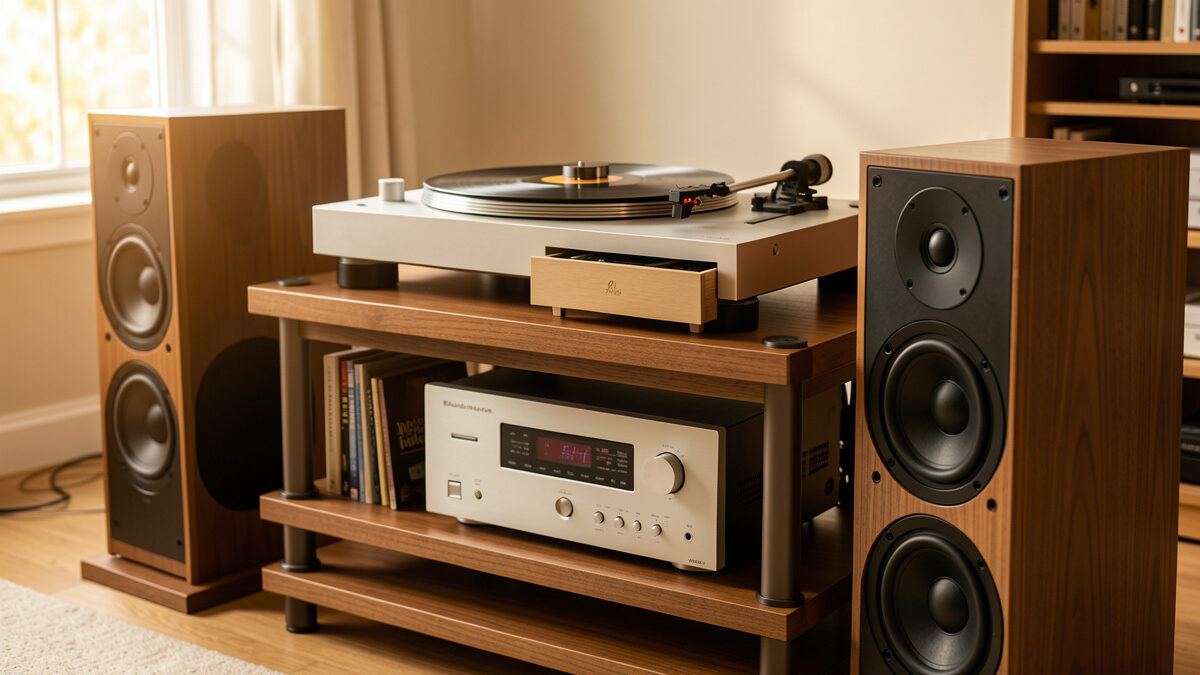
A phono stage is the small preamplifier that turns the tiny, tilted signal coming off your cartridge into a normal line-level signal your amp can use. It does two jobs: it applies about 40 dB of gain for a moving-magnet cartridge, and it reverses the RIAA equalization curve cut into every record. Get those two numbers wrong and the deck I run sounds either thin and quiet or boomy and harsh.
I have spent more time chasing problems back to the phono stage than to any other box in the chain, which is exactly why this guide exists. After mounting and aligning carts across a Technics SL-1200-class direct drive, a rebuilt Rega P3, and a Pro-Ject in the X2/Debut class, and running budget solid-state, a switchable MM/MC step-up, and a tube stage side by side, I have a clear opinion: the phono stage is where the money quietly decides how good your records sound, long before the table does. This is the pillar guide for the whole topic, and it links out to the deep dives on each piece.
What a Phono Stage Actually Does
A phono stage does two specific things, and understanding both is the difference between guessing and dialing. First, it boosts an extremely low-output signal: a moving-magnet cartridge puts out roughly 3 to 5 millivolts, while your amp wants about 300 to 500 millivolts at its line input. That is roughly a hundredfold jump, around 40 dB of gain. Second, it applies the inverse RIAA curve.
Records are not cut flat. The RIAA standard rolls bass down and lifts treble during cutting so the groove physically fits and tracks better. The phono stage reverses that exactly, boosting bass and cutting treble back to flat on playback. A line input does neither, which is why plugging a turntable straight into an aux jack gives you that famous thin, distant, volume-at-the-ceiling sound. If you want the longer beginner walkthrough, I wrote a phono stage explained for beginners and an older companion piece on why you need a phono preamp at all.
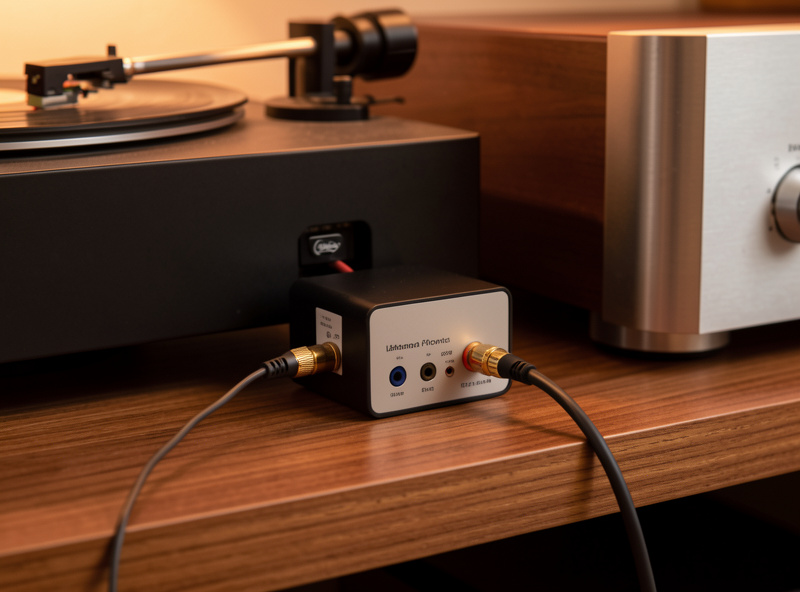
Do You Already Have a Phono Stage?
Before you buy anything, find out what you already own, because half the people who ask me about phono stages already have two. Many integrated amps and AV receivers have a “PHONO” input. Most modern turntables, including the Pro-Ject and Audio-Technica decks I keep around, ship with a switchable built-in phono stage you can turn off. Powered speakers aimed at vinyl often include one too.
The rule I follow: you only need one phono stage in the chain, and stacking two is the single most common beginner mistake I troubleshoot. If your turntable has a PHONO/LINE switch and your amp has a phono input, pick one and disable the other. I cover the trade-offs in full in built-in vs external phono stage, but the short version is that a built-in stage is fine to start and an external box is the first real upgrade most people should make.
MM vs MC: Your Cartridge Decides the Phono Stage
The biggest fork in the road is whether your cartridge is moving-magnet (MM) or moving-coil (MC), because the two need completely different amplification. A moving-magnet cart, like the Audio-Technica VM95 family or an Ortofon 2M, outputs a healthy 3 to 5 mV and wants 47 kΩ loading and around 40 dB of gain. A low-output moving-coil cart might put out 0.3 to 0.5 mV, needs 60 to 65 dB of gain, and wants a much lower load, often somewhere between 100 and 1,000 ohms.
That gap is enormous. Feed an MC cartridge into an MM-only stage and you get a faint, hissy signal you have to crank. Feed an MM cart into an MC stage and you overload it into distortion. A good adjustable phono stage handles both with a switch, which is why my reference stage has selectable gain and loading. The full breakdown lives in MM vs MC phono stage comparison, and if you are still choosing the cartridge itself, start with the best phono cartridges of 2026.
Gain and Loading: The Two Dials That Matter
If a phono stage gives you adjustments, gain and loading are the two that change what you hear. Gain sets how loud the output is and must match your cartridge output; too little and you ride the volume knob, too much and you clip the input. Loading is the electrical resistance (and, for MM, capacitance) the cartridge sees, and it shapes the high frequencies.
For moving-magnet carts the resistive load is standardized at 47 kΩ, so the dial that matters is capacitance: keep total loading capacitance, cable plus stage, in the 100 to 200 pF range for most modern MM carts or the treble goes peaky. For moving-coil, resistive loading is the lever, and I set it by ear against the cartridge maker’s recommended range. I lay out every setting with example values in the phono stage loading and gain guide, and there is deeper cartridge-side detail in cartridge loading explained.
Internal vs External Phono Stages
A built-in phono stage shares a crowded box with a power supply, a tuner, or a Bluetooth board, and that proximity is the problem: noise. An external stage gets its own enclosure, often its own clean power supply, and physical distance from interference. On the same Rega P3 with an Ortofon 2M Blue, swapping from a receiver’s phono input to a dedicated outboard stage is the most consistent “the noise floor dropped and detail came up” change I can demonstrate to a skeptic.
That said, built-in stages have improved a lot, and a good one beats a bad external box every time. The honest answer is that the built-in stage on a decent deck will get you listening tonight, and a $150 to $300 external stage is the upgrade that usually delivers the clearest jump for the money. I weigh both sides in built-in vs external phono stage.
What Budget Phono Stages Actually Buy You
You do not need to spend a fortune. A well-designed $100 to $200 external phono stage delivers a quiet, accurate, correctly-equalized signal, which is most of the job. The expensive stages buy you a lower noise floor, switchable MC support, more loading options, and better parts, with diminishing returns that get steep fast. My budget solid-state stage holds its own against boxes costing several times more on a moving-magnet cartridge.
Where extra money is genuinely worth it: if you run a low-output MC cartridge, you need the gain and loading flexibility that cheap MM-only boxes do not have. If you are buying your first external stage on a moving-magnet setup, spend modestly. I keep a current shortlist in best budget phono stages 2026. You can also browse current phono preamps on Amazon to see the field. As an Amazon Associate I earn from qualifying purchases.
The Upgrade Path: Spend It in the Right Order
Most beginners upgrade in exactly the wrong order, chasing a flashier table first. The order I actually recommend, and the one that buys the most audible improvement per dollar, is: clean your records, then dial your setup (tracking force, anti-skate, alignment), then upgrade the phono stage, then the cartridge, and only then the table. The first three cost little and fix the most.
The phono stage sits high on that list because it is cheap relative to its effect and because a clean, correctly-loaded signal is the foundation everything else rides on. There is no point fitting a $400 cartridge if it feeds a noisy built-in stage with the wrong loading. I lay out the whole sequence, with what each step costs and returns, in the phono stage upgrade path guide, and there is a broader turntable upgrade guide if you want the full picture beyond the phono chain.
Phono Stage Tiers Compared
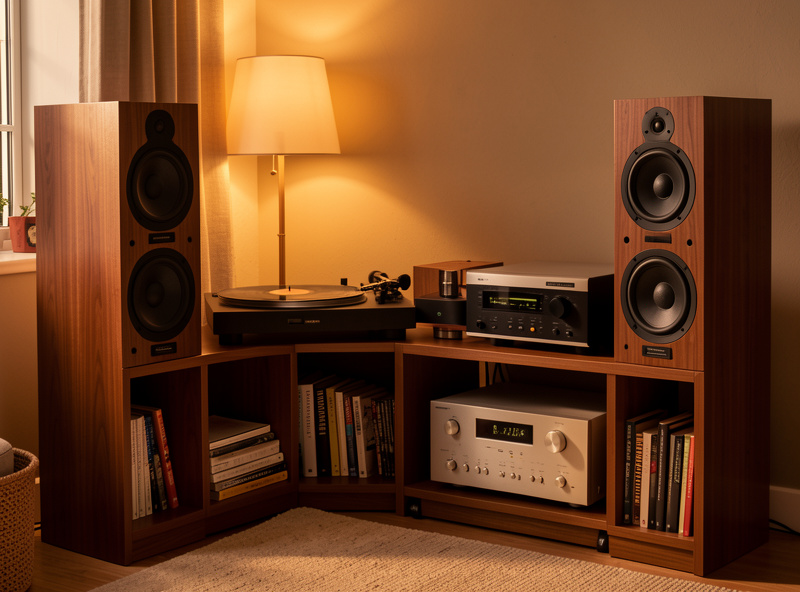
Here is how I think about the tiers, from the stage already inside your gear up to a dedicated tube box. Use it to find where you are and what the next step actually changes.
| Tier | Typical price | Gain | Loading | MM / MC | Best for |
|---|---|---|---|---|---|
| Built-in (amp or deck) | Included | Fixed ~40 dB | Fixed 47 kΩ | MM only | Getting started tonight |
| Budget external | $100–$200 | Fixed ~40 dB | Fixed 47 kΩ | MM (some MC) | First real upgrade, MM carts |
| Adjustable mid | $250–$600 | Switchable 40–65 dB | Selectable 100 Ω–47 kΩ | MM and MC | MC carts, tuning by ear |
| Tube / reference | $600–$2,000+ | Switchable, high | Fully selectable | MM and MC | Character and last-degree detail |
Common Phono Stage Problems
Three issues account for nearly every phono stage complaint I diagnose. The first is hum: a low, steady buzz almost always traced to the turntable ground wire not connected to the phono stage’s ground post, or to a ground loop. Connect the ground wire first, every time. The second is the thin, quiet sound of no RIAA: a turntable plugged into a line input instead of a phono input, or two phono stages cancelling each other when both are switched on.
The third is gain or loading mismatch: an MC cartridge in an MM stage sounds faint and hissy, while wrong capacitance on an MM cart makes the treble shouty. Work through ground, then input type, then gain, then loading, in that order, and you will solve the overwhelming majority of phono problems without buying anything. If hum persists after the ground wire, check that your interconnects are not running alongside a power cable, which is a fix I have made on more than one wobbly setup.
Tube vs Solid-State Phono Stages
Most phono stages are solid-state, and for good reason: they are quiet, accurate, reliable, and cheap to build well. A clean solid-state stage gives you a low noise floor and a neutral, honest presentation, which is what I want from the foundation of a system. The vast majority of people are best served by a good solid-state box and should not think twice about it.
Tube phono stages are a different proposition. A well-designed tube stage can add a touch of even-order harmonic richness, the quality people loosely call warmth, and on the right system it can be genuinely lovely. But tubes add noise, run hotter, need replacing, and cost more for the same measured performance. I run a tube stage specifically for that character on certain records, not because it is more accurate. If you are curious about why tube circuits sound the way they do, I dug into the mechanism in tube amps and even-order distortion. The high-end side prefers exotic tube and transformer-coupled designs for low-output MC carts; that is a real and worthwhile world, but it is well past where most listeners get the best return, and I treat those claims as the high-end community’s territory rather than something I push on a first build.
How to Set Up a New Phono Stage
Installing a phono stage is genuinely simple, and the order matters more than people expect. Connect your turntable’s RCA cables to the phono stage input. Connect the turntable’s thin ground wire to the ground post on the phono stage, then run the phono stage’s own ground to your amp if hum persists. Connect the phono stage output to a LINE input on your amp, never the phono input, because routing a phono output into a phono input doubles the RIAA curve and the gain and gives you unlistenable, distorted bass.
Then set the cartridge type. If your stage has an MM/MC switch, match it to your cartridge. Set gain to match output, and loading to the cartridge maker’s spec. Power everything on with the amp volume down, because a misconfigured stage can pop. I always start with the volume low and bring it up while listening for hum and for the correct tonal balance. Once it sounds right, the only thing left is the listening, and the rest of your tracking force and anti-skate setup and cartridge alignment matter just as much as the box itself.
How I A/B Test a Phono Stage
When I compare phono stages I keep everything else identical: same cartridge, same record, same volume matched by ear or meter, and I switch quickly. Slow swapping lets your memory invent differences that are not there, so I make the switch take seconds, not minutes. I listen for three things in order: noise floor (turn the volume up on a silent groove and listen for hiss and hum), then bass control and weight, then the top end for whether cymbals and sibilance are clean or peaky, which usually points back to loading.
What I have learned doing this across budget solid-state, my switchable step-up, and the tube stage is that the biggest differences are almost always noise floor and loading, not some mystical “musicality.” A stage that is quiet and correctly loaded for your cartridge will beat a more expensive stage set up wrong. That is the whole argument of this site in one sentence: setup and matching beat spending. If you want the spending sequence spelled out, the upgrade path guide ranks every move by return, and the broader record player guide puts the phono stage in the context of the whole deck.
Cables, Capacitance, and Grounding
The cable between your turntable and a moving-magnet phono stage is part of the circuit, not just a wire. Tonearm cable plus interconnect adds capacitance, and that capacitance combines with the cartridge’s inductance to shape the treble. Most MM cartridges want to see 100 to 200 picofarads of total loading capacitance, and a long, high-capacitance cable can push you well past that and make the highs sharp. If your treble sounds hot and you have already checked anti-skate and cleanliness, suspect cable capacitance before you blame the cartridge.
Grounding is the other cable issue people underestimate. A turntable needs a solid ground path to the phono stage or you get hum, and a system with two ground paths can create a loop that hums just as badly. The fix is methodical: one good ground wire from turntable to phono stage, and if a loop persists, lift or reroute rather than adding more grounds. None of this is expensive, which is exactly why it sits above buying a new table on my upgrade list.
Frequently Asked Questions
Do I need a phono stage if my amp has a phono input?
No. A phono input on your amp already contains a phono stage, so you do not need a separate box. You only ever need one phono stage in the chain. If your turntable also has a built-in stage, switch one of them off so they do not stack.
What is the difference between a phono stage and a phono preamp?
Nothing. Phono stage, phono preamp, and phono preamplifier are three names for the same device. It boosts the cartridge signal to line level and applies the inverse RIAA equalization curve so records play back at the correct tonal balance.
How much should I spend on a phono stage?
For a moving-magnet cartridge, a $100 to $200 external stage gets you most of the way. Spend more only if you run a low-output moving-coil cartridge that needs 60 plus dB of gain and adjustable loading, or if you want tube character.
Why does my turntable hum through the phono stage?
The most common cause is the turntable ground wire not connected to the phono stage ground post. Connect it first. If hum remains, you likely have a ground loop or interconnects running alongside a power cable; reroute the cables and try a different outlet.
Can one phono stage work with both MM and MC cartridges?
Only if it has switchable gain and loading. Moving-magnet needs about 40 dB and 47 kilohm loading; moving-coil needs 60 to 65 dB and a much lower load. An adjustable stage handles both via a switch, while a fixed MM-only box cannot properly drive an MC cartridge.
Is an external phono stage really better than a built-in one?
Usually, but not always. An external stage gets its own enclosure, clean power, and distance from internal noise, which lowers the noise floor. A good built-in stage still beats a poor external one, so the gain depends on the specific boxes, not the category alone.