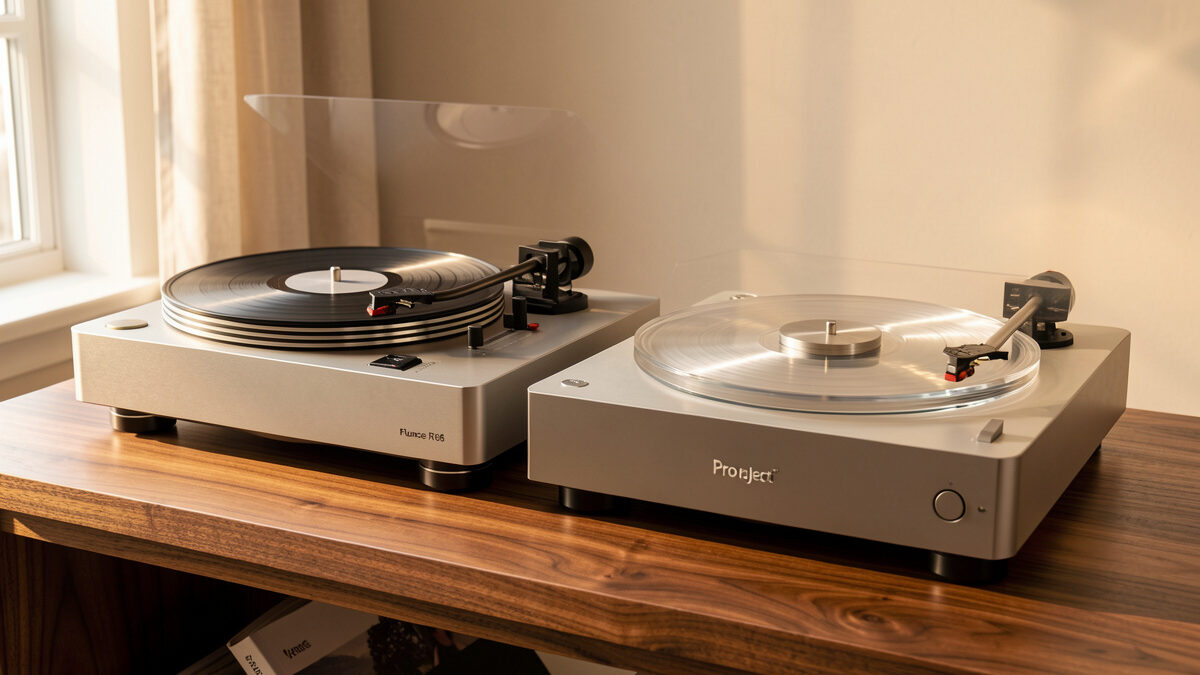
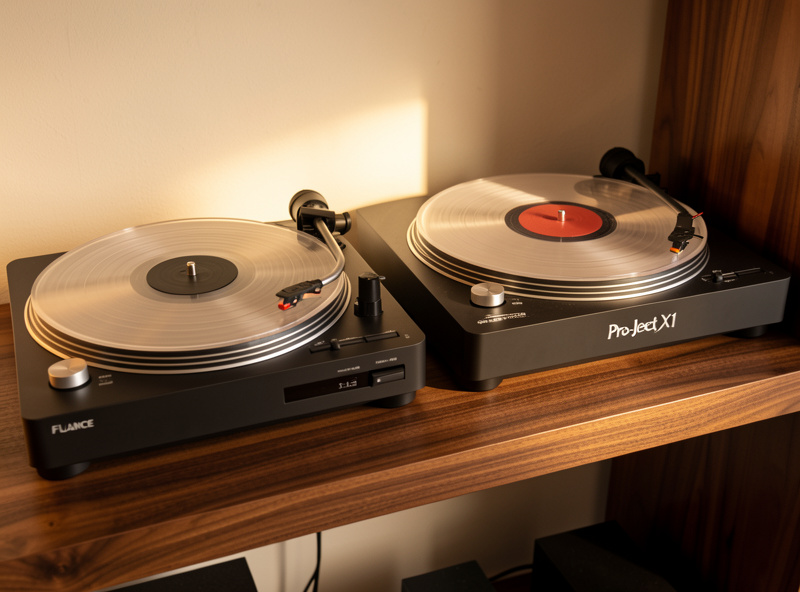
The Fluance RT85 and the Pro-Ject X1 both hang an acrylic platter over a belt-driven motor, but they answer different questions. The RT85 stacks an acrylic platter and a $200-class Ortofon 2M Blue into a ~$500 box. The X1 asks ~$799 and spends the difference on an adjustable carbon arm and Pro-Ject’s upgrade ecosystem. This is hardware-per-dollar versus a platform you can grow.
I’ve aligned both, and the RT85’s value is genuinely hard to argue with on a parts-cost basis — an acrylic platter alone runs real money as an aftermarket upgrade, and the 2M Blue is a cartridge people happily buy separately. So why would anyone pay $300 more for the X1? Because the X1’s arm adjusts where the RT85’s mostly doesn’t, and because Pro-Ject sells a ladder you can climb without changing decks. Which of those matters to you is the whole decision, and it comes down to one question: are you a set-it-and-enjoy-it listener or a serial upgrader?

What Do You Actually Get for the Price Difference?
For the extra ~$300, the X1 buys an adjustable carbon-fiber tonearm, electronic speed change, and Pro-Ject’s upgrade path — but no built-in preamp. The RT85 answers with an acrylic platter, an Ortofon 2M Blue cartridge, isolation feet, and a switchable built-in phono stage, all for around $500. You’re comparing bundled hardware against adjustability.
Fluance’s whole pitch is components. The Fluance RT85 gives you an acrylic platter (which stores less energy and rings less than the aluminum on cheaper decks), a factory-mounted Ortofon 2M Blue with its nude elliptical stylus, an adjustable counterweight and anti-skate, isolation feet, and a built-in preamp you can switch out of the signal path when you get a better one. On a parts basis, that’s a lot of turntable for the money. It’s the same value case I make for the RT85 in the best turntable around $500 shortlist, where it’s the pick for most buyers.
The X1’s answer isn’t parts — it’s engineering and flexibility. The Pro-Ject X1 uses a single-piece carbon/aluminum tonearm with proper VTA and azimuth adjustment, an acrylic platter of its own, a heavier sub-platter and belt system, and electronic speed switching between 33 and 45. It ships without a phono stage because Pro-Ject assumes you’ll supply a good one — which is philosophically consistent with everything else they build. The X1 is a deck you buy expecting to modify.
Fluance RT85 vs Pro-Ject X1: Spec Comparison
Every row is something I check on the bench. Prices are 2026 street figures and move around.
| Feature | Fluance RT85 | Pro-Ject X1 |
|---|---|---|
| Street price | ~$500 | ~$799 |
| Platter | Acrylic | Acrylic |
| Cartridge | Ortofon 2M Blue | Pick-it / Sumiko MM |
| Tonearm | Aluminum S-type | Carbon/alu, adjustable |
| VTA / azimuth | Limited | Yes / Yes |
| Built-in preamp | Yes, switchable | No |
| Speed change | Electronic | Electronic |
The table makes the split clear: the RT85 wins the “what’s in the box” rows — better bundled cartridge, built-in preamp — while the X1 wins the “what can you change” rows with its adjustable arm. Both run acrylic platters and electronic speed, so those cancel. The real question the table can’t answer is how much you value adjustability, and that’s a temperament question, not a spec.
Is the Ortofon 2M Blue on the RT85 a Big Deal?
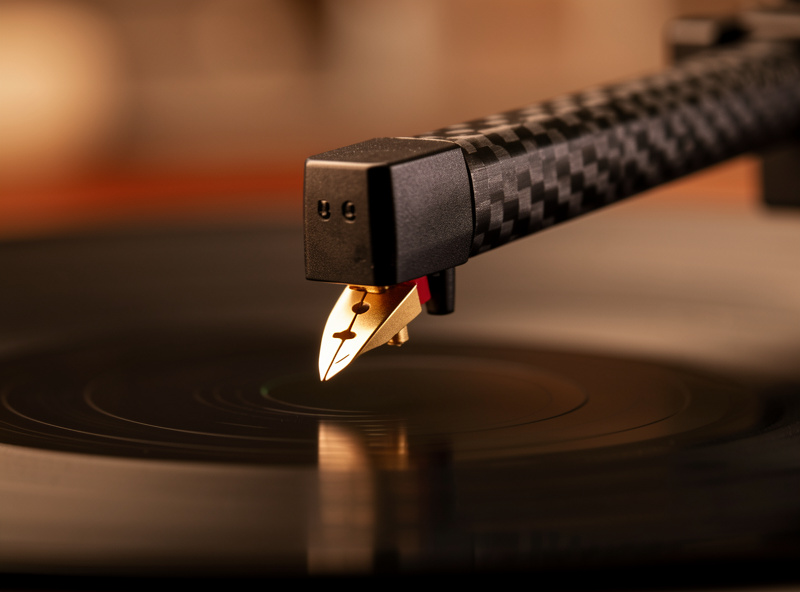
Yes — it’s the RT85’s trump card. The 2M Blue uses a nude elliptical stylus that tracks the groove more precisely than the bonded ellipticals on cheaper decks, pulling more detail out of inner grooves where lesser styli smear. As a separate purchase it costs roughly what people expect to spend on a cartridge upgrade. Fluance bundles it.
On my bench the 2M Blue is the cartridge I’d point a beginner toward anyway, so getting it pre-mounted on a $500 deck is a real head start. Its stylus profile resolves inner-groove passages — massed strings, a busy fade near the label — with noticeably less grit than the conical and bonded-elliptical tips you find at lower prices. And because it’s an Ortofon 2M, the upgrade path is elegant: you can later swap the stylus assembly up to a 2M Bronze without replacing the whole cartridge body. The X1’s bundled cartridge is competent but a step behind the 2M Blue in stylus profile, so out of the box the RT85 often sounds more resolved despite costing less. That said, cartridges wear — when yours does, my guide to stylus and cartridge wear covers when to retip versus replace. Ortofon’s own line documentation on Ortofon is the reference I check for stylus compatibility before recommending any swap.
Does the X1’s Adjustable Arm Justify the Extra Money?
It depends entirely on whether you’ll use it. The X1’s carbon arm lets you set VTA and azimuth precisely, which matters the moment you fit a cartridge that isn’t the exact height the deck assumes. If you’ll never change cartridges, that adjustability is money spent on a feature you won’t touch — and the RT85 is the better buy.
Here’s where I’ve watched buyers overpay. Someone gets talked into the X1 “because it’s more upgradeable,” mounts the factory cartridge, and never once touches the VTA tower. For that person the RT85 would have delivered more sound for less money. But flip it around: someone who’s already planning to run a moving-coil or a tall MicroLine cartridge genuinely needs the X1’s adjustable arm, because setting VTA and azimuth on a mismatched cartridge is the difference between clean tracking and a subtle smear. I set azimuth by reflection and confirm by crosstalk, and you simply can’t do that on an arm that won’t adjust. The X1 hands you the tools; the RT85 assumes you won’t need them. If an adjustable arm is what you’re really after, the step below this pair — Pro-Ject Debut Carbon vs EVO — shows where Pro-Ject’s adjustability starts at a lower price. Both benefit from getting the basics right first — tracking force before anything else.
Do You Need the Built-In Preamp?
The RT85 includes a switchable built-in phono stage; the X1 doesn’t. If you’re plugging into powered speakers or an amp without a phono input, the RT85 works out of the box while the X1 needs a separate preamp — an added cost that narrows the price gap. If you already own a good external phono stage, the X1’s omission doesn’t matter.
This is the sneaky part of the comparison. On paper the X1 costs $300 more; in practice, if you don’t own a phono stage, you’ll spend another $150–$300 on one to use the X1 at all, while the RT85 plays immediately. The RT85’s built-in preamp is decent, and crucially it’s switchable — when you buy a better outboard stage, you flip a switch and bypass the internal one. That’s the right way to build a starter deck. That said, past a certain quality point the phono stage matters more than the table, so anyone serious will eventually run an external stage on either deck. I lay out gain, loading, and where to spend in the phono stage guide.
How Do They Compare on Build, Speed, and Noise?
Both are solid, quiet decks with acrylic platters and electronic speed control, so wow and flutter on either sits below the level a human ear hears as pitch wobble. The differences are in feel: the X1’s carbon arm and heavier sub-platter feel more refined, while the RT85’s metal S-arm and isolation feet punch above its price. Neither has a speed-stability problem.
On my bench the acrylic platters on both do their job — acrylic damps the ringing that an undamped aluminum platter stores, which you hear as a slightly blacker background between notes. The X1 feels the more precisely built of the two when you handle the arm; there’s less play, and the bearing action is smoother. But the RT85’s factory isolation feet are genuinely effective, and that matters more than platter refinement if your shelf isn’t ideal. That’s the recurring truth across every deck I test: placement swamps small build differences. Mount either one on a springy shelf near the speakers and footfalls and bass will inject more rumble than any spec-sheet gap between them — the fix is a solid surface and good feet, which I cover in the turntable isolation guide. And whatever you spin, clean it first; most of the “noise” people blame on a deck is dust in the groove, which my guide to cleaning used records tackles head-on.
Which Belt Table Wins?
For most buyers, the Fluance RT85 wins on value — the acrylic platter, the 2M Blue, and the built-in preamp deliver more finished sound per dollar. The Pro-Ject X1 wins for the tinkerer who wants an adjustable arm and an upgrade path and already owns a phono stage. Neither is a bad deck; they reward different owners.
If you’d told me your budget was $500 and you “just want it to sound great,” I’d hand you the RT85 without hesitation — it’s the most resolved sound you can buy at that price with the least fuss. If you’d told me you’re already reading about MicroLine styli and cartridge loading, I’d point you at the X1 and its adjustable arm. Both belong in the wider modern belt-drive picture I map in the Rega vs Pro-Ject vs Fluance showdown, and if you’re cross-shopping the entry tier, the Rega Planar 1 vs Pro-Ject Debut matchup covers the step below these two.
As an Amazon Associate I earn from qualifying purchases.
Shop them here: Fluance RT85 and Pro-Ject X1. If you go X1, budget for a phono stage; if you go RT85, a record brush and a stylus gauge finish the kit.
Is the Fluance RT85 or Pro-Ject X1 better value?
The RT85 is better value for most buyers. For around 500 dollars it includes an acrylic platter, an Ortofon 2M Blue cartridge, and a switchable built-in preamp. The X1 costs about 300 dollars more and needs a separate phono stage, though it adds an adjustable carbon tonearm and an upgrade path.
Does the Pro-Ject X1 come with a phono preamp?
No. The Pro-Ject X1 has no built-in preamp, so you need an amp with a phono input or a separate phono stage to use it. The Fluance RT85 includes a switchable built-in preamp, so it plays into powered speakers or a line input out of the box.
Is the Ortofon 2M Blue a good cartridge?
Yes. The 2M Blue uses a nude elliptical stylus that tracks inner grooves more cleanly than the bonded styli on cheaper decks, and it upgrades neatly to a 2M Bronze stylus later. Getting it pre-mounted on the RT85 is a genuine value advantage.
Who should buy the Pro-Ject X1 over the RT85?
Buyers who want to adjust VTA and azimuth, plan to run higher-end or moving-coil cartridges, and already own a phono stage. The X1’s adjustable carbon arm and upgrade ecosystem reward tinkerers. Set-and-forget listeners get more finished sound per dollar from the RT85.
Related Articles
- Rega vs Pro-Ject vs Fluance: A Setup Tech’s Belt-Drive Showdown
- Rega Planar 1 vs Pro-Ject Debut: The Real Differences
- Best Turntable Around $500: A Setup Tech’s Shortlist
- Phono Stage Guide: Gain, Loading, MM/MC, and Where to Spend
- Stylus and Cartridge Wear: Retip, Rebuild, and Replace