Speakers are where every choice you made upstream — the deck, the cartridge, the phono stage — finally turns into air you can hear, and at the hobbyist tier they move your sound more than a turntable upgrade ever will. For a vinyl-first room, prioritize a speaker that is easy to drive (87 dB sensitivity or higher), placed off the walls, over chasing exotic drivers.
I run a Technics SL-1200-class direct drive next to a rebuilt Rega P3 and a Pro-Ject belt deck, and I have fed all of them into the same pair of speakers to hear what each source actually does. The speaker is the component that exposes that work — or buries it. This guide is the setup-tech version of speaker selection for vinyl: what sensitivity and impedance mean for your amp, where bookshelf and floorstander each earn their keep, how placement and isolation change the result more than the price tag, and where the money is best spent. Every section links to a deeper guide on its specific question.
Why Speakers Matter More Than the Turntable
Past a certain entry price, the speaker is the single biggest lever on what you hear — a good pair will reveal a cartridge alignment error or a noisy phono stage, and a mediocre pair will hide your best gear. Doubling your turntable budget rarely changes the sound as much as moving from a generic bookshelf to a properly chosen, properly placed pair.
This runs against the upgrade order most beginners follow. The instinct is to buy a nicer deck first because the deck is the visible, spinning, romantic object. But the table’s job is narrow: spin at a stable speed with low rumble and let the arm track the groove. Once a deck does that competently — and most modern decks from the established makers do — the limiting factor in your chain shifts downstream. The speaker is where the largest, most audible differences live, because it is the only component that has to physically push air and interact with the acoustics of your room. My standing order of spend for a vinyl rig is cleaning and setup first, then the phono stage, then cartridge, then speakers, then the table last — and within “speakers,” half the result is the speaker and half is where you put it.
Bookshelf or Floorstander for a Vinyl Room
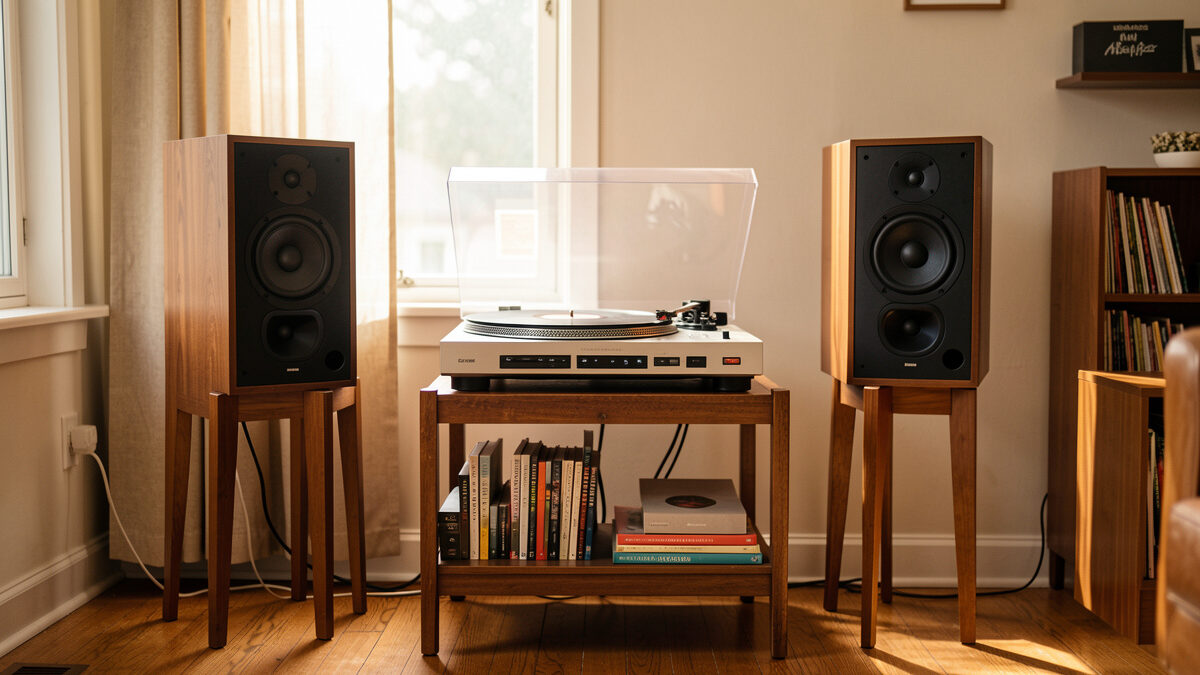
For most vinyl rooms under about 20 square meters, a quality bookshelf speaker on solid stands is the smarter buy — it gives you cleaner imaging, an easier placement job, and more budget left for the stands and the phono stage. Floorstanders earn their keep in larger rooms or when you genuinely listen loud and want low bass without a subwoofer.
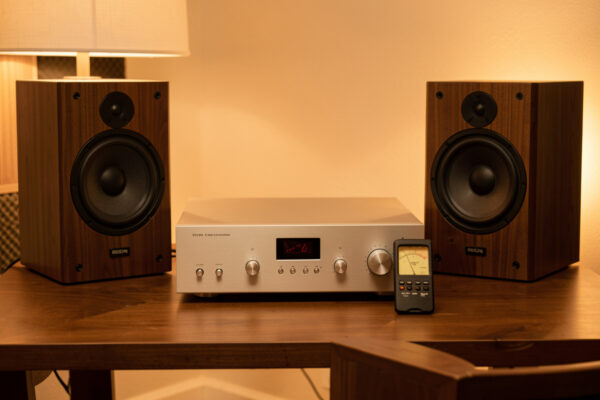
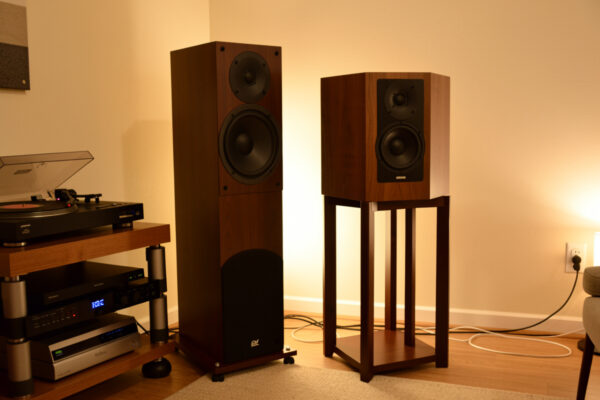
The bookshelf-versus-floorstander argument gets fought like it has a universal answer. It doesn’t. A bookshelf speaker is a two-way (sometimes three-way) cabinet small enough to sit on a stand; a floorstander is a taller cabinet with more drivers and internal volume that reaches lower in the bass. The floorstander’s advantage is real low-end extension and the ability to fill a big room. The bookshelf’s advantages are tighter imaging, lower cost for the same driver quality, and forgiveness about placement — and on stands, it puts the tweeter at ear height where it belongs. For vinyl specifically, where surface noise and inner-groove distortion are already part of the signal, I lean toward the controlled, well-imaged presentation of a good bookshelf. My full breakdown of the tradeoff lives in floorstanding vs bookshelf speakers for a vinyl room, and if you have settled on bookshelves, the best bookshelf speakers for vinyl shortlist is the next stop.
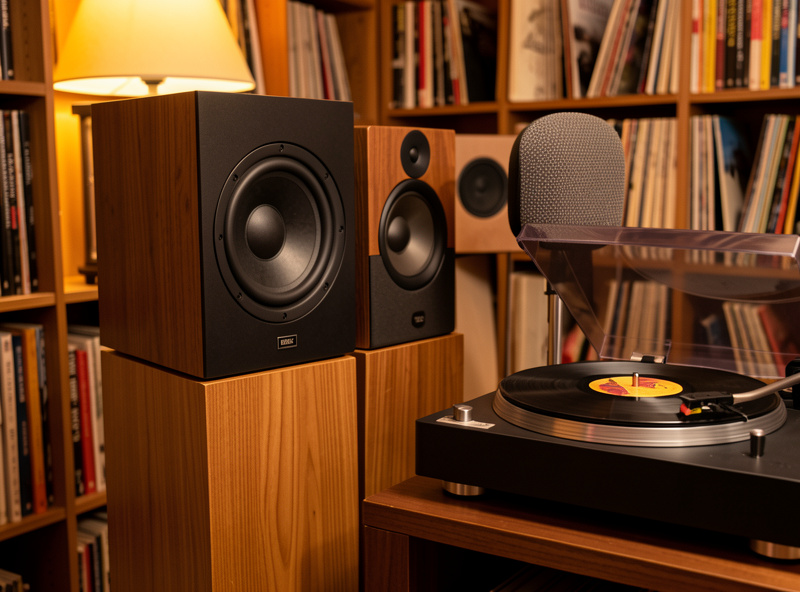
Sensitivity and Impedance: Matching Speakers to Your Amp
Sensitivity tells you how loud a speaker plays per watt — measured in dB at 1 watt and 1 meter — and it is the spec that decides whether your amplifier has enough headroom. An 84 dB speaker needs roughly four times the power of a 90 dB speaker to hit the same volume, which is why a sensitive speaker can sound effortless on a modest amp while an inefficient one strains it.
Two numbers matter when matching: sensitivity (dB/W/m) and nominal impedance (ohms). For a typical vinyl rig running an integrated amp or a tube amp, sensitivity is the one I check first. Below about 86 dB, you want real watts behind the speaker; 88 dB and up plays comfortably on lower-power amps, including most tube integrateds, which is why high-sensitivity designs pair so naturally with the tube-amp-for-vinyl approach. Impedance is the second check — a nominal 8-ohm load is the safe default, while 4-ohm speakers demand an amp that is happy driving lower impedances. Get this pairing wrong and you get clipping, thin dynamics, or in the worst case a stressed amplifier. I walk the whole matching exercise — including how to read a manufacturer’s sensitivity claim honestly — in speaker sensitivity and amplifier matching.
Placement: The Free Upgrade Most People Skip
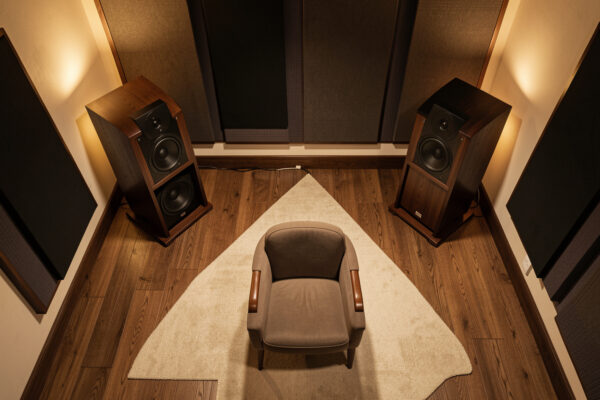
Speaker placement changes your sound more than a several-hundred-dollar component swap, and it costs nothing. Pulling speakers 30 to 90 cm off the front wall, toeing them in toward the listening seat, and forming a rough equilateral triangle with your chair will tighten bass and sharpen the stereo image immediately.
This is the upgrade nobody charges you for and almost nobody fully uses. A speaker shoved against the wall gets a bass boost from boundary reinforcement, but it is bloated, smeared bass — and the soundstage collapses flat. Moving the cabinet out, setting tweeter height to ear level on proper stands, and adjusting toe-in by ear is the single highest-value hour you will spend on your system. The other half of placement for vinyl is mechanical: speakers pump acoustic energy into the floor and walls, and that energy can find its way back into the stylus as feedback, especially with floorstanders or a suspended floor. That is why placement and turntable isolation are the same conversation in a vinyl room. The complete method — distances, toe-in, height, and keeping the speakers from feeding the deck — is in speaker placement for vinyl listening.
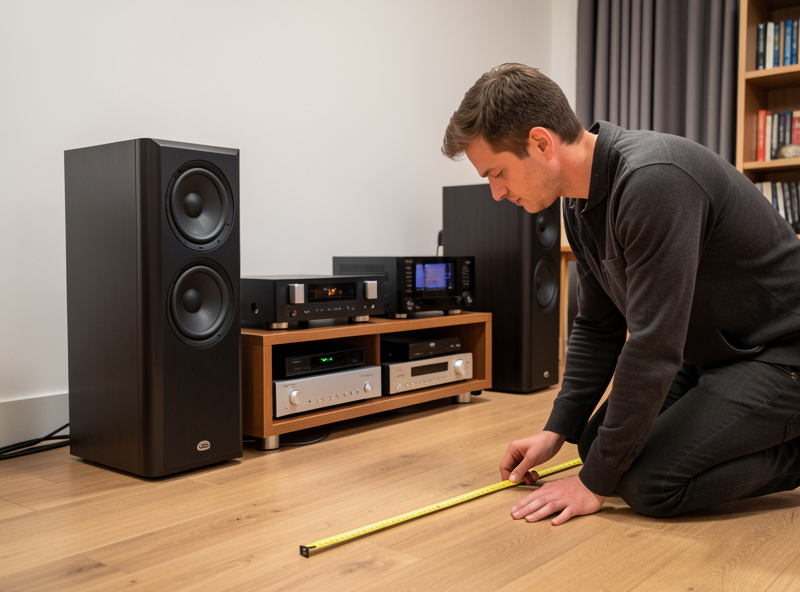
Vintage or Modern Speakers for Vinyl
Vintage speakers from the 1970s and 80s can be a genuine bargain and pair beautifully with records, but only after you account for aged crossover capacitors, perished surrounds, and the cost of refoaming or recapping. A clean modern bookshelf is the lower-risk path; a serviced vintage three-way can deliver more speaker for the money if you go in eyes open.
There is a romance around vintage speakers and vinyl that is half true. The good part: a well-built vintage three-way often used real wood cabinets, large drivers, and high sensitivity that suits low-power amps and the analog source. The catch is age. Electrolytic capacitors in the crossover drift out of spec, foam surrounds rot, and a “working” pair from a listing photo may be quietly broken in ways that flatten the sound. Modern speakers benefit from better measurement, tighter quality control, and warranties. I treat this as a risk-and-effort question rather than a sound-quality verdict, and I lay out exactly what to inspect and what a refurb costs in vintage vs modern speakers for vinyl.
Passive Speakers and Amp, or Powered Speakers?
A turntable cannot drive passive speakers directly — it needs a phono stage to boost and apply RIAA equalization to the signal, then an amplifier to power the speakers. Powered (active) speakers fold the amplifier inside the cabinet, and many now include a built-in phono stage, which makes them the simplest complete answer for a small vinyl setup.
This is the architecture decision that trips up newcomers. Passive speakers (the bookshelf and floorstanders above) need a separate amp; the upside is total flexibility to mix and match and upgrade each box. Powered speakers put the amp — and often a phono stage and Bluetooth — inside, so a turntable can connect almost directly. For a desk or a small room, powered speakers are clean and cost-effective; for a real listening room you intend to grow, separates win on flexibility. I compare the two paths in depth in powered speakers vs amp and speakers for turntables, and the signal chain itself — why the phono stage is non-negotiable — is covered in the phono stage guide.
Your Room Is Half the Speaker
The room contributes as much to what you hear as the speaker itself, because every reflection off a bare wall, window, or hard floor arrives at your ears slightly after the direct sound and smears the result. A few soft furnishings — a rug between you and the speakers, curtains, a bookshelf on the rear wall — tame the worst reflections for free.
I learned to stop blaming components for problems the room was causing. A speaker that sounds harsh and fatiguing in a tiled, glass-walled room can sound balanced in a furnished one, and no amount of cabinet swapping fixes a reflective room. The first reflection points — the spots on the side walls where a mirror would show you the tweeter from your seat — are where a panel or even a bookshelf does the most good. A rug on a hard floor kills the floor bounce between you and the speakers. None of this requires a treated studio; it requires noticing that the room is a component you already own. For vinyl, the bonus is that a more absorptive room also lowers the airborne energy that can excite the turntable, which ties directly into airborne versus footfall vibration at the deck.
Do You Need a Subwoofer for Vinyl?
Most vinyl listeners do not need a subwoofer, because the deep bass below about 40 Hz that a sub adds is sparse on records and can excite turntable feedback if handled carelessly. A well-placed pair of bookshelves or floorstanders usually delivers all the low end a record actually contains.
This is where I push back on the more-is-better instinct. Records are cut with bass management of their own — very low, out-of-phase bass is rolled toward mono or trimmed at the cutting lathe to keep the stylus in the groove, so the seismic sub-bass you hear in movies simply is not on most pressings. A subwoofer can help in a large room or with bass-light bookshelves, but it introduces a new risk for a turntable: the sub’s output is exactly the low-frequency energy that finds its way back into the stylus as a feedback rumble. If you add one, place it away from the deck, cross it over low (around 60 to 80 Hz), and keep the turntable on a properly isolated platform. For most rooms I would put the subwoofer money toward better stands and placement first.
How to Read a Speaker Spec Sheet
Two specs decide whether a speaker fits your amp and room: sensitivity in dB and nominal impedance in ohms. Frequency response numbers are nearly useless without the tolerance window, because a speaker quoted at “45 Hz to 20 kHz” tells you nothing until you see the plus-or-minus dB figure attached to it.
Manufacturers play games with sensitivity, quoting a 2.83-volt figure that flatters a 4-ohm speaker, so treat a published number as optimistic by a dB or two. Nominal impedance hides the minimum — a speaker labeled 8 ohms may dip to 3 ohms at some frequencies, which is the load your amp actually has to survive. Frequency response is the spec most abused: “20 Hz to 20 kHz” without a tolerance like plus or minus 3 dB is marketing, not data. The honest reading is to weight sensitivity and impedance for the amp match, look at the bass extension figure with its tolerance for room fit, and ignore the rest. I unpack the full matching math in speaker sensitivity and amplifier matching, which is the spec that trips up the most buyers.
Speaker Types Compared
The quick way to see where each design fits a vinyl room:
| Type | Bass extension | Typical sensitivity | Placement demand | Best for |
|---|---|---|---|---|
| Bookshelf (passive, on stands) | Moderate (needs sub for deep bass) | 84–88 dB | Stands + room to breathe | Small to medium rooms, imaging |
| Floorstander (passive) | Deep, full-range | 87–91 dB | More space off walls | Larger rooms, listening loud |
| Vintage three-way (serviced) | Deep, big drivers | 89–94 dB | Forgiving, high sensitivity | Low-power/tube amps, value |
| Powered/active | Varies by model | N/A (built-in amp) | Plug-and-play, even desktop | Small setups, simplicity |
Where to Spend on a Vinyl Speaker Setup
On a fixed budget, buy quality stands and a modest sensitive speaker before a flashier model that ends up on the floor or against the wall — the stand and the placement realize the speaker. A solid pair of stands plus a well-reviewed budget bookshelf will outperform a pricier speaker set up carelessly.
One place not to spend: exotic speaker cable. Once a cable is of sensible gauge for the run length — 16 AWG for short runs, 14 AWG for longer ones — its contribution to the sound is vanishingly small compared to the speaker, the placement, and the room. The same applies to fancy binding-post jewelry. Money that would go to boutique cable is far better spent on stands, isolation, or simply moving up a speaker tier. I am allergic to audio-religion here: the protractor-and-gauge discipline I apply to turntable setup says spend where it measures, and cable is not where it measures.
The right spending order for the speaker end of a vinyl rig mirrors the order for the whole system: get the fundamentals right before the badge. Stands and isolation come first because they let any speaker image and keep the deck quiet — pair them with the right furniture and rack. Then the speaker itself, chosen for sensitivity and room size. Then, if the bass is genuinely lacking, a subwoofer. The cartridge and phono stage still come before any speaker spend in the global order, because a clean signal is what the speaker has to reveal. If you are starting from zero with a tight budget, the best budget speakers for a turntable guide is built around exactly this priority.
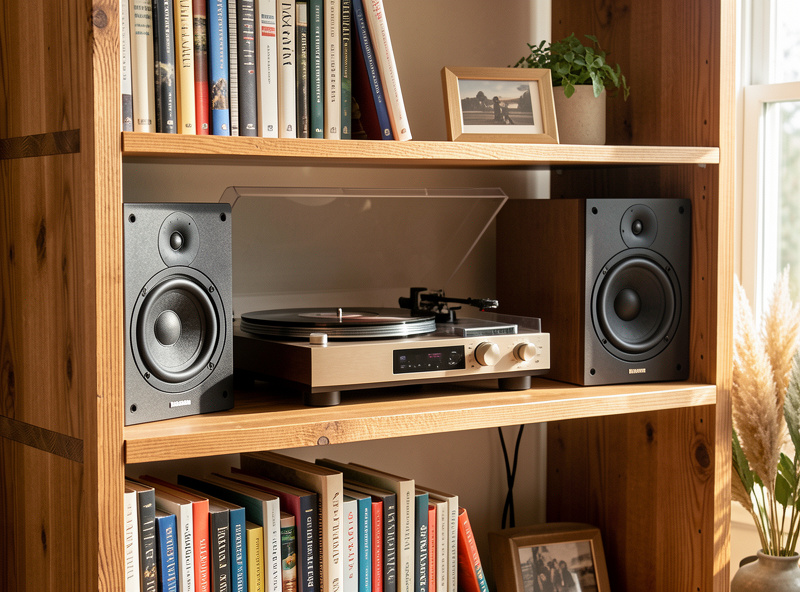
As an Amazon Associate I earn from qualifying purchases. When a speaker for a vinyl room is worth a look, I point to a current bookshelf speakers for turntable search and a set of speaker stands, because the stands matter as much as the box.
Frequently Asked Questions
Do I need special speakers for vinyl?
No. There are no vinyl-specific speakers. Any quality passive or powered speaker works, because the phono stage and amplifier have already turned the cartridge signal into a normal line-level signal before it reaches the speaker. Choose for room size and sensitivity, not for an analog label.
Can I connect a turntable straight to passive speakers?
No. A turntable outputs a tiny phono-level signal that must pass through a phono stage and then an amplifier before it can drive passive speakers. Powered speakers contain the amplifier, and many include a phono stage, so they can connect almost directly.
What speaker sensitivity should I look for?
For a typical vinyl rig, 86 dB or higher keeps things easy on most amplifiers, and 88 dB and up pairs comfortably with low-power tube amps. Below about 84 dB you need a powerful amp with real headroom to avoid strain.
Are bookshelf speakers good enough for vinyl?
Yes. In rooms under about 20 square meters, a quality bookshelf speaker on solid stands often images better than a floorstander and costs less, leaving budget for the phono stage. Add a subwoofer only if you genuinely miss the deep bass.
Do speakers cause turntable feedback?
They can. Speakers pump energy into the floor and walls, and that vibration can return to the stylus as a rumbling feedback loop, worst with floorstanders on a suspended floor. Separating the speakers from the deck and isolating the turntable solves it.
Should I buy speakers or a better turntable first?
Speakers, in most cases. Once a deck spins at a stable speed with low rumble, the speaker and its placement move the sound far more than a pricier table. Spend on cleaning, setup, and the phono stage first, then speakers, then the deck last.
Related Guides
Work through the cluster in the order that matches where you are:
- Best Bookshelf Speakers for Vinyl
- Floorstanding vs Bookshelf Speakers for a Vinyl Room
- Speaker Placement for Vinyl Listening
- Speaker Sensitivity and Amplifier Matching
- Vintage vs Modern Speakers for Vinyl
- Best Budget Speakers for a Turntable
- Powered Speakers vs Amp and Speakers
- Phono Stage Guide: Gain, Loading, and Where to Spend