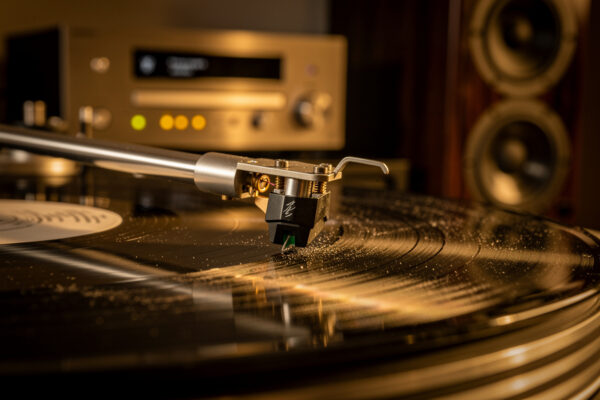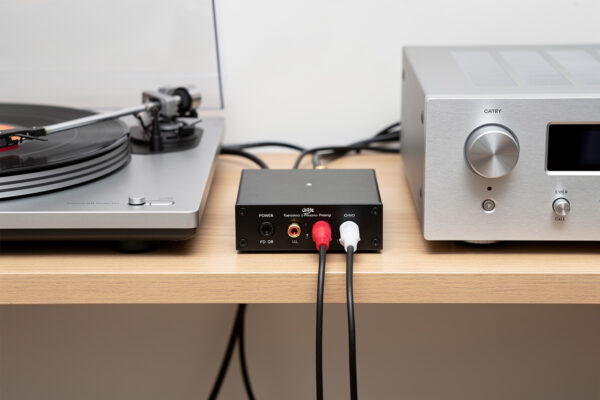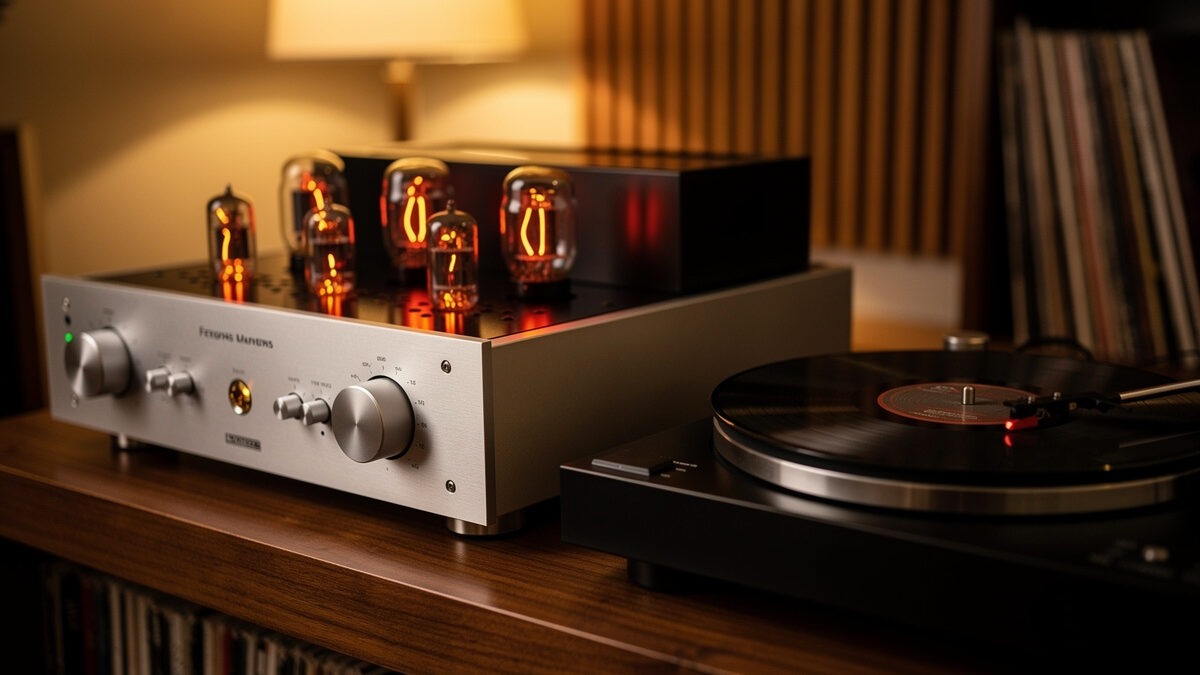
Tube amplifiers sound “warm” because they generate harmonic distortion that’s mostly even-order — primarily second and fourth harmonics, which are exactly one and two octaves above the fundamental note. Even-order distortion sounds musical to human ears because it reinforces the natural overtone series. Solid-state amplifiers generate predominantly odd-order distortion (third, fifth, seventh harmonics), which sit at dissonant intervals from the fundamental and sound harsh at audible levels — even though their overall distortion measurements are typically lower.
This guide walks through the actual physics of why tubes pair so well with vinyl, the four common tube topologies (single-ended triode, push-pull, Class A, Class AB) and what each does to vinyl source material, the tube types that matter (12AX7, 6L6, EL34, KT88, 300B), and how to pick the right tube amp for your turntable, cartridge, and speaker combination.
Why Even-Order Distortion Sounds Warm
Music is built on the harmonic series. A note at 440 Hz (A above middle C) has natural overtones at 880 Hz (octave), 1320 Hz (octave + perfect fifth), 1760 Hz (two octaves), and so on. These are all integer multiples of the fundamental — and second-, fourth-, and sixth-order distortion add energy at exactly these same intervals.
When a tube amplifier adds 1% second-harmonic distortion to a 440 Hz note, it adds a tiny amount of 880 Hz — which the ear perceives as the same note one octave up, reinforcing rather than competing. The result is a fuller, richer, “warmer” sound.
Solid-state amplifiers typically generate less total distortion (often below 0.01% THD) but the distortion they do produce is predominantly third- and fifth-order. Third harmonic of 440 Hz is 1320 Hz — a perfect fifth above the octave, which is consonant. But fifth harmonic is 2200 Hz — a major third above two octaves, which is dissonant. Seventh harmonic is even worse. So a solid-state amp at 0.005% THD can sound less pleasant than a tube amp at 1% THD because the distortion energy lands on dissonant intervals rather than consonant ones.
Why Tubes Pair Especially Well With Vinyl
Three reasons the tube + vinyl combination has stuck around:
- Vinyl already has more harmonic content than digital. Cartridge-cantilever resonance, mechanical compliance, and the RIAA equalization curve all add their own harmonic flavor to the playback signal. Tube amplifiers complement this rather than fighting it; solid-state can sometimes magnify the slightly imperfect signal in a fatiguing way.
- Vinyl’s noise floor and dynamic range are forgiving. Vinyl’s roughly 65-70 dB dynamic range and natural surface noise mean that the higher noise floor of tube amplifiers (typically 80-90 dB SNR) is inaudible. With digital sources approaching 110+ dB SNR, the tube noise floor becomes more noticeable.
- Vinyl listening sessions favor immersion over analysis. Tube amplifiers reward the kind of focused, full-album listening that vinyl encourages. The very slight distortion that adds warmth doesn’t matter for engagement; it matters for the kind of microscopic critical analysis that tubes are not designed for.
The Four Tube Amp Topologies
Single-Ended Triode (SET)
One output tube per channel, run in pure Class A. Lowest power (typically 3-25 W per channel) but highest “tube character” — second-harmonic distortion as the dominant feature. SETs pair only with high-efficiency speakers (94+ dB sensitivity). Loved by vintage-jazz and acoustic listeners. Examples: Decware Zen Triode, Coincident Frankenstein, classic Marantz tube amps.
Push-Pull (PP)
Two output tubes per channel in opposing phase, canceling out even-order distortion. Higher power (20-100 W) but less “tube character” because the canceled even-order distortion was the source of the warmth. Best for higher-volume listening, larger speakers. Examples: Cary Audio CAD-300SEI, Primaluna EVO 100, Mcintosh MC275.
Class A vs Class AB
Class A tube amps run output tubes at full bias all the time — most heat output, lowest distortion, shortest tube life. Class AB amps only fully bias under signal peaks — cooler, longer tube life, slightly more distortion. For vinyl listening at moderate levels, Class A SETs are the gold standard for purists; Class AB push-pull is the sensible default for most listeners.
Output Transformer Quality (the Real Differentiator)
For tube amps, the output transformer matters more than the tubes themselves. Hand-wound transformers from Hashimoto, Tamura, or Lundahl (the audiophile-grade brands) deliver dramatically lower bandwidth limitations than budget transformers. A great $300 tube amp with high-quality transformers outperforms a $3,000 amp with budget transformers on every measurement that matters.
The Five Most Common Tube Types in Audio
| Tube | Type | Typical use | Sound character | Approx tube cost |
|---|---|---|---|---|
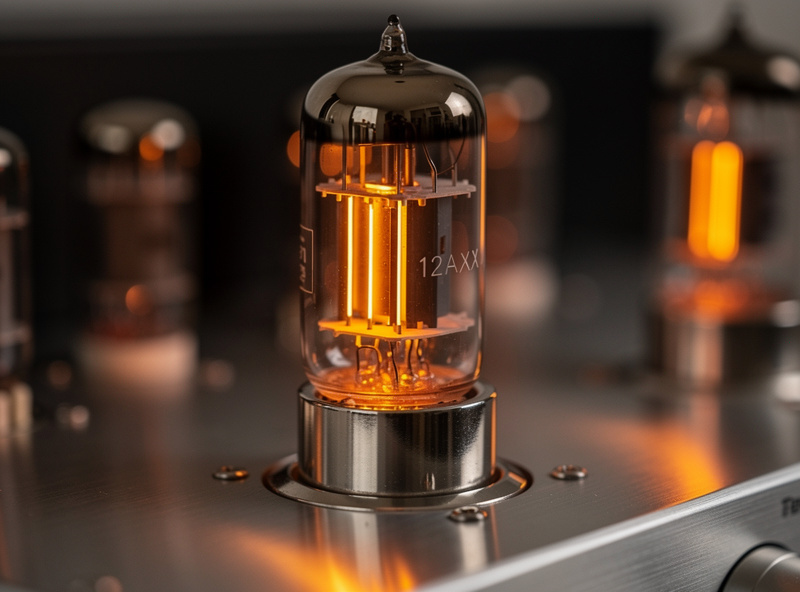
| 12AX7 (ECC83) | Dual triode preamp | Phono stage, line stage, guitar amp | Highest gain preamp tube — adds detectable warmth | $15-50 each (NOS rare $80-200) |
| 12AU7 (ECC82) | Dual triode preamp | Line stage, phase splitter | Lower gain than 12AX7, cleaner | $15-40 each |
| 6L6 / KT66 | Beam tetrode output | Push-pull amps 20-50W | Punchy, dynamic, less “tubey” | $25-70 each |
| EL34 | Pentode output | Push-pull amps 25-80W | Classic British “warm and lush” | $30-90 each |
| KT88 | Beam tetrode output | Push-pull amps 50-100W | Most powerful, cleanest of the popular output tubes | $60-150 each |
| 300B | Triode output | SET amps 3-25W | The “ultimate” tube sound — lush, detailed midrange | $200-1500+ pair |
| 2A3 | Triode output | SET amps 3-15W | Even more delicate than 300B, less power | $150-800 pair |
For broader amplifier-side context — including the full tube vs solid-state debate at the system level — see our partner site’s tube vs solid-state amplifier comparison, which covers the engineering and listening differences across more topologies and price points than fit in a single tube-focused article.
Pairing Tube Amps With Cartridge and Speaker Choice
The tube amp is one of three components in a vinyl signal chain. The other two — cartridge and speakers — determine whether the tube amp can actually deliver its character.
- Moving Magnet (MM) cartridges: Output 3-7 mV, work with virtually any tube phono stage. The default for affordable systems. Most 12AX7-based phono preamps are designed around MM input.
- Moving Coil (MC) cartridges: Output 0.2-0.5 mV, need either a step-up transformer (SUT) or a specialized MC phono stage. SUTs preserve the tube character; active MC stages can defeat it.
- Speaker sensitivity matters more than wattage with tube amps. A 96 dB sensitivity speaker plays at the same volume from a 5W SET as an 88 dB speaker plays from a 50W solid-state. SET amps require 92+ dB speakers; push-pull tube amps work with 88+ dB speakers; nothing tube under 25W works with 84 dB sensitivity speakers in any meaningful way.
The 12AX7 in the Phono Stage Specifically
Most tube-warmed vinyl systems get their tube character primarily from the phono stage rather than the power amplifier. A 12AX7-based phono preamp like the Pro-Ject Tube Box S2, Schiit Mani 2, or Croft Phono Integrated adds the characteristic tube warmth at the front of the signal chain — where it’s most influential — without requiring a tube power amp.
For someone exploring tubes for the first time, this is the lower-risk entry point. A $300-700 tube phono stage in front of a solid-state integrated amp delivers 70% of the tube experience at 20% of the cost and complexity. Our broader phono preamp guide covers the full landscape of phono stage types and what to look for at each price point.
Tube Amp Buying Recommendations for Vinyl Listeners
| Amp | Topology | Power | Best matched cartridge | Best matched speakers | Approx Cost |
|---|---|---|---|---|---|
| Willsenton R8 | Push-pull KT88 | 50W/ch | MM or high-output MC | 87+ dB sensitivity | $1,300 |
| Cayin A-50T MK2 | Push-pull EL34 | 40W/ch | MM | 87+ dB sensitivity | $1,800 |
| Primaluna EVO 200 | Push-pull EL34/KT88 | 44W/ch | MM (built-in stage available) | 87+ dB sensitivity | $3,500 |
| Decware Zen Triode SE34I.5 | SET 6V6/EL34 | 2.3W/ch SET | MM | 94+ dB sensitivity required | $1,990 |
| McIntosh MC275 mk VI | Push-pull KT88 | 75W/ch | MM or MC (with separate stage) | 85+ dB sensitivity | $8,500 |
| Cary Audio CAD-300SEI | SET 300B | 15W/ch | MM | 92+ dB sensitivity required | $8,000 |
| Quicksilver Audio Mini Mono | Push-pull EL84 | 25W mono pair | MM | 89+ dB sensitivity | $2,400 |
What to Buy First if You’re Starting From Solid State
- Step 1: Tube phono stage. Pro-Ject Tube Box S2 ($600) or Croft Phono Integrated ($1,200). Adds the most character for the least money.
- Step 2: Confirm speaker sensitivity. If your speakers are below 88 dB sensitivity, the next upgrade should be speakers (not amp) — tube amps need efficient speakers to shine.
- Step 3: Push-pull integrated tube amp. Willsenton R8 ($1,300) or Cayin A-50T ($1,800) — both have built-in MM phono stages, which lets you skip the separate phono preamp and route everything through tubes.
- Step 4 (optional, years later): SET amplifier. Only after you’ve invested in 92+ dB efficient speakers and committed to the SET listening style. Decware Zen Triode is the budget entry; Cary 300B is the audiophile destination.
For the broader vinyl signal chain decisions — turntable, cartridge, phono stage, and speaker selection — see the turntable buying guide 2026, the best phono cartridges 2026, and the turntable upgrade guide for what to upgrade in what order. The cartridge alignment guide covers the setup work that determines whether your front-end is feeding the tube amp clean signal in the first place.
For deeper background on tube electronics and harmonic distortion analysis, the diyAudio community remains the deepest free resource for tube amplifier design, and the TubeCAD Journal publishes the engineering analysis behind why specific topologies sound the way they do.
Frequently Asked Questions
Why do tube amps sound warm?
Tube amplifiers generate predominantly even-order harmonic distortion (second, fourth, sixth harmonics), which fall on consonant musical intervals (octaves and octaves+fifths) above the original note. This reinforces the natural overtone series and sounds rich and warm. Solid-state amps generate odd-order distortion at dissonant intervals, which sounds harsher even at lower total distortion levels.
Are tube amps actually better for vinyl than solid-state?
Better in the sense of pairing well with vinyl’s existing character — yes, for most listeners. Vinyl already adds harmonic content that tube amps complement rather than fighting. Solid-state amps are technically more accurate but can magnify vinyl’s imperfections in a fatiguing way. The choice is subjective and depends on your speakers and listening preferences.
What is a SET amplifier and do I need one?
Single-Ended Triode amps run a single output tube per channel in pure Class A, producing the most distinct tube character but only 3-25 watts per channel. They require highly efficient speakers (94+ dB sensitivity) to play loud enough. SETs are the audiophile destination for some listeners; for most people a push-pull tube amp delivers a better balance of tube character and practical power.
Should I get a tube phono stage or a tube power amp first?
Tube phono stage. The phono stage is at the front of the signal chain where tube character has the most influence on the final sound, and tube phono stages cost a fraction of tube power amps. A $600 tube phono preamp into a solid-state integrated amp delivers most of the tube experience without the heat, expense, and tube-rolling complexity of a full tube power amp.
How long do tubes last in a tube amplifier?
Output tubes typically last 2,000-5,000 hours in normal use — about 3-7 years for a moderate listener. Preamp tubes (12AX7, 12AU7) last 5,000-10,000 hours. NOS (new old stock) tubes from the 1950s-60s often last decades because they were manufactured with thicker glass and better materials than modern equivalents. Replacement cost ranges from $30 to several hundred per tube depending on type and rarity.
What speaker sensitivity do I need for tube amps?
At least 88 dB sensitivity for push-pull tube amps under 50 watts. SET amps under 25 watts need 92+ dB sensitivity. Floorstanding speakers in the 88-94 dB range work with most tube amps; bookshelf speakers below 86 dB sensitivity should pair with solid-state amps unless you only listen at low volumes.
Can I run a moving coil cartridge into a tube phono stage?
Yes, but you typically need a step-up transformer (SUT) ahead of the tube phono stage to boost the low MC output (0.2-0.5 mV) to a level the MM-input tube stage can handle. SUTs preserve tube character. Some specialized tube phono stages have built-in MC inputs that include the necessary gain — verify the stage you’re considering has explicit MC support.