
Tracking force — the weight a stylus presses into the groove — should sit between 1.5 and 2.0 grams on a proper turntable. Cheap record players apply 4 to 6 grams, and you can’t turn it down. That single fixed number is the real reason suitcase decks wear vinyl, more than the cartridge or the platter, and it’s the one variable the deck makes least fixable.
Of the three things a suitcase player gets wrong — tracking force, stylus material, and tonearm geometry — tracking force is the one I’d put first, because it does the most damage and it’s the one the deck bolts shut. I measure it on every deck that crosses my bench with a digital stylus-force gauge that reads to 0.01g, and the gap between a proper turntable and a Crosley-class player is the first thing that gauge shows you. The Ortofon 2M on my Technics SL-1200 sits at 1.8g; the ceramic cartridge in a typical suitcase sits at 5g, set at the factory and unmoving.
This is the technical companion to the broader question of whether suitcase record players are bad, and to the piece on whether Crosley players ruin records — those cover the what and the how-many-plays. This one is the why: what force actually is, what 5 grams does to a groove that 2 grams doesn’t, why a suitcase arm can’t be adjusted, and how to measure the number yourself on any deck that can. If you read only one section, read the one on what 5 grams actually does — that’s where the wear becomes mechanical rather than theoretical.
What Is Tracking Force, and Why Does the Groove Need It?
Tracking force is the downward pressure the stylus exerts on the record groove, created by a counterweight at the back of the tonearm pulling against a spring or the cartridge’s weight at the front. Its job is simple and non-negotiable: keep the stylus seated in the groove so it can follow the side-to-side and up-and-down modulation cut into the walls. Too little force and the stylus lifts out of the groove on loud passages, mistracking and skipping; too much and it grinds material off the walls faster than the music requires. The correct force is the smallest amount that keeps the stylus reliably seated, and for a magnetic cartridge that’s almost always between 1.5 and 2.0 grams.
The reason that range is so narrow is that the groove is a mechanical signal, not a smooth track. The stylus has to accelerate and decelerate to follow modulation that can represent everything from a quiet brush on a snare to a full orchestra peak, and it does that by flexing a tiny cantilever suspension. The force has to be enough to keep the tip in contact through those accelerations without being so heavy that it can’t move. A magnetic cartridge is built around a compliant suspension that tracks at low force; a ceramic cartridge, the kind in a suitcase player, is built around a stiff element that needs several grams just to generate a signal. The format was designed around the low-force magnetic ideal — the RIAA equalization curve and the groove geometry assume a light, compliant stylus — and the cheap deck’s high force is a workaround for its own cartridge choice, paid for by the record.
The Safe Range: 1.5 to 2.0 Grams, and Where Cheap Players Sit
The safe tracking-force range for the cartridges most hobbyists run is tight and well-documented. The Ortofon 2M family specs 1.8 grams; the Audio-Technica VM95 family lives around 2.0 grams; a moving-coil cartridge might track anywhere from 1.5 to 2.2 grams depending on compliance. These numbers come from the manufacturer’s measured optimum for stylus wear and tracking ability, and they’re the reason I set every cartridge by gauge rather than by the engraved dial. A proper deck lets you dial into that range and stay there; a cheap player ignores the range entirely and parks at the top of a completely different scale.
A Crosley-class player applies roughly 4 to 6 grams, with some samples measuring higher. That’s two to three times the safe ceiling, and it’s not a mistake — it’s the force the ceramic cartridge needs to track at all without an active phono stage amplifying a weak signal. The ceramic element generates its voltage by physically deforming under pressure, so the pressure is part of the design, not an accident. The cost of that design choice is borne entirely by the groove: every play removes more vinyl than a magnetic cartridge would at a fraction of the force, and there is no adjustment on the deck to reduce it. You can read the full method for setting force on a deck that allows it in my tracking force adjustment guide, but the short version is that the safe range exists for a measurable reason, and suitcase players live outside it on purpose.
What 5 Grams Actually Does to a Vinyl Groove
The damage from high tracking force is mechanical and it happens at the contact patch — the tiny area where the stylus tip meets the groove wall. Force divided by contact area is pressure, and at 5 grams on a sapphire tip with a small contact radius, that pressure is high enough to exceed the elastic limit of the vinyl on loud transients. Below the elastic limit, the groove flexes and recovers, and the stylus traces it cleanly. Above it, the groove deforms permanently, and the stylus is no longer reading the original modulation — it’s rewriting it, a fraction of a micron at a time, every time the needle drops.

There are two failure modes that come out of this, and they show up at different timescales. The first is fast: on a single loud passage, a heavy stylus can deform the groove enough that the next play mistracks where the deformation happened, which is part of why records played on cheap decks seem to degrade in specific spots rather than evenly. The second is slow: the steady polishing of the stylus tip against the walls removes high-frequency detail over hundreds of plays, heard as a softening of the top end and a flattening of dynamics. The fast mode is what people notice and blame; the slow mode is what actually accumulates. Both are downstream of the same number — 5 grams instead of 2 — and neither is fixable once the groove material is gone.
Why You Can’t Adjust Tracking Force on a Suitcase Player
The reason a suitcase player can’t be fixed is structural, and it’s worth understanding because well-meaning advice to “just dial down the force” doesn’t apply. A proper tonearm has a counterweight — a threaded or sliding mass at the back of the arm that you rotate or move to balance the cartridge’s weight at the front and then add the desired downward force. A suitcase tonearm has no counterweight, no threaded shaft, and no force dial; the downward pressure comes from a fixed spring or from the arm’s own unbalanced geometry, and neither is user-accessible. There is no screw to turn and no scale to read, because the manufacturer set the force at the factory and sealed it.
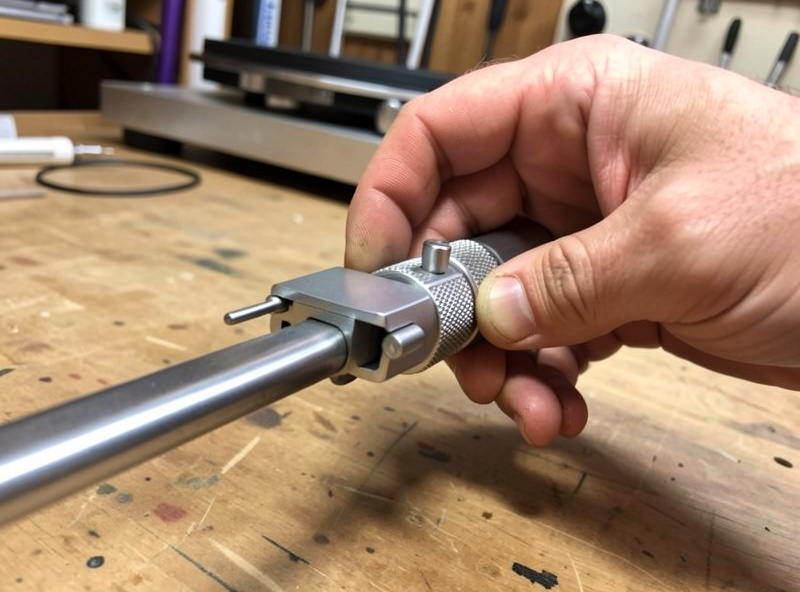
This is the single biggest reason I tell people not to invest in “fixing” a suitcase player. You can clean the records, you can swap a worn stylus for a fresh one, and you can isolate the platter from rumble — all of those help. But the 5 grams is the deck, and short of machining a counterweight onto an arm that was never designed for one, the force stays where it is for the life of the player. The money you’d spend trying to improve a suitcase deck is better spent on the cheapest real turntable that puts the force into spec, because that single upgrade undoes the cause of the wear rather than treating its symptoms. The full side-by-side of suitcase player vs real turntable covers what else changes when you make that jump — the geometry, the isolation, the arm — beyond just the force.
How to Measure Tracking Force With a Digital Gauge
Measuring tracking force is the one setup step that’s cheap, fast, and immediately useful, and it works on any deck with an adjustable arm. You lower the stylus onto a digital stylus-force gauge placed on the platter at the playing position, read the number off the display, and adjust the counterweight until it matches the cartridge’s spec. A gauge that reads to 0.01g costs less than a single new record, and it removes the guesswork that the engraved dial on a budget arm can’t — those dials are routinely off by half a gram or more, which is a meaningful error at these magnitudes.
The procedure matters more than the tool. The gauge has to sit at record height, because the arm’s geometry changes the measured force as the arm angle changes — measuring with the gauge on the plattermat at playing height gives you the real number. You lower the cueing lever gently rather than dropping the arm by hand, and you take the reading with the stylus centered on the gauge’s sensor, not at the edge. I re-check force every few months, because it drifts: temperature swings, tonearm handling, and even the cartridge settling into its mounting can shift a 1.8g setting by a few tenths over time. Early on I set force by feel and the engraved dial, used the gauge once, and assumed it stayed set for a year — when I finally re-measured, a record I’d been playing had drifted to 2.3g and the top end had flattened. Force is not set-and-forget, and a gauge is the only honest way to know.
The full step-by-step — gauge placement, counterweight balancing, the zeroing step most people skip — is in my tracking force adjustment guide, and if you’re buying a gauge I’d point you at a digital stylus force gauge in the 0.01g-resolution class; the cheap ones are accurate enough for hobbyist work and the expensive ones buy build quality, not a different reading.
Tracking Force vs Anti-Skate: Two Numbers People Confuse
Tracking force and anti-skate are the two numbers people mix up, and they do different jobs. Tracking force is the downward pressure keeping the stylus seated; anti-skate is a small outward force countering the arm’s natural inward drift as the groove friction pulls the stylus toward the center. Set tracking force right and the stylus sits at the right depth; set anti-skate right and it sits centered between the two groove walls, wearing them evenly instead of grinding the inner one. A cheap player gets both wrong, but in different ways — the force is too high, and the anti-skate is simply absent.
The absence of anti-skate is what makes the high force worse rather than just faster. At 5 grams with no anti-skate, the arm is dragged inward and the inner groove wall takes more than its share of the pressure, so the wear is asymmetric — one channel’s high frequencies go dull before the other’s, and the stereo image shifts toward the less-worn side. On my bench I dial anti-skate against a blank groove section, where a correctly balanced arm neither skates in nor drifts out, and the difference between anti-skate set and anti-skate zeroed is an audible clean-up of that channel imbalance. The interaction between force and anti-skate, and why skipping the second one costs you even on a deck that gets the first one right, is laid out in my anti-skate setting guide and the deeper piece on how anti-skate affects inner-groove distortion.
Does Cranking Up Tracking Force Stop Skips?
There’s a persistent piece of folk advice that says if a record skips, turn up the tracking force, and it’s the worst habit you can pick up on a cheap deck. It’s true that a stylus mistracking because it’s too light can be cured by more force, but on a suitcase player the force is already too high, and the skip is almost never a force problem — it’s a geometry and compliance problem. The stiff ceramic cartridge can’t accelerate fast enough to follow a loud bass transient, so the stylus is thrown out of the groove regardless of how hard it’s pressed in. More force doesn’t fix that; it just presses the mistracking stylus harder into the groove and deforms the spot where it skipped, making the skip permanent on future plays.
The right response to a skip on a cheap deck is to recognize it as a limitation of the deck, not a problem with the record. A record that skips on a Crosley will usually ride through the same passage cleanly on a proper turntable with a compliant cartridge and correct geometry, because the stylus can actually follow the modulation instead of being launched out of it. The diagnostic for telling a groove-damage skip from a setup-failure skip is in my guide on why a record skips, and it’s worth running before you conclude the record is the problem — most of the time, on a cheap deck, it isn’t.
The Fix When the Force Won’t Come Down
If you’re on a suitcase player and the force is fixed at 5 grams, the only real fix is to move to a deck where the force is adjustable or at least preset into the safe range. The cheapest meaningful step is a fully automatic deck like the AT-LP60X around $149, which presets to roughly 2 grams with a diamond stylus and stops the ongoing wear. If you want to actually set the force yourself and grow into the hobby, an Audio-Technica AT-LP120X around $300 is the first deck in the line that’s fully adjustable — counterweight, anti-skate, and a replaceable cartridge on a standard headshell — and it’s the one I’d buy if I intended to learn setup rather than just play records.
The point of the upgrade isn’t better sound, though that comes too — it’s getting the stylus force out of the damage zone. Every record you play on a 5g deck is losing groove material you can’t recover, and every record you play on a 2g deck isn’t. That’s the whole calculation, and it’s why tracking force is the real risk on cheap players rather than a secondary concern. The deck you can adjust is the deck that stops costing you records.
Related Articles
- Are Suitcase Record Players Bad? An Honest Setup Answer
- Do Crosley Players Ruin Your Records? What Actually Happens
- Tracking Force Adjustment Guide for Turntables
- How Long Does a Phono Stylus Last? Real-World Hours
- Turntable Setup and Calibration: The Complete Guide
What is a safe tracking force for a record player?
Between 1.5 and 2.0 grams for most magnetic cartridges. The Ortofon 2M family specs 1.8g and the Audio-Technica VM95 family lives around 2.0g. That range is the smallest force that keeps the stylus reliably seated without grinding the groove.
Why do cheap record players track at 5 grams?
They use ceramic cartridges that generate signal by physically deforming under pressure, so the high force is part of the design, not an accident. A magnetic cartridge needs only 1.5 to 2.0 grams, but it also needs a phono stage, which raises the deck’s cost.
Can you adjust tracking force on a suitcase player?
No. A suitcase tonearm has no counterweight, no threaded shaft, and no force dial. The downward pressure comes from a fixed spring or the arm’s unbalanced geometry, set at the factory and sealed. The force stays at roughly 5 grams for the life of the deck.
Does turning up tracking force stop a record skipping?
Usually no, and on a cheap deck it makes things worse. Skips on a suitcase player are usually a compliance and geometry problem, not a force problem. Adding force just presses the mistracking stylus harder into the groove and can make the skip permanent.
How do I measure tracking force without guessing?
Use a digital stylus-force gauge that reads to 0.01g. Place it on the platter at record height, lower the stylus onto the sensor gently with the cueing lever, and adjust the counterweight to the cartridge spec. A gauge costs less than a single record and removes the guesswork the engraved dial cannot.
Is 5 grams really enough to damage a record?
Yes, cumulatively. At 5 grams the pressure at the contact patch can exceed the elastic limit of the vinyl on loud passages, causing permanent groove deformation, and the steady polishing removes high-frequency detail over hundreds of plays. The damage is slow but irreversible.
As an Amazon Associate I earn from qualifying purchases.