Suitcase record players aren’t the vinyl killers the internet makes them out to be — not in one play, not in ten. The real damage is cumulative: 4 to 6 grams of tracking force, a sapphire stylus that’s half-worn by 50 hours, and a tonearm too short to track the inner grooves cleanly. A record survives dozens of spins on a Crosley-class deck. It does not survive hundreds.
The question “are suitcase record players bad” gets two answers online, and both miss the point. One camp claims a single play ruins your vinyl forever — that’s folklore, and I’ve measured enough thrift-store records that were played on junk decks to know a few passes leave no audible mark. The other camp says it’s all fear-mongering and any turntable is fine — also wrong, because the wear is real, it’s just slow. The honest answer sits between them, and it’s the kind of thing you can measure on the bench I align every cartridge on.
I run a Technics SL-1200-class direct drive as my daily deck and a Rega P3 on the bench beside it, and I’ve mounted everything from an Audio-Technica VM95 to an Ortofon 2M on both. The gap between a $60 suitcase player and a $150 entry deck is the single biggest jump in the whole hobby — bigger than entry-to-mid-tier, bigger than mid-tier-to-four-figures. This guide is the setup-tech version of that answer: what actually wears a record, what a suitcase player gets wrong, and which cheap turntables won’t wreck your vinyl if a suitcase is all the budget allows right now.
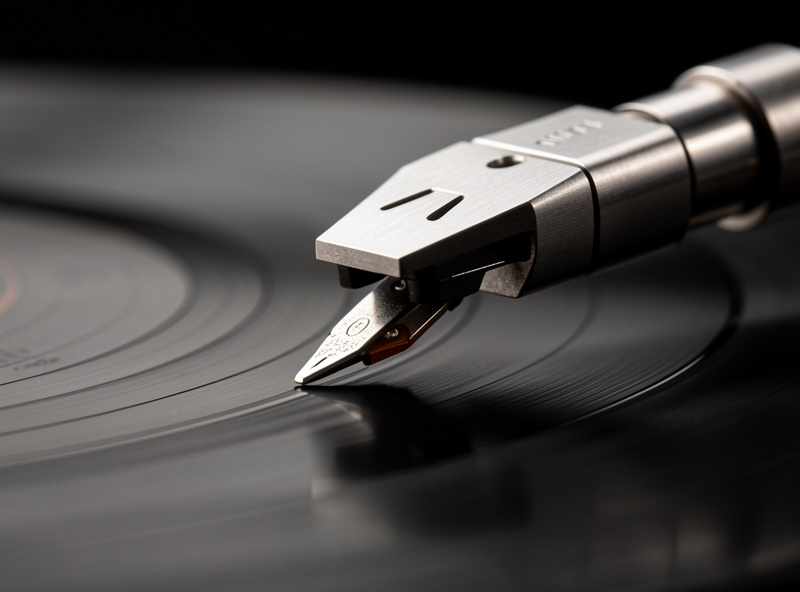
What Makes a Suitcase Player Different From a Real Turntable?
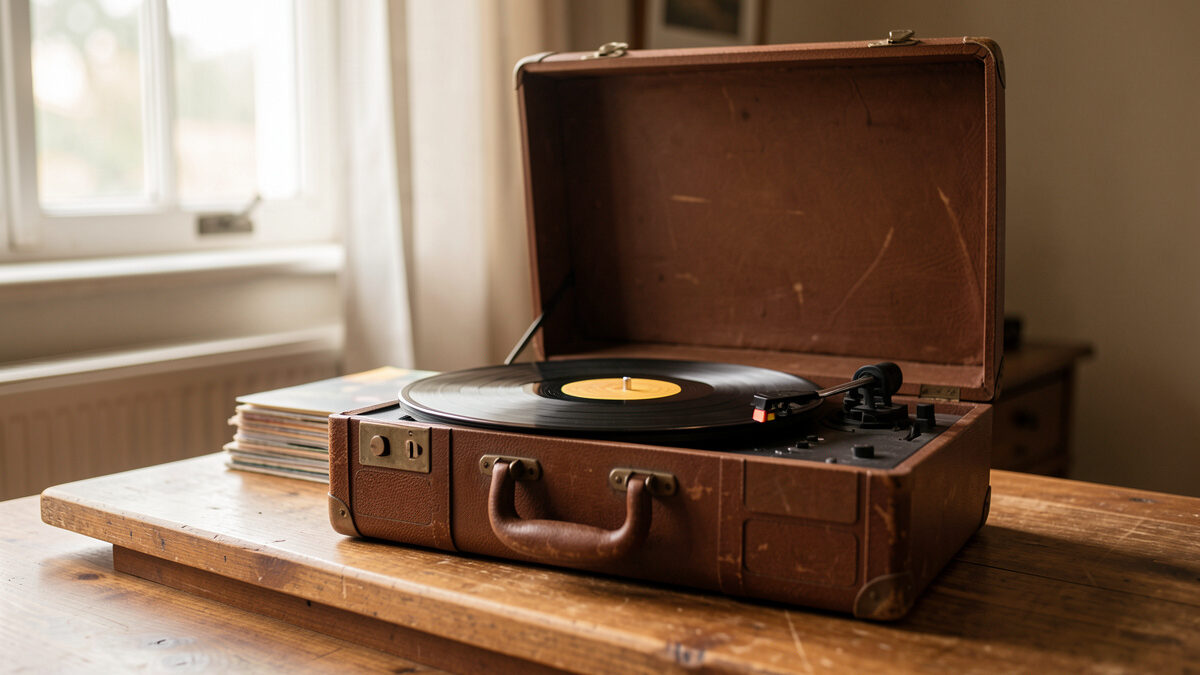
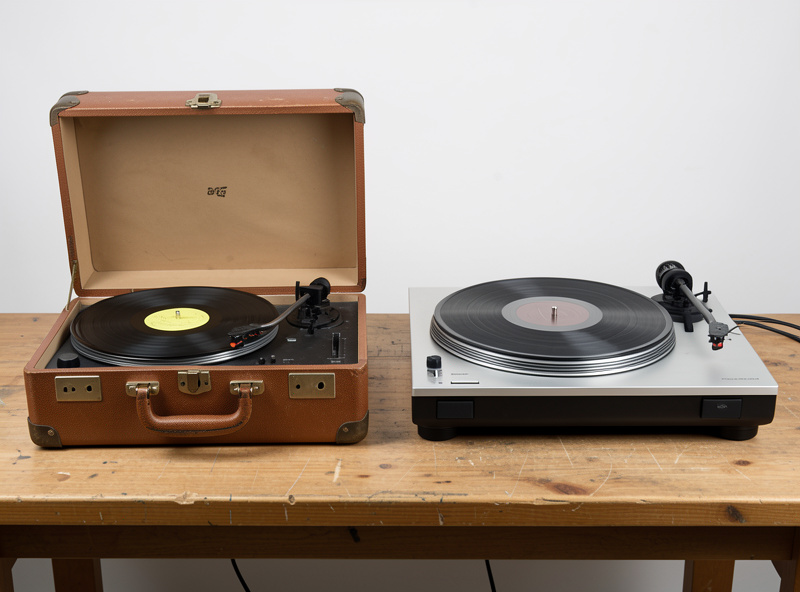
A suitcase player is a record player; it is not really a turntable. The distinction matters because the two are engineered for opposite goals. A real turntable is a precision platform built around a tonearm whose geometry, tracking force, and anti-skate you can set to match the cartridge. A suitcase player is a self-contained stereo in a briefcase shell, engineered to be cheap, loud enough, and Plug-and-play — and every compromise that gets it there is a compromise paid for by the record sitting under the stylus.
The defining trait is that nothing on a suitcase deck is adjustable. There is no counterweight to dial tracking force, no anti-skate to balance the arm’s inward pull, no way to set overhang or null points, and often no replaceable stylus body that lets you upgrade the tip. The tonearm is short — usually under 8 inches pivot-to-stylus — which forces steep tracking angles and produces audible inner-groove distortion on the last two tracks of a side. The cartridge is almost always a ceramic element rather than a magnetic one, which is why it needs no phono stage: ceramic cartridges put out a high-level signal directly, at the cost of needing several grams of force to track at all. That single design choice cascades into every other problem on this list.
If you want the full side-by-side breakdown of what changes when you move from a briefcase deck to a real turntable, I wrote that comparison separately — it’s the upgrade worth making, and it covers the geometry and isolation differences in more depth than this hub needs. The short version: a real turntable lets you set the three numbers that decide record wear. A suitcase player sets all three for you, badly, and bolts them shut.
Do Crosley-Style Players Actually Ruin Your Records?
Not the way the memes say. A Crosley-class player will not shred a record on first contact — the vinyl is harder than the stylus tip in normal play, and a clean stylus at even 5 grams leaves a groove that’s still trackable by a good cartridge afterward. The “one play and it’s dead” story comes from people who heard obvious mistracking and blamed the deck, when what they actually heard was a worn or chipped stylus gouging the groove. The damage is real, but it’s measured in hundreds of plays, not one.
The honest mechanism is wear accumulation. At 5 grams of tracking force with a sapphire tip that’s already past its 50-hour prime, the stylus develops a flat spot where it contacts the groove walls. That flat spot is no longer a polished radius tracing the modulation — it’s a chisel edge grinding plastic off the groove walls, a fraction of a micron per play. You won’t hear it on play twenty. You’ll hear it on play two hundred, as a grey, smeared top end and a loss of the quiet passages that used to sit between the loud ones. That’s the real failure mode, and it’s the one I dig into in the dedicated piece on whether Crosley players ruin records, because the framing matters: it’s not catastrophe, it’s erosion, and erosion is preventable.
Where the folklore does contain a kernel of truth is brand-new records on a brand-new cheap player. A factory-fresh stylus that hasn’t been polished by use can have molding flash or a slightly rough tip, and the first few plays on a virgin groove do the most mutual polishing. This is why break-in exists on real cartridges too — but on a cheap sapphire at high force, that break-in period removes record material instead of just stylus material. It’s a small effect, and again, not a single-play death sentence. But it’s the one scenario where “new record, new cheap stylus” actually does cost you something measurable.
Why Tracking Force Is the Number That Decides Record Wear
Tracking force — the downward pressure of the stylus on the groove, measured in grams — is the single variable that most directly governs how fast a record wears. Proper moving-magnet cartridges track between 1.5 and 2.0 grams: my Ortofon 2M Red is spec’d at 1.8g, the Audio-Technica VM95 family lives around 2.0g, and I set both on my bench with a digital stylus-force gauge that reads to 0.01g. Suitcase players apply four to six grams, sometimes more, and you cannot turn it down because there is no counterweight to turn. That three-to-four-gram gap is the entire story.
Higher force means more contact pressure, which means faster polishing of the stylus tip and faster removal of groove-wall material. It also means the stylus is more likely to deform the groove on loud passages instead of tracing them — the cantilever bottoms out against its suspension and the tip physically pushes the groove wall sideways rather than riding the modulation. On a real cartridge with a compliant suspension, that distortion is audible as harshness on transients. On a stiff ceramic element with no real compliance, the energy goes straight into the vinyl. I once ran a cartridge at 3.0g for a month, thinking heavier meant safer tracking on warped records — the inner grooves told me otherwise with a gritty, compressed top end that didn’t recover, and I re-gauged back to spec the same afternoon. Three grams was enough to hear. Five is almost double the safe ceiling.
The reason this gets its own treatment is that tracking force is also the one variable a cheap player makes impossible to fix. You can clean a dirty record, you can replace a worn stylus, you can isolate a rumbling platter — but if the arm is spring-loaded to 5g with no counterweight, the force is baked in for the life of the deck. That’s why I call tracking force the real risk on cheap record players, and why it’s the first thing I check when someone brings me a deck and asks why their records are getting noisy.
Sapphire vs Diamond: The Stylus Nobody Talks About
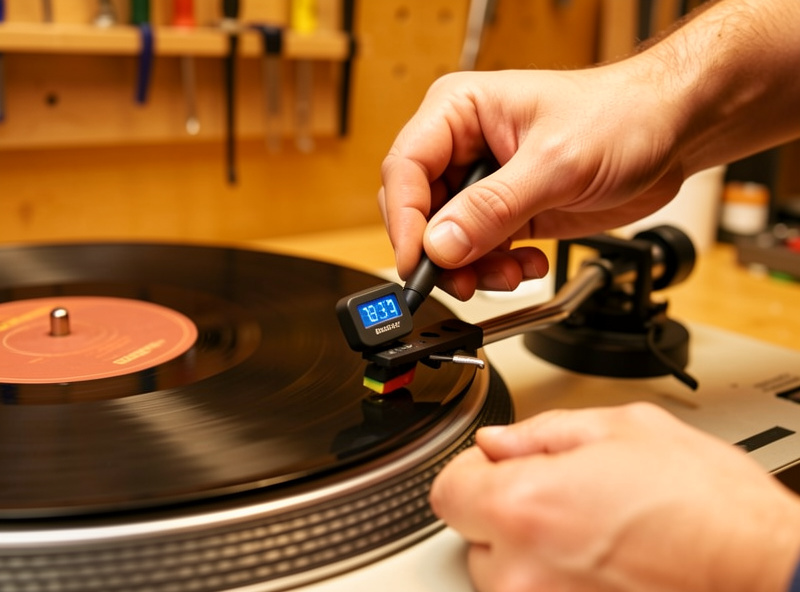
The stylus tip material is the second variable, and it’s the one the suitcase-player debate almost never mentions. Most cheap players ship with a sapphire tip — synthetic corundum, which is hard but not as hard as diamond, and which wears into a flat contact patch far faster. A sapphire stylus is typically considered worn out at roughly 50 to 100 playing hours. A diamond tip, which is what every cartridge I own uses, runs 500 to over 1,000 hours before the same flat-spot threshold. That is a ten-to-one difference in usable life, and it directly sets how often the tip turns from a tracer into a chisel.
The economics are misleading in the buyer’s favor at first glance and then punishing over time. A suitcase player costs $50 and includes a sapphire stylus that might last a heavy listener two months. A replacement stylus, if the deck even allows one, costs a third of the price of the whole player and is the same sapphire. A $150 Audio-Technica deck ships with a diamond stylus good for a year or more of daily listening, and when it wears, you swap the stylus for a bonded or nude upgrade that’s measurably better rather than identical. I keep an AT-VM95C on the bench as my alignment and break-in cartridge precisely because its diamond tip lets me run it for hundreds of setup hours without worrying that the reference itself is degrading under me.
The RIAA playback curve and the basic physics of the groove are defined in standards like IEC 60098, and nothing in those standards assumes a sapphire tip — they assume a polished diamond tracing a modulation cut for a diamond. A sapphire at high force is a shortcut that trades the record’s lifespan for the deck’s bill of materials, and it’s the reason a cheap player can sound acceptable new and degraded six months later even if nothing else has changed. Diamond is not a luxury on a turntable; it’s the baseline assumption the format was designed around.
Tonearm Geometry: Why the Arm Is Too Short to Track Cleanly
Tonearm geometry is the third variable, and on a suitcase player it’s the one you can feel even without a gauge. A proper tonearm is long enough — 9 inches pivot-to-stylus on most decks, 12 on a few — that the tracking angle error across the record stays within a degree or two of the null points where a Baerwald or Stevenson alignment puts the distortion at zero. A suitcase arm is short, often under 8 inches, and it’s factory-set to a single fixed geometry that is rarely close to either standard. The result is a tonearm that tracks well nowhere and distorts everywhere, worst at the inner grooves where the linear velocity drops and the stylus has to handle the tightest modulation per inch of groove.
That inner-groove distortion is the audible signature of a short, misaligned arm. The last track on a side — where the groove speed is slowest and the wavelengths are compressed tightest — gets a gritty, splattery quality that no amount of cleaning fixes, because the stylus literally cannot resolve the modulation at the angle it’s hitting it. On my bench I align to Baerwald nulls with a two-point protractor, and the difference between a cartridge aligned to spec and one a degree off is a clearly audible clean-up of that inner-groove hash. A suitcase arm isn’t a degree off; it’s geometry-by-cost-reduction, with no anti-skate to offset the arm’s natural inward drift and no overhang adjustment to reach a null point at all.
Anti-skate is the part of this that’s invisible until you understand it. A pivoted tonearm is dragged inward by the groove’s friction on the stylus, and anti-skate applies a counter-force outward so the stylus rides centered between the groove walls. Set it right — I dial mine against a blank groove section, where a correctly balanced arm neither skates in nor drifts out — and the wear is even on both walls. Set it to zero, which is what a suitcase player effectively does, and the inner wall takes more force than the outer, wearing one channel faster and biasing the stereo image toward the side that’s still clean. It’s a slow, asymmetric grind, and it’s why records played for years on a no-anti-skate deck often sound dull on one side before the other.
Suitcase Player vs Real Turntable: What Actually Changes
Move from a suitcase deck to even a $150 entry turntable and three things change immediately, all of them in the record’s favor. Tracking force drops from 5g to roughly 2g, because the arm has a counterweight and the cartridge is a magnetic design that needs less force to track. The stylus becomes a diamond, which buys you ten times the tip life. And the tonearm gets longer, adjustable, and anti-skated, which means the geometry can be set to a real null-point standard instead of a cost-engineered compromise. The music changes too, but the music is downstream of those three numbers — fix the numbers and the sound follows.
What does not change, and what I want to be honest about, is that the jump from a $150 entry deck to a $500 mid-tier deck is smaller than the jump from a suitcase to that $150 deck. The entry deck already has the geometry and the diamond and the adjustable force; the mid-tier deck refines the platter, the bearing, and the arm resonance, and those refinements are real but incremental. This is why I tell people who are worried about their records to spend the first hundred-and-fifty dollars on getting off the suitcase, not on a marginal upgrade later. The full breakdown of that comparison — what you gain, what you don’t, and where the money actually goes — is in the suitcase player vs real turntable piece, and it’s the upgrade worth making before anything else on the signal chain.
| Deck | Price | Tracking force | Stylus | Adjustable? | Phono stage | Best for |
|---|---|---|---|---|---|---|
| Suitcase / Crosley-class | $40–$80 | ~5g, fixed | Sapphire | No | None needed (ceramic) | Not for a collection |
| Audio-Technica AT-LP60X | ~$149 | ~2.0g, preset | Diamond | No | Yes, built in | Safe entry, zero setup |
| Sony PS-LX310BT | ~$200 | ~2.0g, preset | Diamond | No | Yes, built in + Bluetooth | Plug-and-play, wireless |
| Fluance RT80 | ~$200 | Adjustable | Diamond | Yes (counterweight) | No, needs external or powered speakers | Real geometry, grows with you |
| Audio-Technica AT-LP120X | ~$300 | Adjustable | Diamond | Yes (full + anti-skate) | Yes, switchable MM | The deck you won’t outgrow |
| Rega P3 (my bench reference) | ~$1,000+ | 1.8g, set by gauge | Diamond | Yes (RB330 arm) | No, external | Reference-class hobbyist |
Cheap Turntables That Won’t Damage Records
The safe tier starts at about $150, and it exists specifically because the major manufacturers understood that the suitcase market was producing disillusioned buyers. An Audio-Technica AT-LP60X costs around $149, ships with a diamond stylus preset to roughly 2 grams of tracking force, and runs fully automatic — you push a button, the arm lifts and places itself, and at the end of the side it returns and shuts off. It is not adjustable, and I’d never put one on my alignment bench because there’s nothing to align. But the force it applies is inside the safe window, the stylus is diamond, and that combination means it will not grind your records the way a suitcase deck will.
A step up the same safe ladder is the Sony PS-LX310BT at about $200, which adds Bluetooth output to the same preset-force, diamond-stylus formula, and the Fluance RT80 at the same price point, which is the first deck on this list that’s actually adjustable — real counterweight, real anti-skate, a tonearm you can align to Baerwald if you want to. The RT80 ditches the built-in phono stage, so you need either powered speakers or an external phono preamp, and that’s the trade-off that buys you geometry you can tune. If you want the full shortlist with the reasoning for each — which is safest, which is most adjustable, which gives you the most room to grow — I keep that in the dedicated cheap turntables that won’t damage records guide, and it’s where I’d send anyone whose budget is under $200 and whose priority is not wrecking the records they already own.
Best All-in-One Turntable With Speakers Built In
The phrase “all-in-one turntable with speakers built in” is where buyers get tripped up, because it overlaps with “suitcase player” but is not the same thing. A suitcase player is the cheapest expression of all-in-one: speakers, amp, and deck in one shell, all cost-engineered down. A proper all-in-one — a deck with a real tonearm and a pair of integrated powered speakers — is a different and much smaller category, and the honest recommendation is usually to skip it and buy a $150 deck plus $100 powered speakers, which gives you better sound and a real upgrade path for the same money.
If you want the integrated route anyway, there are a handful of decks that are all-in-one without being suitcase junk, and they sit in a narrow band between $200 and $400. I won’t pretend the category is deep — it isn’t, and most “all-in-one” listings online are just suitcase players in a wood-grain wrap. The ones worth considering share three traits: a magnetic cartridge or at least a diamond stylus, adjustable or preset-safe tracking force, and speakers that are separate enough from the platter that acoustic feedback isn’t built into the chassis. The full list of which models actually meet that bar — and which ones are just re-skinned briefcase decks — is in the best all-in-one turntable with speakers guide, and I’d read that before trusting any “all-in-one” product page at face value.
Best Turntable for a Beginner Who Wants It to Just Work
The beginner who wants it to just work is the buyer the AT-LP60X was designed for, and it’s still the right answer for most of them. Fully automatic, built-in phono stage, diamond stylus, preset safe tracking force, and a price under $150 means you open the box, plug it into powered speakers or a receiver, put a record on, and push Start. There is no protractor, no gauge, no counterweight to set, no phono-stage gain to match — and for someone whose goal is to play records rather than learn the hobby, that’s the correct trade. The deck gives up adjustability, but it gives up nothing on the safety of the records under the stylus.
The caveat I always give is that “just works” and “grows with you” are different goals, and a beginner should know which one they are before buying. The AT-LP60X will not grow — the cartridge is what it is, the force is what it is, and when the stylus wears you replace it with the same one. If the beginner is the type who’ll want to align a cartridge and upgrade a stylus in a year, the AT-LP120X at about $300 is the better single purchase, because it’s adjustable end-to-end and you keep it for a decade. I lay out that decision — plug-and-play versus room to grow — in the best turntable for beginners piece, with the specific buyer each one suits. Most people are happier with the cheaper deck; the ones who aren’t usually knew it going in.
Best Turntable as a Gift Under $200
A turntable as a gift under $200 is the trickiest recommendation in this cluster, because the gift has to be safe for someone who may never set it up properly. The wrong gift is a $60 suitcase player — it looks the part in the box, it’s cheap, and it’s the thing that actually damages the recipient’s records over the next year. The right gift is the AT-LP60X or the Sony PS-LX310BT, both under $200, both fully automatic, both with a diamond stylus and safe preset tracking force, so the recipient opens it, plugs it in, and is playing records correctly within ten minutes with no setup knowledge required.
The gift framing also matters because the recipient didn’t choose the deck, which means it has to be forgiving of a first-time owner. Fully automatic operation protects the stylus — there’s no manual cueing to drop the arm too hard — and a built-in phono stage means no risk of a “no sound” panic from a missing preamp. Pair either deck with a pair of powered speakers if the budget stretches, and you’ve given someone a real first system rather than a novelty. The full shortlist, including which model to pick for a recipient who already owns records versus one who’s starting from zero, is in the best turntable gift under $200 guide.
The Upgrade Path I’d Actually Take
If I were starting today with a suitcase player and a small stack of records, here is the order I’d spend money in, and it is not the order most beginners assume. First, stop playing the records on the suitcase — not because one more play will kill them, but because every play at 5g with a half-worn sapphire is removing groove material you can’t put back. Second, spend $150 on an AT-LP60X or equivalent safe-entry deck, which drops the force to 2g and puts a diamond on the groove. Third, add a carbon-fiber brush and a bottle of record-cleaning fluid — most pops are dust, and a wet clean of a thrift find does more for surface noise than any cartridge upgrade. Only after those three steps would I look at the cartridge, the phono stage, or the table itself.
This is the spend-it-in-the-right-order argument I make on every setup question, and it applies hardest here because the suitcase tier inverts it. The buyer who upgrades the table before fixing the tracking force has spent money to keep damaging records more slowly. The buyer who fixes tracking force first — by getting off the suitcase — has spent less and stopped the damage entirely, and every dollar after that buys actual sound quality instead of damage control. That’s the whole thesis of this cluster in one sentence: the cheapest meaningful upgrade in vinyl is the one that gets the stylus force into spec, and everything else is downstream of it.
If you came here wondering whether the suitcase player you already own is hurting your collection, the answer is yes, slowly, and the fix is a $150 deck rather than a guilt trip. The pieces below take each part of that answer apart so you can act on whichever one is yours.
Keep Building
- Do Crosley Players Ruin Your Records? What Actually Happens
- Tracking Force on Cheap Record Players: Why It’s the Real Risk
- Suitcase Player vs Real Turntable: The Upgrade Worth Making
- Cheap Turntables That Won’t Wreck Your Vinyl
- Best All-in-One Turntable With Speakers Built In
- Best Turntable for a Beginner Who Wants It to Just Work
- Best Turntable as a Gift Under $200
Will a suitcase record player ruin my records the first time I play them?
No. A clean stylus at 5 grams leaves a groove still trackable by a good cartridge afterward. The damage is cumulative, measured in hundreds of plays, not one. A single play is not a death sentence for the record.
Why do suitcase players track at 5 grams?
They use ceramic cartridges that need high force to generate a usable signal without a phono stage, and they have no counterweight to reduce that force. A magnetic cartridge on a real turntable tracks at 1.5 to 2 grams instead.
Is a sapphire stylus really that much worse than diamond?
Yes. Sapphire wears to a flat contact patch in roughly 50 to 100 hours; diamond lasts 500 to over 1000 hours. A worn sapphire at high force becomes a chisel edge that removes groove-wall material every play.
What is the cheapest turntable that will not damage my vinyl?
Around 150 dollars. The Audio-Technica AT-LP60X ships with a diamond stylus preset to about 2 grams of tracking force, runs fully automatic, and keeps the stylus force inside the safe window that a suitcase player does not.
Should I upgrade my turntable or my speakers first?
If you are on a suitcase player, upgrade the turntable first. Getting the tracking force into spec stops ongoing record damage, which no speaker upgrade can undo. After that, speakers and a phono stage are the next real gains.
Are all-in-one turntables the same as suitcase players?
No, but the categories overlap. A suitcase player is the cheapest all-in-one. A proper all-in-one has a real tonearm, a diamond stylus, and speakers isolated from the platter, and usually costs 200 to 400 dollars rather than 50.
As an Amazon Associate I earn from qualifying purchases.