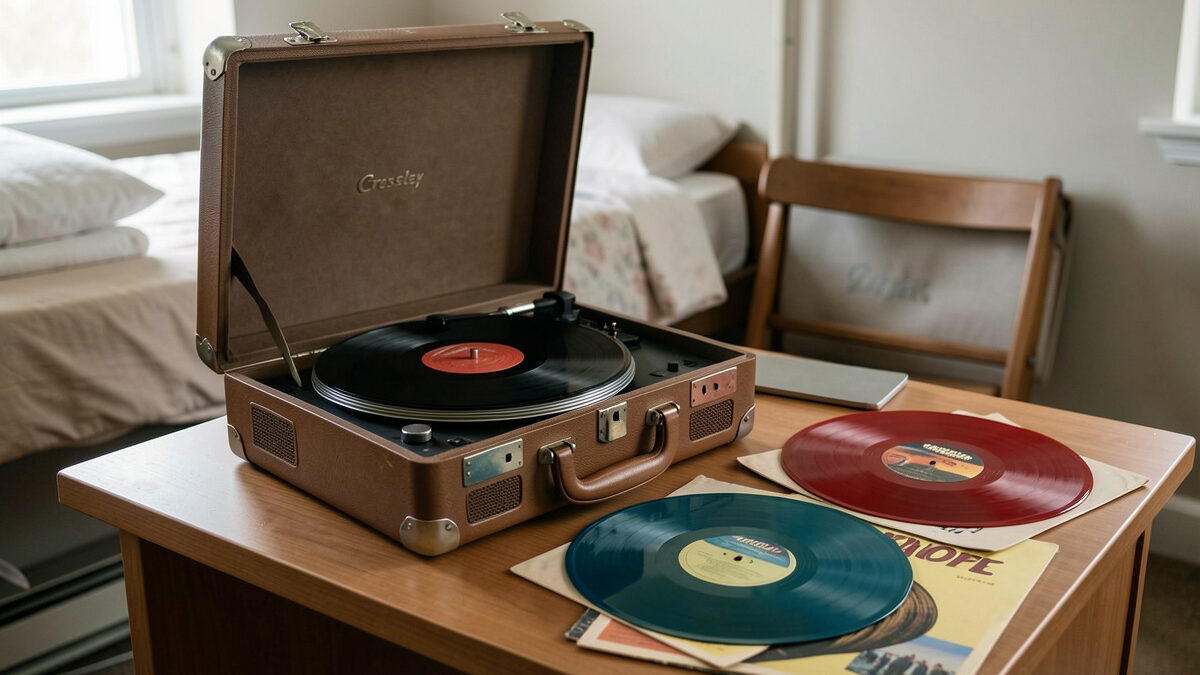
A Crosley player won’t ruin a record the first time you play it — that part of the myth is wrong. What it will do is wear the groove faster than a proper turntable, through 5 grams of tracking force, a sapphire stylus that’s half-shot by 50 hours, and a tonearm too short to track cleanly. The damage is real, but it’s slow, and that distinction is the whole answer.
The “Crosley ruins records” claim has become a kind of internet shorthand, and like most shorthands it’s half right and half panic. I’ve put Crosley-class players on my bench beside the Technics SL-1200 I run daily, measured their tracking force with the same digital stylus-force gauge I set my Ortofon 2M with, and inspected the styli under a loupe after real playing time. The gap between what people fear and what actually happens is wide, and it’s measurable on the gear rather than argued from vibes.
The short version is that a Crosley doesn’t shred vinyl on contact — the record is harder than the stylus in normal play, and a clean tip at even 5 grams leaves a groove a good cartridge can still read afterward. What a Crosley does is accelerate wear along three axes at once, and none of them are fixable on the deck itself. If you want the umbrella version of this — suitcase players, all-in-ones, the safe upgrade tier — that lives in the hub on whether suitcase record players are bad. This piece is the Crosley-specific teardown: what “ruin” actually means, how many plays it takes, and the one scenario where the panic is justified.
What Does It Even Mean to “Ruin” a Record?
Before asking whether a Crosley ruins records, it helps to define the word, because the internet uses it for two completely different kinds of damage. The first is catastrophic damage — a scratched, gouged, or cracked groove that skips on every deck and is audibly broken forever. The second is cumulative wear — a slow loss of high-frequency detail and a greying of the dynamics that you only notice by comparing to a fresh pressing. A Crosley almost never does the first on a single play. It absolutely does the second over hundreds of plays, and that’s the failure mode worth talking about.
Catastrophic damage on a Crosley usually means the stylus itself is damaged — chipped, bent, or caked with hardened dust — and that damaged tip is what gouges the groove, not the player’s geometry alone. A clean, intact sapphire at 5 grams is abrasive but not carving; a chipped sapphire at 5 grams is a plow. This is why the honest answer to “do Crosley players ruin records” is “not the deck, usually — the stylus on the deck, after it’s worn or chipped.” The deck sets the conditions for fast wear; the worn stylus delivers the actual damage. If you want to see what that looks like before it’s too late, the method I use to check a tip without lab gear is in my guide on how to inspect a stylus for wear, and it works the same on a Crosley stylus as on a cartridge ten times the price.
How Many Plays Before a Crosley-Class Player Damages Vinyl?
There is no single play count, because the damage rate depends on the stylus condition, the record’s cleanliness, and how loud the music is, but a workable rule of thumb is this: the first fifty plays of a clean record on a fresh Crosley stylus are largely indistinguishable from plays on a decent deck to most listeners. Between fifty and two hundred plays, the sapphire has worn enough that a critical ear starts to hear a softening of the top end and a loss of separation in busy passages. Past a few hundred plays on a worn stylus, the wear becomes audible on any system, and it’s permanent — the groove material is gone.
Those numbers assume a clean record and a stylus that hasn’t been chipped. Introduce dust — which acts as an abrasive paste between the tip and the groove — and the timeline collapses fast. A dusty record on a Crosley stylus at 5 grams is effectively lapping compound, and a single dirty play can leave audible scuffing that a hundred clean plays wouldn’t. This is why the cleaning step matters disproportionately on a cheap deck: the high force presses whatever’s on the record straight into the groove wall. The record that sounds noisy after a month on a Crosley is often a record that was played dirty, not a record that was played often, and the difference is diagnosable by ear if you know what to listen for.
The Tracking Force Number That Does the Real Damage
Tracking force is the single biggest reason a Crosley wears records faster than a proper turntable, and it’s a number you can read off a gauge in five seconds. A Crosley-class player applies roughly 5 grams of downward force, and you can’t turn it down because there’s no counterweight to turn. The Ortofon 2M on my bench tracks at 1.8 grams; the Audio-Technica VM95 family lives around 2.0 grams. That three-gram gap is not a rounding error — it’s the difference between a stylus that floats in the groove and one that’s mashed into it, and it sets the rate at which both the stylus and the groove polish each other away.
The mechanism is contact pressure. Force divided by contact area gives pressure, and a higher force at the same tip radius means higher pressure, which means faster material removal from both surfaces. On a real cartridge, the cantilever suspension absorbs some of that force on loud transients; on the stiff ceramic element a Crosley uses, the force goes more directly into the vinyl. I once trusted the engraved counterweight scale on a budget arm instead of my gauge and ended up at 2.6 grams on a cartridge spec’d for 1.8 — those engraved scales can be off by nearly a gram, and the inner grooves went gritty within a month. A digital gauge costs less than a single record and removes the guess entirely. Five grams, sustained, with no way to reduce it, is the baseline condition of every Crosley ever made, and it’s the variable I treat as the real risk on a cheap record player.
That force also can’t be fixed without changing the arm. You can clean a record, you can swap a worn stylus, but if the spring-loaded arm is set to 5 grams for life, the force is fixed for the life of the deck. The full mechanics of why that number matters so much — and how it’s set on decks where you can adjust it — is in my tracking force adjustment guide, and it’s the first spec I check on any deck someone brings me.
The Sapphire Stylus and the 50-Hour Cliff
The stylus material is the second axis, and it’s the one the Crosley debate barely mentions. Most Crosley-class players ship with a sapphire tip rather than diamond. Sapphire is hard, but it’s not as hard as diamond, and it wears to a flat contact patch far sooner — typically considered worn at roughly 50 to 100 playing hours, versus 500 to over 1,000 hours for a diamond. That is a tenfold difference in usable life, and it directly sets how quickly the tip stops being a polished tracer and starts being a chisel.
The failure mode is subtle until it isn’t. As the sapphire wears, the contact patch flattens and widens, which means the tip no longer traces the sharp bottom of the groove modulation — it rides the walls, blurring the fine high-frequency detail that gives records their air. You hear it as a softening, then a smearing, then a flat, dull top end that no amount of cleaning recovers, because the information was never tracked in the first place. The real-world hours you can expect from a stylus, broken down by tip material and profile, are in my piece on how long a phono stylus lasts, and the sapphire-versus-diamond gap is the single biggest factor in that table.
Why the Tonearm Makes It Worse, Not the Force Alone
If tracking force were the only problem, a Crosley with a fresh stylus would be merely aggressive rather than ruinous. The tonearm is what turns aggressive wear into audible damage, because the arm is short, fixed, and has no anti-skate. A Crosley tonearm is usually under 8 inches from pivot to stylus, which forces a steep tracking angle that no standard alignment — Baerwald or Stevenson — can rescue, because there’s no overhang adjustment to reach a null point. The result is a geometry that distorts everywhere and worst at the inner grooves, where the linear groove speed drops and the stylus has to resolve the tightest modulation per inch.
That inner-groove distortion is the Crosley’s audible signature. The last track on a side gets a gritty, splattery quality that no cleaning fixes, because the stylus is hitting the modulation at the wrong angle and literally cannot resolve it. On my bench I align cartridges to Baerwald nulls with a two-point protractor, and a one-degree error is audible as a clean-up of that inner-groove hash; a Crosley arm isn’t a degree off, it’s geometry-by-cost-reduction. Add the complete absence of anti-skate — which balances the arm’s inward drift so the stylus rides centered between the groove walls — and the wear goes asymmetric, grinding one wall harder than the other and biasing the stereo image toward the less-worn channel over time. The deck isn’t just wearing the record fast; it’s wearing it unevenly, which is why a record played for years on a Crosley often sounds dull on one side before the other.
The One Case a Crosley Does Hurt a Brand-New Record Fast
There is exactly one scenario where the “ruins records” panic is justified, and it’s narrow enough to name precisely: a brand-new, factory-sealed record played on a brand-new Crosley with a stylus that hasn’t been broken in. A fresh sapphire tip can carry molding flash or a slightly rough surface from manufacturing, and the first few plays are when the stylus and groove polish each other. On a real cartridge, that break-in removes a little stylus material and the record is fine. On a fresh sapphire at 5 grams, the break-in period removes record material too, because the force is high enough and the tip rough enough that the polishing is aggressive rather than gentle.
This doesn’t mean a new record is destroyed on a new Crosley — it means the first few plays cost a small, measurable amount of high-frequency detail you can’t get back. The practical fix is to not break in a stylus on a record you care about. Play the new stylus on a record you’re willing to sacrifice for the first ten hours, or — better — don’t break in a sapphire at all, and start on a diamond. If you’re hearing noise on a record you suspect was already played on a cheap deck, the diagnostic for separating pressing defects, dirt, and stylus damage is in my guide on vinyl surface noise, and it’ll tell you whether the record was actually damaged or just needs a clean.
Is It the Player, or Just a Dirty or Damaged Record?
A lot of “my Crosley ruined my record” stories are actually “my record was dirty, or already scratched, or the stylus was caked with dust.” Before blaming the deck, it’s worth separating the four real causes of a noisy record: surface dust and static, a pressing defect from the factory, groove damage from a worn or misaligned stylus, and actual skips from a damaged groove wall. Only the last two are the Crosley’s fault, and only the third is the slow-wear story this piece is about. A record that crackles on a Crosley but plays quietly on a good deck was probably dirty, not ruined — the Crosley’s high force just made the dirt audible faster.
Skips are the other common complaint, and they’re a setup problem more than a damage problem. A Crosley with no adjustable tracking force or anti-skate will skip on passages a real deck rides through cleanly, especially on bass-heavy or dynamically loud records, and owners often read a skip as “the player ruined the record” when it’s actually the player failing to track a groove that’s still intact. The diagnostic walkthrough for that — figuring out whether a skip is groove damage or a setup failure — is in my guide on why a record skips, and it’s worth running before concluding the record is gone.
What I’d Do If I Already Own a Crosley
If you already own a Crosley-class player and a small stack of records, the practical path is to stop playing the records you care about on it — not because one more play will kill them, but because every play at 5 grams on a half-worn sapphire removes groove material you can’t put back. Then spend the next hundred-and-fifty dollars on a deck that puts the stylus force into spec. An Audio-Technica AT-LP60X around $149 ships with a diamond stylus preset to roughly 2 grams, runs fully automatic, and stops the ongoing damage the Crosley is doing. It’s not adjustable, and I’d never put one on my alignment bench, but the force it applies is inside the safe window, and that’s the entire point of the upgrade. The wider shortlist of cheap turntables that won’t damage records runs through every safe option at this tier if the AT-LP60X isn’t the right fit.
If the budget won’t stretch to a new deck yet, the cheapest meaningful harm reduction is stylus hygiene: replace the sapphire the moment it passes 50 hours of play, keep the records clean, and never play a dusty record on the deck. That won’t fix the 5 grams or the short arm, but it removes the worst of the chisel effect, and it buys time until the real fix is affordable. The records already played on the Crosley aren’t garbage — most of them will clean up and play fine on a proper deck — so the upgrade is worth making for what it saves going forward, not for what it undoes.
The Crosley isn’t a villain and it isn’t harmless; it’s a deck that trades the record’s lifespan for a low price and a Plug-and-play experience. If you came here terrified that one play wrecked your favorite album, it almost certainly didn’t. If you came here wondering whether to keep playing your collection on it, the answer is to move off it as soon as the budget allows — and the full map of which cheap turntables are safe, which all-in-ones to avoid, and what to gift a beginner who wants it to just work is laid out in the suitcase record players hub this piece is part of.
Will a Crosley ruin my record the first time I play it?
No. A clean stylus at 5 grams leaves a groove a good cartridge can still read afterward. The damage is cumulative and measured in hundreds of plays, not one. Catastrophic single-play damage usually comes from a chipped stylus, not the deck itself.
How many plays does it take for a Crosley to damage a record?
Roughly the first 50 plays on a fresh stylus are hard to distinguish from a decent deck. From 50 to 200 plays the top end softens as the sapphire wears. Past a few hundred plays on a worn stylus, the wear is audible on any system and permanent.
Is it the Crosley or a worn stylus that ruins records?
Mostly the worn stylus. The Crosley sets the conditions for fast wear with 5 grams of force and a sapphire tip, but the actual gouging is done by a stylus that has worn flat or chipped. Replacing the stylus at 50 hours removes the worst of the damage.
Do Crosley players skip because they damage the groove?
Usually no. Skips are mostly a setup failure: the Crosley has no adjustable tracking force or anti-skate, so it fails to track loud or bass-heavy passages a real deck rides through. The groove is often still intact and will play cleanly on a proper turntable.
What is the cheapest fix to stop a Crosley damaging records?
Replace the sapphire stylus at 50 hours of play, keep records clean, and never play a dusty record on it. That removes the chisel effect of a worn tip. The real fix is a roughly 150 dollar deck like the AT-LP60X that puts tracking force into spec.
As an Amazon Associate I earn from qualifying purchases.