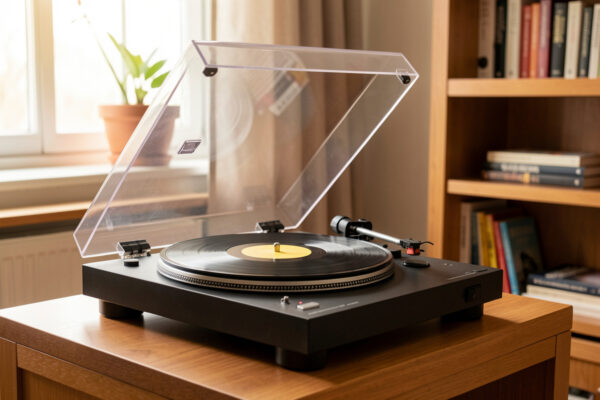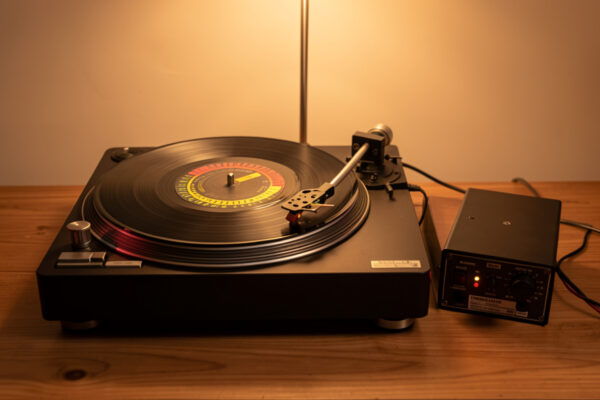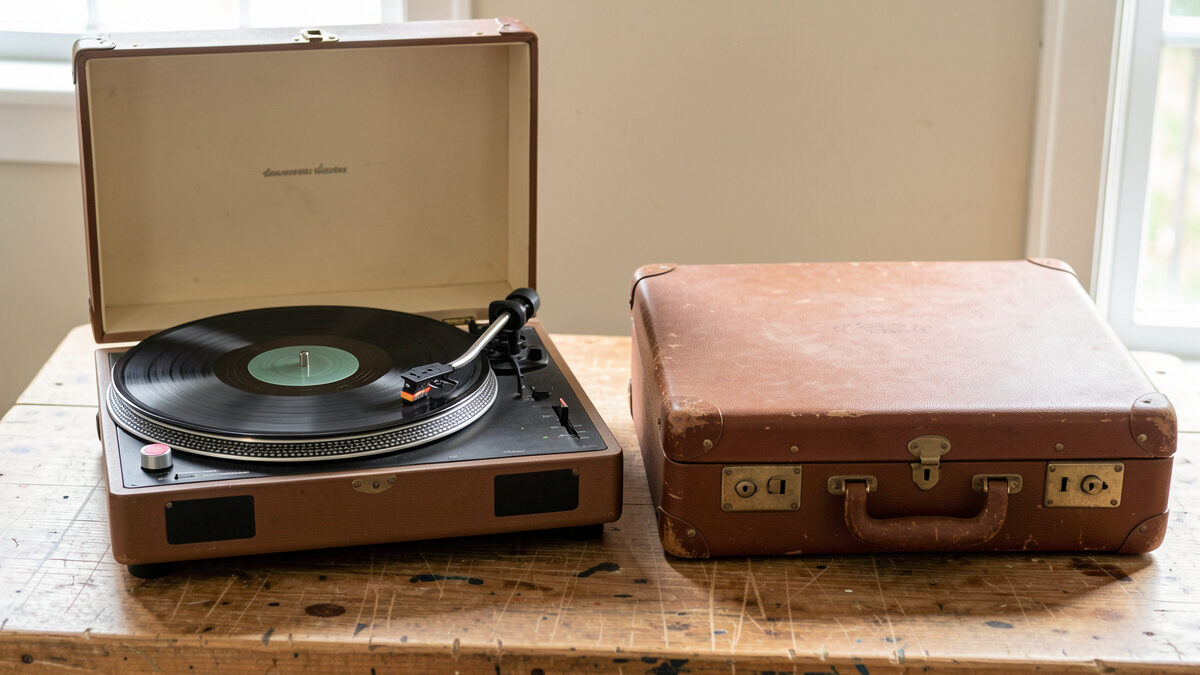
A suitcase player and a real turntable do the same job on paper — spin a record, track a groove, make sound — but they’re engineered for opposite goals, and the record pays the difference. A real turntable, even a $150 one, sets tracking force into a safe range, uses a diamond stylus, and gives the tonearm the geometry and anti-skate to track cleanly. A suitcase player fixes all three of those at damaging values and bolts them shut. That’s the upgrade worth making, and it’s the biggest single jump in the hobby.
I’ve run the comparison on my bench more times than I can count, moving the same record between a Crosley-class player, an Audio-Technica entry deck, and the Technics SL-1200 I use daily. The gap between the first two is the one that matters, and it’s larger than the gap between the second and the third. The suitcase player isn’t a worse version of a turntable; it’s a different product that happens to play records, and the cost of that difference is paid in groove wear you can hear after a few hundred plays. If you want the umbrella framing of why suitcase players are bad, that’s in the hub; this piece is the head-to-head.
The comparison matters because the “suitcase vs real turntable” question is really three questions in a trench coat: what’s different, what does the difference cost your records, and is the upgrade worth it for the way you actually listen. I’ve broken each of those out below, with the numbers I measure on the gear rather than the adjectives the marketing uses. The short version is that a real turntable fixes the three things a suitcase gets wrong, and the cheapest one that does is around a hundred and fifty dollars.
What You’re Actually Comparing
A suitcase player is a self-contained stereo: deck, amplifier, and speakers in one shell, built to a price and engineered to be Plug-and-play. A real turntable is a precision platform — a platter, a tonearm, and a cartridge — built around the idea that the geometry and force can be set to match the record’s needs, with the amplifier and speakers as separate decisions. The suitcase trades adjustability and record safety for integration and low cost; the real turntable trades integration and low cost for adjustability and record safety. Every spec difference between them flows from that one trade-off.
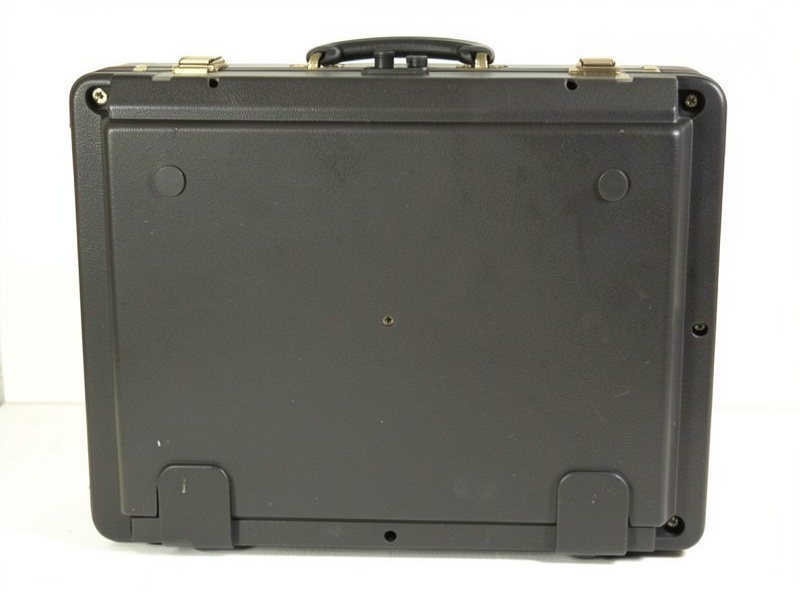
The integration isn’t inherently bad — a well-engineered all-in-one can be a legitimate product. The problem is that at the suitcase price point, every integrated component is the cheapest version of itself, and the component that suffers most is the one in contact with the record. The amplifier and speakers in a suitcase are mediocre but harmless; the tonearm and stylus are actively damaging. This is why the upgrade isn’t really “suitcase to turntable” so much as “damaging tonearm to safe tonearm” — the rest of the deck is almost incidental to the record’s fate.
The Three Things a Real Turntable Fixes
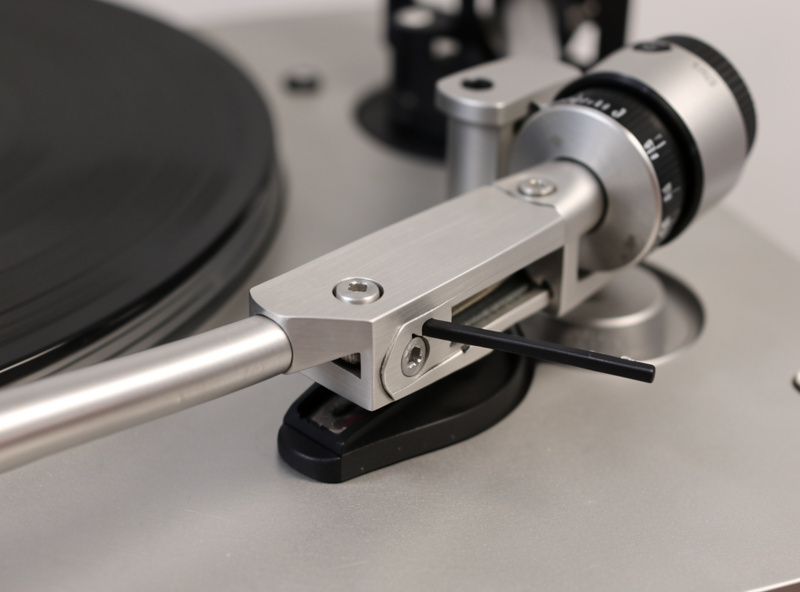
Move from a suitcase to a real turntable and three numbers change, all in the record’s favor, and I’d rank them in exactly this order. First, tracking force drops from roughly 5 grams to between 1.5 and 2.0 — either preset safely at the factory, as on an AT-LP60X, or adjustable with a counterweight, as on anything above it. That single change moves the stylus out of the damage zone, and it’s the variable I treat as the real risk on cheap players; the full mechanics are in my piece on tracking force on cheap record players.
Second, the stylus becomes a diamond instead of a sapphire, which buys you roughly ten times the tip life — 500 to over 1,000 hours instead of 50 to 100. A diamond stays a polished tracer for years of daily listening where a sapphire becomes a chisel in months. Third, the tonearm gets longer, adjustable, and anti-skated, so the geometry can be set to a real null-point standard and the stylus rides centered between the groove walls instead of grinding the inner one. The combination of those three is why a record played for years on a real turntable still sounds like itself, and the full myth-bust on how slowly the cheap deck actually wears a record is in the piece on whether Crosley players ruin records.
Suitcase Player vs Real Turntable, Side by Side
The differences concentrate into a short list of attributes, and putting them next to each other makes the trade-off obvious. The table below compares a generic Crosley-class suitcase player against an entry-level real turntable — the kind that costs around $150 and represents the minimum viable upgrade. Every row is a spec I can measure on the bench, not a marketing claim.
| Attribute | Suitcase player | Real turntable (entry) |
|---|---|---|
| Tracking force | ~5g, fixed | 1.5–2.0g, preset safe or adjustable |
| Stylus material | Sapphire, ~50–100 hr life | Diamond, 500–1000 hr life |
| Tonearm length | Under 8 in, fixed geometry | ~9 in, alignable to Baerwald |
| Counterweight | None | Yes, on adjustable decks |
| Anti-skate | Absent | Present and settable |
| Replaceable stylus | Sometimes, same sapphire | Yes, upgradable profile |
| Phono stage | Not needed (ceramic) | Built-in or external |
| Record wear rate | Fast, cumulative | Slow, within spec |
Read down the right-hand column and you can see why the upgrade stops the damage rather than slowing it: every row that’s actively harmful on the left becomes either safe or tunable on the right. The suitcase doesn’t do one thing wrong; it does all of them wrong at once, and they compound — high force on a sapphire on a short arm with no anti-skate is a multiplication of wear factors, not an addition. Fixing any one of them in isolation would help, but the real turntable fixes all of them as a package, which is why the jump is so audible and so protective of the record.
What Changes in the Sound — and What Doesn’t
The sound difference between a suitcase and a real turntable is real, but it’s worth being honest about what changes and what doesn’t, because the expectations set the satisfaction. What changes most is the top end and the inner grooves. The diamond stylus at low force retrieves high-frequency detail the sapphire at 5g was either missing or smearing, and the longer, aligned tonearm resolves the inner tracks that sounded gritty and splattery on the suitcase. The soundstage opens up, the transients get sharper, and the quiet passages between the loud ones become audible again.
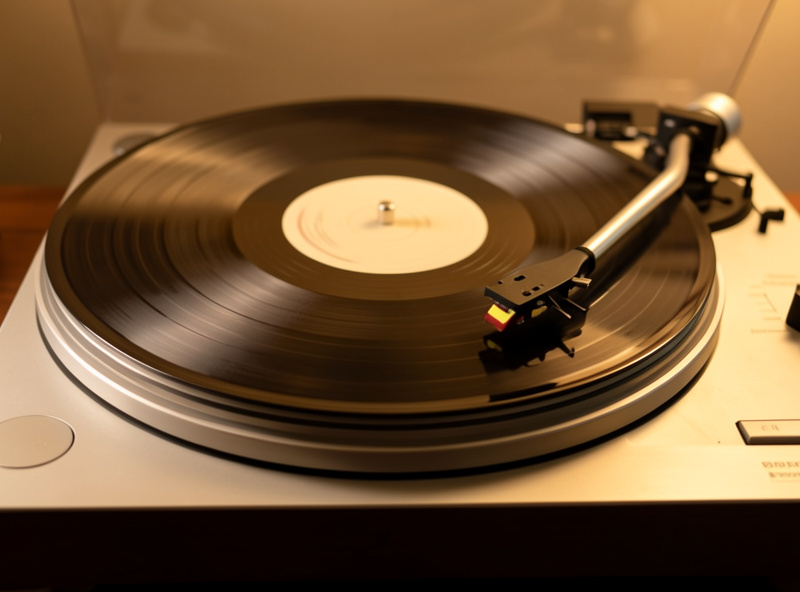
What doesn’t change, and what no upgrade will fix, is a record that’s already been worn. The groove material a suitcase has removed is gone, and a better deck will retrieve what’s left more cleanly but won’t restore what’s missing. This is the bittersweet part of the upgrade: the records you played on the suitcase will sound better on the real turntable, because the real turntable is more accurate, but they’ll also reveal the damage the suitcase did, because that same accuracy exposes what’s been worn away. The upgrade is worth making for the records you haven’t damaged yet, and the ones you have will at least stop getting worse.
Is the Upgrade Worth It If You Only Play Occasionally?
The “I only play records occasionally, so the wear doesn’t matter” argument is the one I push back on hardest, because it’s half-true in a way that hides the whole problem. It’s true that occasional play spreads the wear over a longer calendar time, so the record lasts longer in months even if the per-play damage rate is unchanged. It’s false that the wear doesn’t matter, because every play still removes groove material at the suitcase’s accelerated rate, and a record played once a week for five years on a suitcase has absorbed the same damage as one played daily for a few months — the total plays, not the calendar, decide the wear.
The occasional-listener case actually argues for the upgrade more strongly, not less, because the upgrade is a one-time cost that protects every record you’ll ever own, and the occasional listener owns records for decades. A hundred-and-fifty-dollar deck that lasts ten years and protects a few hundred records is paying for itself in preserved vinyl whether you play daily or monthly. The math favors the upgrade hardest for the listener who keeps records a long time and plays them rarely, because that’s the profile where the cumulative damage has the most years to accumulate. If you’re just starting and deciding what to buy first, the broader case for getting it right from day one is in the guide on starting a vinyl collection.
Where the Money Goes When You Upgrade
The price ladder from suitcase to real turntable is shorter than people assume, and the first rung does most of the work. A Crosley-class player is $40 to $80; an Audio-Technica AT-LP60X, the minimum viable real turntable, is around $149 and includes a built-in phono stage and a diamond stylus preset to safe force. From there, another $50 to $150 buys adjustability — a counterweight, anti-skate, a replaceable cartridge — which is where the deck starts to grow with you rather than being a fixed appliance. The full shortlist of what’s worth it around the $500 mark, once you’re past the entry tier and thinking about belts, arms, and platters, is in my guide to the best turntable around $500.
The honest framing is that the first hundred and fifty dollars buys record safety, and every dollar after that buys sound quality. A listener who never spends past the AT-LP60X has still solved the damage problem completely; a listener who spends thousands without first getting off the suitcase has spent money to keep damaging records more slowly. I made the upgrade-order mistake myself early on, keeping a cheap deck around as a “beater” for thrift-store finds and telling myself the cheap records didn’t deserve better. When I finally played a thrift copy of a record I also owned clean, the beater had worn it enough that the difference was obvious — I’d been quietly ruining the records I thought I was being thrifty with. The beater wasn’t saving me money; it was costing me records.
The Minimum Viable Upgrade
If you’re moving off a suitcase and want the cheapest deck that solves the damage problem, the Audio-Technica AT-LP60X at around $149 is the answer I give most people. It’s fully automatic, has a built-in phono stage, ships with a diamond stylus preset to roughly 2 grams, and stops the ongoing wear the suitcase is doing. It’s not adjustable, and I’d never put one on my alignment bench, but the force it applies is inside the safe window, and that’s the entire point of the upgrade.
If you know you’ll want to learn setup and grow into the hobby, skip the preset tier and go straight to an adjustable deck like the AT-LP120X at around $300, which gives you a counterweight, anti-skate, and a replaceable cartridge on a standard headshell — the three things that let a deck evolve with you. Either way, the upgrade from a suitcase is the one that pays for itself in preserved vinyl, and it’s the move I’d make before spending a dollar on speakers, a phono stage, or a cartridge. The vinyl record is a mechanical format that assumes a light, aligned, diamond stylus; the real turntable gives it that, and the suitcase doesn’t.
The suitcase player isn’t evil and the real turntable isn’t magic — they’re two products built to two different priorities, and only one of those priorities includes keeping your records alive. If you came here weighing whether the upgrade is worth it, the answer is yes, and the cheapest version of it is the single best hundred-and-fifty dollars a vinyl listener can spend. The full map of which cheap turntables are safe, which all-in-ones to avoid, and what to gift a beginner is in the suitcase record players hub, alongside the deeper dives on whether Crosley players ruin records and why tracking force is the real risk.
Related Articles
- Are Suitcase Record Players Bad? An Honest Setup Answer
- Do Crosley Players Ruin Records? What Actually Happens
- Cheap Record Player Tracking Force: Why It’s the Real Risk
- Cheap Turntables That Won’t Damage Records
- Best Turntable for Beginners Who Want It to Just Work
Is a real turntable really better than a suitcase player?
Yes, for the record. A real turntable sets tracking force into a safe 1.5 to 2.0 gram range, uses a diamond stylus, and gives the tonearm adjustable geometry and anti-skate. A suitcase player fixes all three at damaging values. The difference is measurable on the bench and audible after a few hundred plays.
What is the cheapest real turntable that beats a suitcase?
Around 150 dollars. The Audio-Technica AT-LP60X ships with a diamond stylus preset to roughly 2 grams, runs fully automatic, and has a built-in phono stage. It is not adjustable, but the force it applies is inside the safe window, which is the entire point of the upgrade.
Will upgrading my turntable fix records already worn by a suitcase?
No. Groove material removed by a suitcase player is gone for good. A better deck retrieves what is left more cleanly and stops further damage, but it cannot restore worn high frequencies. The upgrade protects the records you have not yet damaged.
Is the upgrade worth it if I only play records occasionally?
Yes, arguably more so. Total plays, not calendar time, decide wear, and an occasional listener owns records for decades. A one-time 150 dollar deck protects every record you will ever own, which favors the upgrade hardest for listeners who keep records a long time.
Does a real turntable need separate speakers?
Usually yes. Unlike a suitcase player, a real turntable does not have built-in speakers, though many entry models have a built-in phono stage. You pair it with powered speakers or a receiver. That separation is part of what makes it sound better and last longer.
As an Amazon Associate I earn from qualifying purchases.