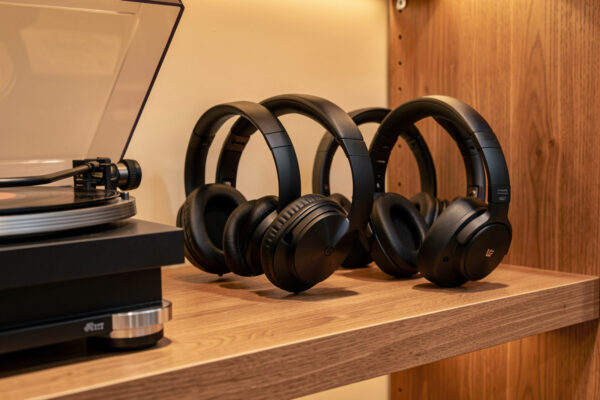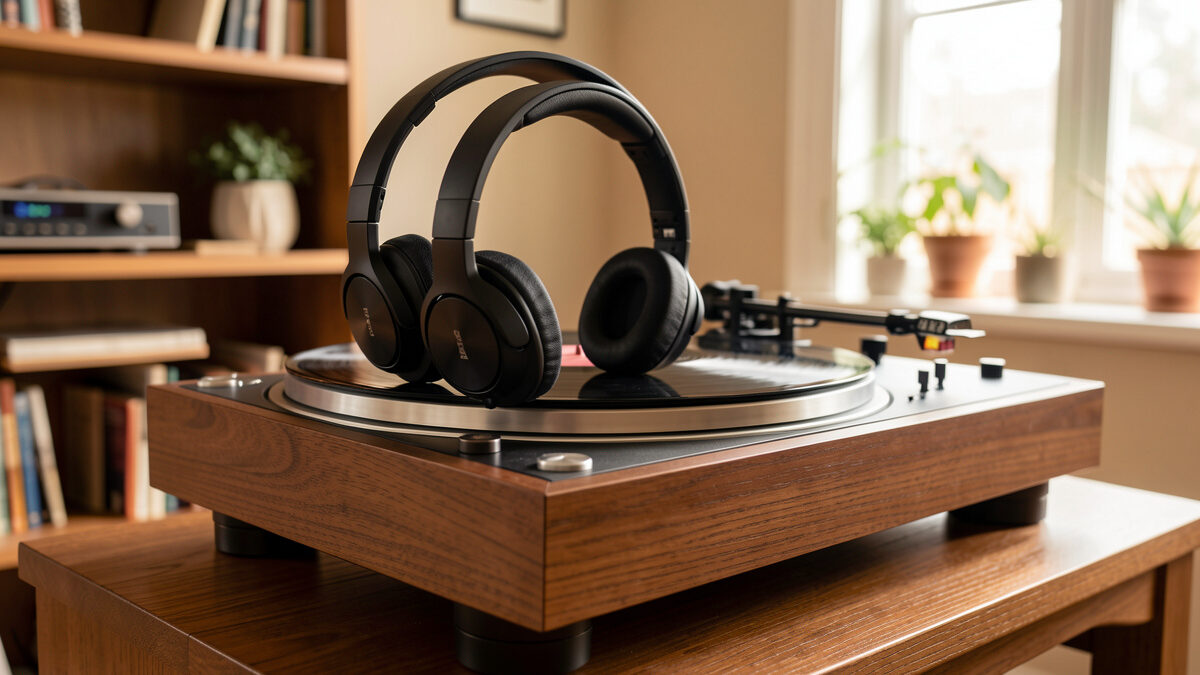
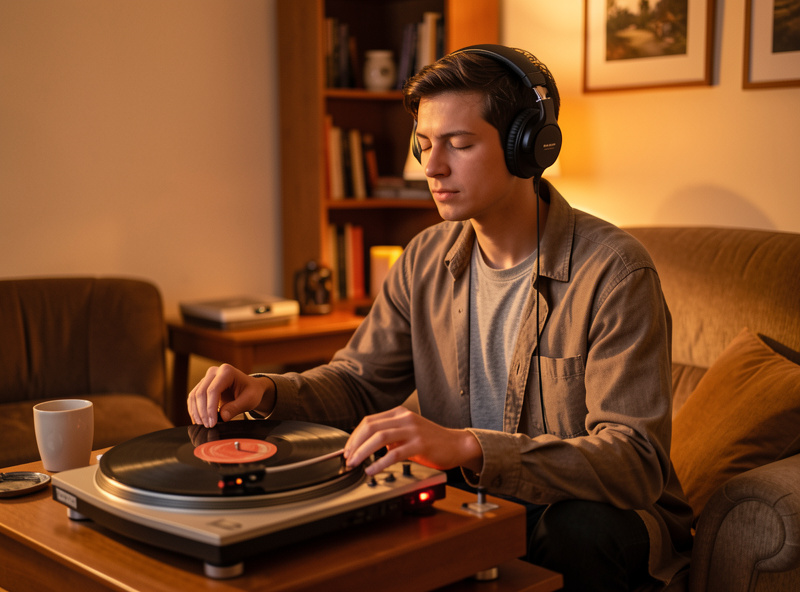
Headphones turn vinyl into a private, close-up listening session — late at night, in an apartment, or just to hear what your cartridge and phono stage are actually doing. But you cannot plug headphones into a turntable directly. You need a real chain: cartridge, phono stage, then a headphone amp with enough drive for the cans you own.
I run my decks both ways — through speakers in the listening room and into headphones at the bench. The headphone path is the most honest monitor I have for setup work, because it strips out the room. No reflections, no speaker feedback rattling the plinth, nothing between the stylus and your ear except the electronics. That clarity is the whole reason this niche exists, and it is also why a sloppy chain sounds so much worse on headphones than it ever does on speakers. This guide is the map: why headphones suit vinyl, the signal chain that makes it work, how to choose open or closed, when you genuinely need a headphone amp, and where the money actually belongs.
Why Listen to Vinyl on Headphones at All
Headphones give you three things speakers cannot: privacy, room-free detail, and freedom from acoustic feedback. A pair of competent open-backs on a decent amp resolves inner-groove detail and channel separation more clearly than most sub-2,000-USD speaker setups in an untreated room, because you have removed the room from the equation entirely.
The privacy case is obvious — vinyl is a sit-down ritual, and headphones let you have that ritual at midnight without waking the house. The detail case is the one setup people underrate. When I am dialing azimuth by crosstalk or chasing a faint channel imbalance, headphones expose it instantly; the same flaw can hide inside speaker-and-room interaction for weeks. And the feedback case is real mechanical physics: speakers pressurize the room, that energy reaches the plinth and the stylus, and at higher volumes you get a low-frequency feedback loop that muddies the bass. Headphones break that loop completely. The platter stops fighting your speakers, and you hear the record instead of the room.
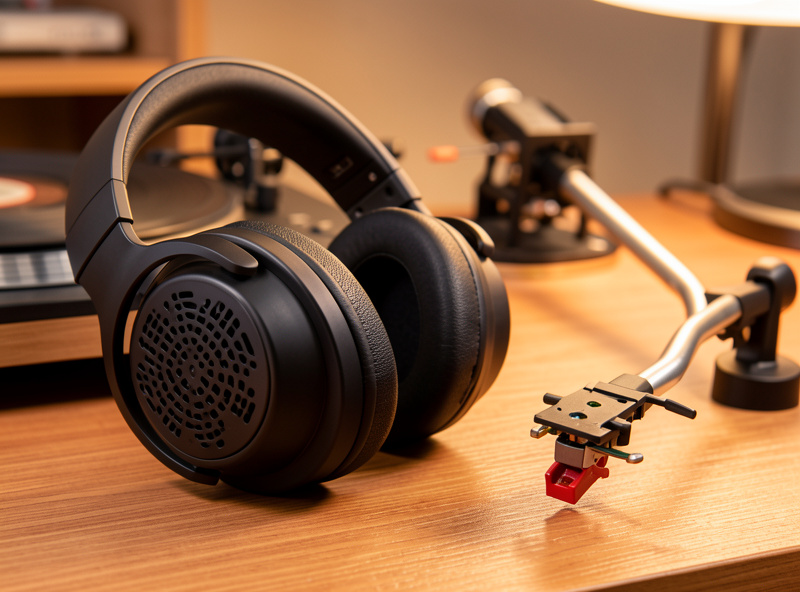
There is a tradeoff worth naming up front: headphones present a stereo image inside your head rather than out in front of you, so the soundstage feels closer and more forward than speakers. Some listeners love that intimacy on vinyl; others miss the room. Neither is wrong. But for hearing exactly what your front end is doing, the headphone view is the one I trust.
The Signal Chain: Cartridge to Phono Stage to Headphone Amp
The order is fixed and non-negotiable: cartridge, phono stage, headphone amplifier, headphones. The cartridge output is tiny and carries the RIAA equalization curve baked in; the phono stage boosts it and reverses that curve; only then does a line-level signal exist that a headphone amp can drive. Skip the phono stage and you get a faint, bass-light, wrong-sounding signal. Skip the headphone amp and most decent headphones never reach proper volume or control.
People get tripped up because the turntable has no headphone jack and the phono stage usually has no headphone jack either. The headphone amplification lives somewhere downstream, and you have a few honest ways to get it. The cheapest is the headphone jack on an integrated amplifier or receiver — fine for easy-to-drive cans, often weak for demanding ones. The cleanest is a dedicated headphone amp fed from your phono stage or preamp output. And the most compact is an all-in-one phono-stage-plus-headphone-amp box, which is where a lot of apartment setups should start.
If the term phono stage is still fuzzy, start with my explanation of why every vinyl rig needs a phono preamp and then the deeper phono stage guide on gain, loading, and MM versus MC. The headphone amp sits immediately after whatever phono stage you choose, and I break that exact handoff down in the phono stage to headphone amp chain guide.
Open-Back vs Closed-Back: The First Real Decision
For a quiet room where nobody minds the leak, open-back headphones almost always win for vinyl — they sound more spacious, more natural, and less boxed-in than closed-backs at the same price. For shared rooms, late-night listening next to a sleeping partner, or anywhere noise isolation matters, closed-back is the practical pick, and a good one gives up surprisingly little.
Open-backs have a vented earcup, so the driver works into open air. That reduces internal resonance and pressure build-up, which is why they image so naturally and why they are the default in serious headphone listening. The cost is zero isolation — they leak sound out and let room noise in, in both directions. Closed-backs seal the cup, isolating you and containing the leak, at the price of a slightly more closed, occasionally boomier presentation. I keep both at the bench and reach for open-backs when I am evaluating a cartridge and closed-backs when the house is asleep. I unpack the full tradeoff in the closed versus open headphones comparison and the dedicated open-back headphones for vinyl guide.
Do You Actually Need a Headphone Amp for a Turntable?
Sometimes yes, sometimes no — it depends entirely on the headphones, not the turntable. Easy-to-drive cans rated around 32 ohms with high sensitivity will play loud enough from a phone-grade jack; demanding designs at 250 to 300 ohms, or low-sensitivity planars, need a real headphone amp to reach volume and, more importantly, to keep control of the bass.
Two specs decide it: impedance and sensitivity. A 300-ohm Sennheiser HD 600 or a 250-ohm Beyerdynamic DT 880 demands voltage that a weak integrated-amp jack cannot deliver — they will play, but thin and gutless. A 32-ohm, high-sensitivity closed-back will sound fine straight from a receiver. The honest test: if you have the volume knob past two-thirds and it still feels soft or loose in the low end, your headphones are starved and an amp will transform them. If it is plenty loud at nine o’clock, you may not need one yet. I walk through impedance matching, gain, and the amp options in the headphone amplifier for turntable guide.
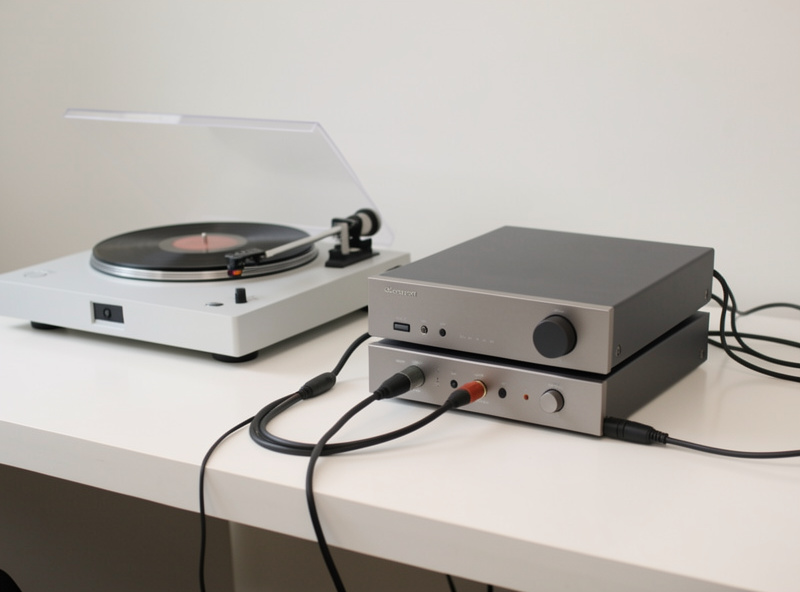
One caution that catches beginners: do not run your headphones from the phono output of a phono stage. That is a line-level signal with no headphone drive and no volume control on most units — you will get either nothing useful or a blast that can damage your hearing and the headphones. The amplification stage is mandatory, and a search for a desktop headphone amplifier is the right starting point if your integrated jack is weak.
Matching Headphones to Your Cartridge and Phono Stage
A revealing pair of headphones will expose every flaw in your front end — that is a feature, not a problem. If your cartridge alignment is off, your tracking force is wrong, or your phono loading is mismatched, headphones tell you faster and more bluntly than speakers ever will, because there is no room to hide the error in.
This is why I treat headphones as a setup instrument. Inner-groove distortion from a bad overhang, sibilance from a too-light or too-heavy tracking force, channel imbalance from azimuth drift — all of it jumps out on headphones. Before you blame the headphones for sounding harsh, check the basics: confirm your tracking force and anti-skate are set, your cartridge alignment is on the null points, and your cartridge loading matches the phono stage. A clean moving-magnet cartridge into a properly loaded phono stage into a competent amp will sound better on modest headphones than a misaligned premium cartridge into expensive ones. The full setup and calibration guide is the foundation everything here sits on, and the cartridge guide covers MM versus MC if you are choosing the front end.
Headphone Types for Vinyl Compared
There is no single best headphone for vinyl, only the right type for your room, your budget, and the cans’ drive demands. The table below sorts the main categories by what actually matters for record listening — isolation, drive difficulty, and the listening situation each one suits.
| Type | Typical Impedance | Needs an Amp? | Isolation | Best For |
|---|---|---|---|---|
| Open-back dynamic | 32-300 ohm | Often, at higher impedance | None (leaks both ways) | Quiet rooms, critical and late-night listening |
| Closed-back dynamic | 32-80 ohm | Usually no | Good | Shared rooms, near a sleeping partner |
| Planar magnetic | 30-60 ohm, low sensitivity | Yes, almost always | Varies | Detail seekers with a real amp |
| On-ear (Grado-style) | 32-48 ohm | Sometimes | Poor | Lively, forward sound on a budget |
| Budget open-back | 32-50 ohm | No | None | First step into headphone vinyl |
A word on the planar-magnetic row, because it trips people up. Planars often show a low impedance, which fools buyers into thinking they are easy to drive, but their low sensitivity means they are current-hungry and almost always want a real amp behind them. They reward that amp with tight, fast bass and a level of detail that suits a clean vinyl front end beautifully — just do not expect them to shine out of a receiver jack. The on-ear Grado-style designs are the opposite: lively and forward, easy to drive, but with essentially no isolation, so they belong in a room you have to yourself.
If you want named starting points, the spoke guides go deep: the best headphones for vinyl listening shortlist covers the all-rounders, and the best budget headphones for turntable guide is where most people should actually begin.
Where the Money Actually Belongs
Spend in this order: clean records, correct setup, a competent phono stage, then headphones, and a headphone amp sized to those headphones. Spending 600 USD on headphones fed by a misaligned cartridge and a noisy phono stage is the most common money-wasting mistake in this hobby, and headphones make that mistake painfully audible.
The reason is leverage. A 150-USD cartridge that is perfectly aligned and properly loaded gives you more real improvement than a 400-USD cartridge dropped in crooked. The phono stage sets the noise floor and the tonal balance; on headphones, a hummy or hissy phono stage is impossible to ignore because there is no room noise to mask it. Get those right first, then buy headphones that match your room and your amp. A sensible first stack is a clean deck you have already aligned, an honest phono stage, a pair of easy-to-drive open-backs, and only later a dedicated amp if your cans turn out to need it. If you are buying records-first on a tight budget, prioritize a pair of open-back headphones you can grow into rather than the flashiest deck.
As an Amazon Associate I earn from qualifying purchases.
Wired or Bluetooth Headphones for Vinyl?
For critical listening, stay wired — the digital conversion and compression in most Bluetooth chains undoes the very analog detail you put headphones on to hear. Wireless headphones are a genuine convenience for casual background spins, but they are the wrong tool for evaluating a cartridge or enjoying a record at its best.
The physics is simple: a Bluetooth transmitter has to convert your analog phono signal to digital, compress it through a codec, beam it, and convert it back. Even good codecs add latency and shave detail, and the cheap transmitters baked into convenience turntables are not good codecs. If you genuinely need wireless — a long couch-to-deck distance, or you move around — feed a quality Bluetooth transmitter from your phono stage or preamp output rather than relying on a turntable’s built-in sender, and accept that it is a convenience layer, not a fidelity upgrade. I cover the wireless side of vinyl in the smart vinyl and Bluetooth bridges guide. For the bench, where I am actually judging sound, the cable stays plugged in every time.
Building Your First Headphone Vinyl Setup
A complete first headphone vinyl setup is four boxes: a clean, correctly aligned turntable, a phono stage, a headphone amp, and a pair of headphones matched to that amp. You can collapse the middle two into one all-in-one unit to save space and money, and that is exactly what I recommend for most apartment listeners starting out.
Here is the order I would actually buy in. Start with the deck you already own and get it right — clean the records, set the tracking force, align the cartridge. That groundwork costs almost nothing and is worth more than any single component. Next, sort the phono stage; if you do not have one, an all-in-one phono-stage-plus-headphone-amp box is the efficient move because it gives you both stages in one purchase and one power supply. Then choose headphones to match: in a quiet room, an easy-to-drive open-back; in a shared space, a closed-back. Only after living with that stack do you decide whether a separate, more powerful headphone amp is worth it — and you will know, because the cans will tell you by sounding soft or loose if they are being starved.
The mistake I see most is buying in reverse: premium headphones first, then discovering the integrated jack cannot drive them, then a hasty amp purchase, with the phono stage and setup still neglected. I made exactly that mistake myself early on — I brought home a 250-ohm pair before I owned anything that could drive them properly, then scrambled for an amp while the deck itself still sat half-aligned on the shelf. Build the chain front to back and every dollar lands. If you want a concrete shortlist sized to a tight budget, the budget headphones guide pairs cans with the amount of drive they realistically need.
Common Headphone-for-Vinyl Mistakes
The biggest mistakes are all chain mistakes, not headphone mistakes. Plugging headphones into the wrong output, ignoring impedance, expecting closed-back bass slam from open-backs, and blaming the headphones for setup flaws — those four account for most of the disappointment I hear about.
Plugging into a phono output instead of a headphone output is the dangerous one — no volume control, line-level into your ears. Ignoring impedance leaves expensive headphones sounding thin from a weak jack. Expecting a sealed, bass-forward sound from an open-back design is a mismatch of expectations, not a fault. And the subtle one: a harsh, fatiguing sound is far more often a tracking-force or alignment problem than a headphone problem, because headphones remove the room that was hiding it. Fix the chain, match the impedance, choose the right back type for your room, and headphones become the most revealing and rewarding way to hear a record. If your turntable is in a shared space, pairing headphones with proper isolation also keeps footfalls and structural rumble out of that very revealing signal path.
Frequently Asked Questions
Can I plug headphones directly into my turntable?
No. A turntable outputs a tiny, RIAA-encoded phono signal with no headphone amplification. You need a phono stage to boost and correct it, then a headphone amp to drive the headphones. Most turntables have no headphone jack at all.
Do I need a headphone amp for vinyl, or is my receiver enough?
It depends on the headphones. Easy-to-drive 32-ohm models often play fine from a receiver or integrated amp jack. Demanding 250 to 300-ohm headphones and low-sensitivity planars need a dedicated headphone amp to reach proper volume and bass control.
Are open-back or closed-back headphones better for records?
Open-back headphones sound more spacious and natural and are the default for critical vinyl listening in a quiet room. Closed-back headphones isolate you and contain the leak, making them the right choice for shared rooms or late-night listening next to others.
Why do headphones make my vinyl sound harsh?
Usually the setup, not the headphones. Headphones remove the room that hides flaws, so wrong tracking force, bad alignment, or mismatched cartridge loading become obvious. Confirm tracking force, alignment on the null points, and correct loading before blaming the headphones.
What is the correct signal chain for headphone vinyl listening?
Cartridge, then phono stage, then headphone amplifier, then headphones, in that fixed order. The phono stage boosts the cartridge and reverses the RIAA curve; the headphone amp provides the drive. An all-in-one phono-stage-plus-headphone-amp box combines the last two stages.
Where should I spend money first for headphone vinyl listening?
In order: clean records, correct setup, a competent phono stage, then headphones, then an amp sized to them. A perfectly aligned modest cartridge into a clean phono stage beats an expensive cartridge dropped in crooked, and headphones expose that difference instantly.