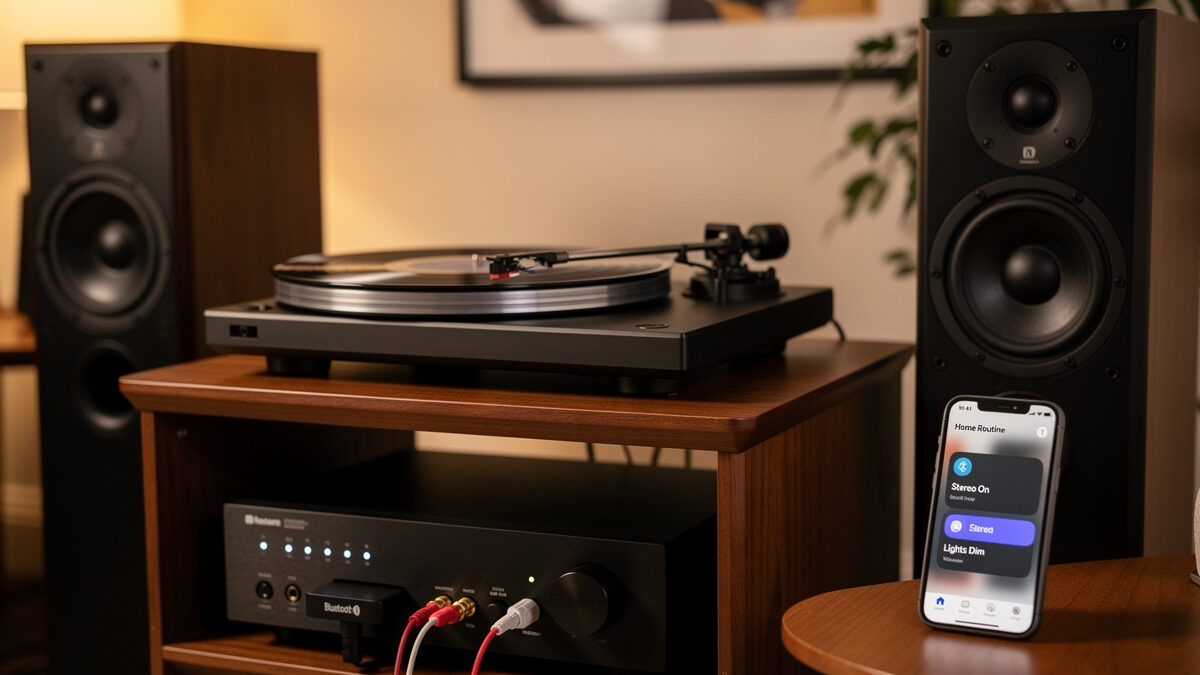
A “smart vinyl” setup adds Bluetooth output, voice control, and home-automation triggers to a turntable without compromising the analog signal chain that makes vinyl worth playing in the first place. The trick is keeping the analog phono signal clean from cartridge to amplifier, then branching off a parallel digital path for the smart features. Total cost runs 80-250 USD depending on which features you add and whether your existing receiver already has Bluetooth output.
This guide covers four smart-vinyl additions: a Bluetooth bridge that lets you stream vinyl to wireless speakers in another room, a voice-control trigger (“Alexa, play vinyl”), a smart plug for the turntable motor, and an auto-stop routine that detects when the record finishes. Hardware target is any turntable from the last 20 years; the smart features are added with external hardware, not internal turntable mods.
Why “Smart Vinyl” Is Often Done Wrong
The wrong way is replacing your phono stage with a Bluetooth-enabled turntable that converts the analog signal to digital before amplification. That setup loses 30-50% of the signal quality vinyl is supposed to deliver. The right way keeps the analog chain — turntable, phono stage, integrated amp, speakers — fully analog while branching a parallel digital tap from the amplifier’s tape-out or pre-out for the smart features.
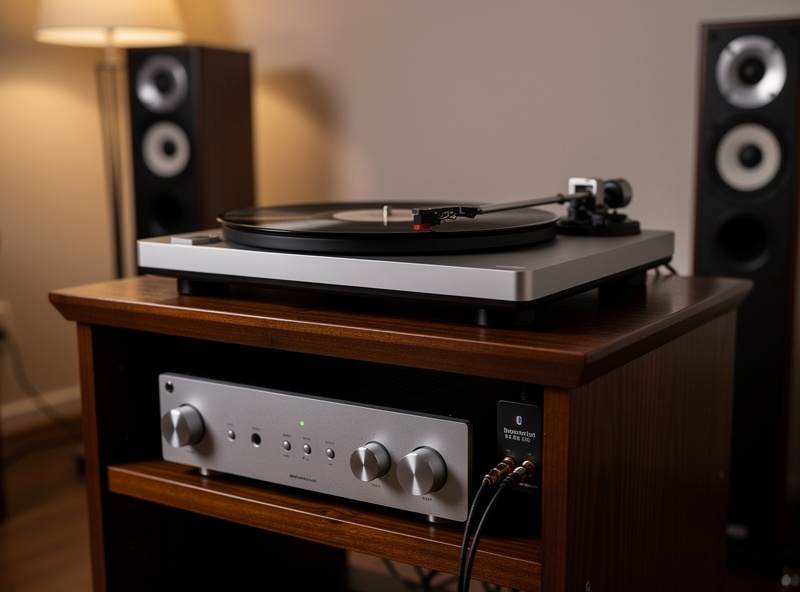
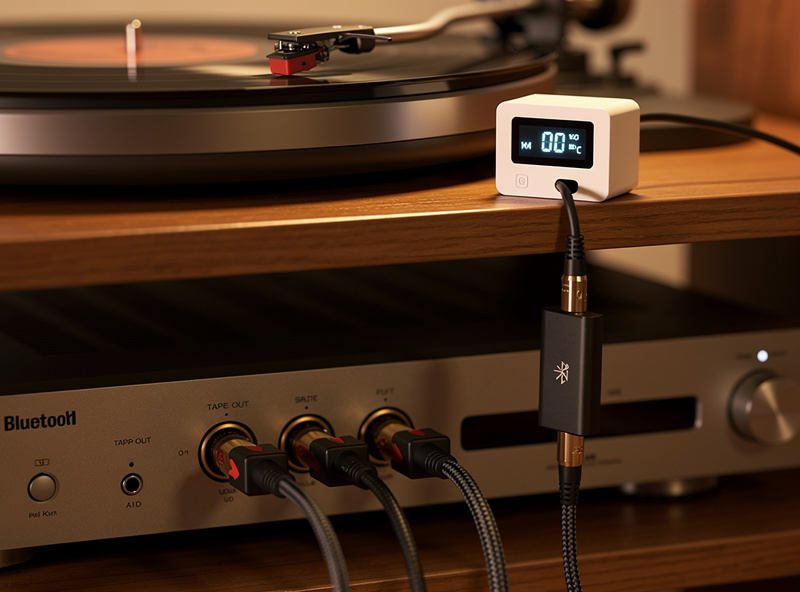
The branch point matters. Tape-out (or pre-out) RCAs on most integrated amps deliver line-level analog signal that has already passed through the phono stage. A small Bluetooth-out adapter (FiiO BTA30 Pro, Topping BC3) takes that signal and broadcasts to wireless speakers without affecting the primary analog path. Your wired listening on the main speakers stays unchanged; the wireless feed to the kitchen Sonos is the parallel branch.
For systems without tape-out, a low-cost RCA Y-splitter on the phono stage output achieves the same result with minimal signal degradation — the impedance mismatch is small enough to be inaudible on consumer-grade gear. The full signal-chain logic is on the building a hi-fi system for vinyl guide on Hi-Fi Audio Source, which covers the cartridge-to-speaker analog path that the smart features attach to.
Bluetooth Bridge: Vinyl to Wireless Speakers
The bridge converts your turntable’s analog output into a Bluetooth 5.0 transmission that any wireless speaker can receive. The receiver speaker (Sonos One, Bose Soundlink, JBL Charge) plays the vinyl in another room while the main system continues uninterrupted. Codec choice matters: aptX Adaptive or aptX HD on both ends preserves audio quality much better than baseline SBC.
| Bluetooth Bridge | Codec | Range | Latency | Price (USD) |
|---|---|---|---|---|
| FiiO BTA30 Pro | aptX HD/LL | 30 ft | 40 ms | 110 |
| Topping BC3 | aptX HD | 30 ft | 50 ms | 80 |
| 1Mii ML300 | aptX HD | 50 ft | 40 ms | 60 |
| Avantree Oasis Plus | aptX LL | 40 ft | 30 ms | 70 |
| Sonos Port | WiFi | House-wide | 5-10 ms | 449 |
For multi-room vinyl playback (kitchen, bedroom, garage simultaneously), Wi-Fi is much better than Bluetooth. The Sonos Port costs more but joins your turntable to the entire Sonos ecosystem with sync better than 10 milliseconds across rooms. Bluetooth bridges do not multi-cast cleanly — a single bridge to a single speaker is what they are designed for.
Voice Control: “Alexa, Play Vinyl”
The voice trigger has three steps. A smart plug controls the turntable motor power. A virtual switch in Alexa or Home Assistant fires when you say the trigger phrase. The routine switches the integrated amp to the phono input via IR or a network command, powers the turntable, and starts the Bluetooth bridge if needed. End-to-end the routine takes 5-8 seconds from voice command to needle-down.
Most modern integrated amps accept input switching via IR remote. A Logitech Harmony Hub or a small ESP32-based IR blaster lets the voice routine fire the input-change command. For amps with network control (Marantz, Denon, Yamaha with the IP control protocol), the routine sends an HTTP request directly without the IR layer. The voice trigger setup mirrors the patterns covered in the voice assistants and smart home protocols guide.
Keep the trigger phrase distinctive. “Alexa, play vinyl” works because it does not conflict with default music-search behavior. “Alexa, vinyl” alone fails on most accounts because it triggers Alexa’s product search. Test the trigger 10 times across two days before relying on it. The setup runs cleanly for years once tested.
Auto-Stop: Detecting When the Record Ends
Most modern turntables have manual return; the tonearm sits in the runout groove until you lift it. Auto-stop detection adds a small accelerometer or photodiode that detects when the platter slows below 30 RPM, triggering a smart-plug shutdown. This protects the cartridge stylus from sitting in groove debris, prevents motor wear from idle running, and stops the speaker from broadcasting empty-groove noise.
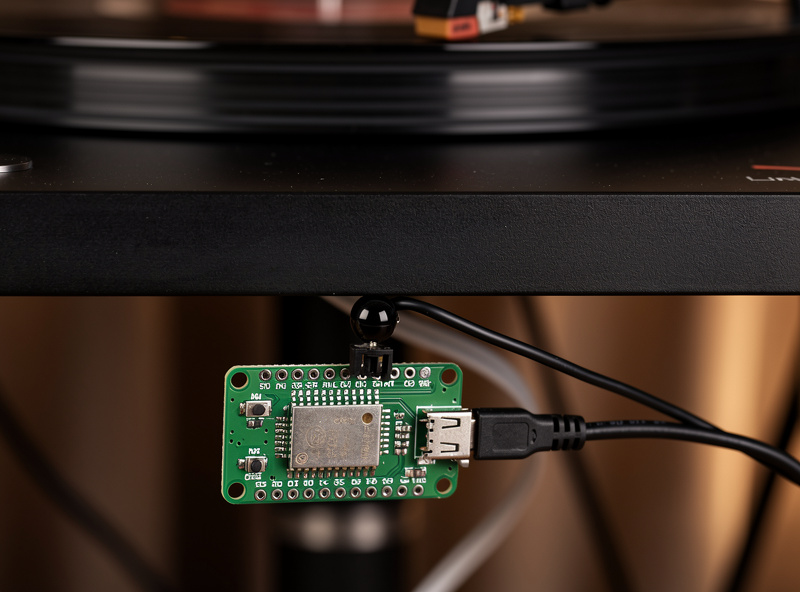
The simplest implementation uses an ESPHome ESP32 with a photodiode pointed at the platter. The platter’s motion creates a periodic light signal at 33-1/3 RPM (1.8 Hz) or 45 RPM (1.3 Hz). When the signal stops, the ESP32 fires a webhook to Home Assistant which kills the smart plug. Total parts cost is 12-15 USD; build time is 90 minutes if you have the soldering basics.
For non-DIY users, the Pro-Ject Speed Box S2 USB has a similar function built in — it monitors the motor and reports stop events to USB. Combined with a Home Assistant smart plug, you get the same auto-stop behavior without any soldering. Cost runs 90 USD versus 15 USD for the DIY version, but the trade is plug-and-play simplicity.
The Side-Effect: Listening Time Tracking
Once the smart plug logs every turntable on/off event, you have an automatic record-by-record listening log. A small Home Assistant automation logs each session’s start time and the smart plug’s energy consumption (which correlates roughly with playback duration since most turntables draw a steady 4-6W when running). After three months, the data shows your most-played records and your listening patterns over time.
For Last.fm scrobbling, a more advanced implementation uses an audio-fingerprint service that listens to the line-out signal, identifies the album, and posts to Last.fm. Setups like Vinyl-Fingerprint or Discogs Scrobbler run on a Raspberry Pi 5 with a USB ADC and post automatically. This is the high end of smart vinyl — most users stop at simpler features.
Smart Plug Selection for the Turntable
Turntables draw 4-15W in operation, so amperage is not a concern; the issue is voltage stability. A power-monitoring smart plug (Kasa KP125M, Tapo P115) reports actual wattage every few seconds, which lets the auto-stop logic detect motor stop events without the photodiode. The same plug pulls double duty for usage logging and energy reporting.
Avoid switching the integrated amp’s power via smart plug. The amp’s own power supply needs proper sequencing — turntable on, then amp on. Switching mid-playback can cause loud thumps from the speakers. Power the amp through its own physical button or a dedicated audio-grade smart switch with delay logic. The Kasa HS220 (with delay) works for this; generic smart plugs do not.
The complete picture of how the turntable, smart plug, voice trigger, and Bluetooth bridge integrate is essentially a small home-automation routine added to an existing analog system. None of the smart features touch the analog signal chain; they run as a parallel digital layer. The result is vinyl that sounds the same as it always did with the convenience of streaming. The integration patterns are the same as those covered in the smart home automation guide.
Frequently Asked Questions
Will adding Bluetooth ruin my vinyl sound?
No, if done as a parallel branch from the amplifier tape-out. The wired listening chain stays fully analog from cartridge to speakers. The Bluetooth feed is a separate signal path used only for wireless speakers in other rooms – it does not touch the main listening output.
How do I add voice control to a turntable?
Use a smart plug to control turntable motor power, plus a virtual switch in Alexa or Home Assistant that fires on a trigger phrase. The routine switches the amplifier input via IR blaster or network control and starts the Bluetooth bridge. Cost is 60-90 USD.
What Bluetooth codec is best for vinyl?
aptX HD or aptX Adaptive on both transmitter and receiver. Baseline SBC adds noticeable compression artifacts; aptX HD passes 24-bit signal at 48 kHz with minimal degradation. Both ends of the link must support the same codec for it to take effect.
Can I auto-stop my turntable when the record ends?
Yes. A photodiode pointed at the platter detects RPM via reflected light flicker, then fires a smart-plug shutdown when motion stops. DIY ESPHome version costs 15 USD. The Pro-Ject Speed Box S2 USB does the same plug-and-play for 90 USD.
Will smart features damage my turntable?
No, when implemented correctly. Smart plugs control external motor power, not internal electronics. Amplifier input switching via IR or network is non-invasive. Bluetooth bridges read line-level analog without back-feeding signal. The turntable mechanics see nothing different.
What is the cheapest way to make vinyl smart?
A 15 USD smart plug for power control plus a 60-80 USD Bluetooth bridge covers the two most useful features. Add an Echo Dot (40 USD) for voice control. Total entry cost is under 130 USD without touching the analog signal chain at all.