The best portable turntable for most people is the Audio-Technica Sound Burger (AT-SB2022): it runs a real moving-magnet cartridge tracking at 3.5 grams, holds wow and flutter under 0.25% WTD, and gives roughly 12 hours off a single charge. That combination — proper cartridge, tolerable speed stability, genuine battery — is rare in a category built mostly to look cute on a shelf.
I need to say the quiet part first, because it’s the whole reason this page exists. Most “portable turntables” are record-grinders. The suitcase model your cousin got for Christmas tracks a ceramic cartridge at somewhere north of 6 grams, and every spin is sandpaper on your grooves. I’ve measured that downforce on my own stylus gauge — a 0.01g digital gauge I trust more than any spec sheet — and watched the number climb past six on a bone-stock Crosley. So this guide is not “portables are magic.” It’s a setup tech telling you which portables won’t quietly destroy the records you care about, and which off-grid tricks actually work.
What Makes a Portable Turntable Actually Safe for Records?
A portable is safe for records when its cartridge tracks under about 2.5 grams and its arm can be adjusted or is factory-set correctly. That single number — vertical tracking force, VTF — separates a deck you can trust with a first pressing from one you should only feed thrift-bin copies. Ceramic cartridges on cheap portables push down at 5 to 7 grams; a properly aligned moving-magnet cartridge on a real deck sits between 1.5 and 2.5 grams.
Here’s why that gap matters more than any other spec. The stylus rides in a groove wall that is, in places, only microns wide. Downforce is spread across a contact patch smaller than a red blood cell. Double the grams and you don’t just play the record louder — you plastically deform the vinyl, flattening the high-frequency detail on the first pass and leaving it there forever. I keep a “sacrifice” copy of a Rumours pressing I abused on a ceramic portable years ago; the sibilance on “Dreams” is permanently smeared. That record taught me the lesson this whole site is built on. If you want the full autopsy, I walked through the mechanism in whether battery-powered turntables are safe for vinyl.
The second safety factor is the arm itself. A good portable uses a proper pivoting tonearm with at least a static-balance or spring-tension system — the Sound Burger uses a dynamic-balance spring that applies a defined 3.5g rather than just letting a slab of plastic drop onto the record. The worst offenders bolt the cartridge to a stubby arm with no real geometry at all, which means overhang and anti-skate are simply wrong out of the box and can’t be fixed. When I evaluate any portable, I check three things before I listen: what tracks the groove, how hard it presses, and whether I can change either.
The Portables I’d Actually Put a Record On
Only a handful of portables clear the bar. Below is how I rank the ones I’ve handled, judged on the metrics that decide record safety and sound: what cartridge tracks the groove, how many grams it presses, whether it runs off a battery, and whether the Bluetooth is worth anything. The “take” column is my listening-space verdict, not a spec-sheet paraphrase.
| Model | Drive | Cartridge & VTF | Bluetooth | Battery | My take |
|---|---|---|---|---|---|
| Audio-Technica Sound Burger (AT-SB2022) | Belt | AT3600L moving-magnet, 3.5g | Yes (out only) | ~12h Li-ion | The only one I’d track a keeper on |
| Audio-Technica AT-SB727 | Belt | Moving-magnet, ~3.5g | Yes | Rechargeable | Same idea, anniversary trim, still safe |
| Victrola Revolution Go | Belt | Ceramic, ~5g+ | Yes | Rechargeable | Convenient off-grid, but play-only copies |
| House of Marley Stir It Up Wireless | Belt | Audio-Technica MM | Yes (in & out) | AC only | Not pocketable, but a real cartridge |
| Crosley Cruiser Plus (CR8005F) | Belt | Ceramic, ~6g | Yes | AC only | Built-in speakers, hardest on grooves |
The pattern is not subtle. Cartridge type sorts this list almost perfectly. The two Audio-Technica units and the House of Marley run moving-magnet cartridges tracking in the safe zone; the Victrola and Crosley use ceramic elements that press two to three times harder. If you take one thing from this table, let it be that the badge on the lid matters far less than the little body clamped to the end of the arm. I broke the head-to-head between the two archetypes down in the Sound Burger vs Crosley portable tested take, because those two decks are the honest extremes of this whole category.
Ceramic vs Moving-Magnet: The Divide That Decides Everything
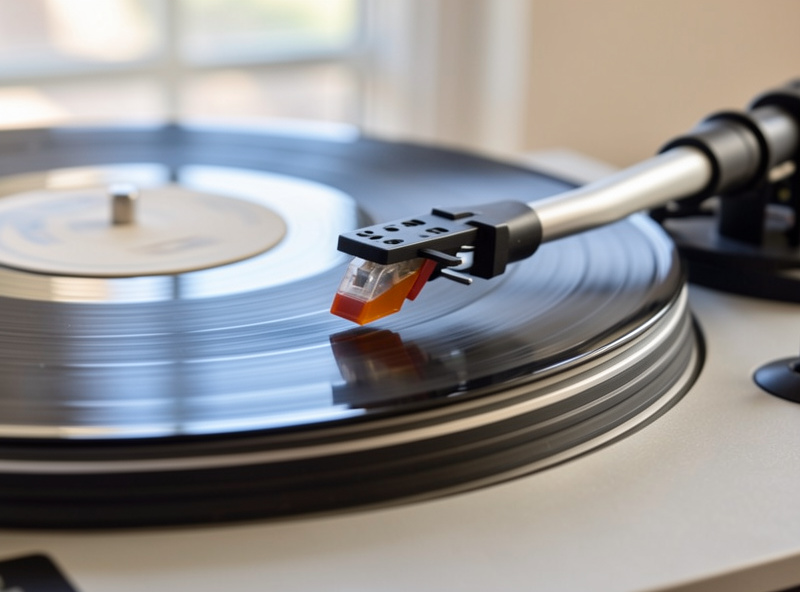
The cartridge is the single most important part of any portable, and portables split cleanly into two camps: ceramic (piezoelectric) and moving-magnet. Ceramic cartridges are cheap, output a huge signal that needs no phono preamp, and are electrically robust — which is exactly why manufacturers love them in kids’ suitcase decks. The catch is that they demand high tracking force and have a compliant, low-resolution stylus that smears detail.
Moving-magnet is the format I mount on every real deck I own. A generator with tiny magnets riding on the cantilever produces a low, clean signal that a phono stage brings up to line level with RIAA equalization applied. The AT3600L in the Sound Burger is the same basic moving-magnet generator Audio-Technica has shipped for decades, and it tracks lightly enough to leave records intact. The tradeoff on a portable is that you need a phono preamp somewhere in the chain — built into the deck, or downstream — which is part of why the good portables cost more than the toys.
I ran a blunt A/B once: same pressing of a Blue Note reissue, first on a borrowed Crosley, then on the Sound Burger into my normal chain. The ceramic deck was louder and honestly not offensive across a room — but the cymbals were a gray wash, and the bass had that one-note thud ceramic always gives me. On the Sound Burger the ride cymbal had a stick edge again. It is not close, and it is not subtle. If you’re choosing a portable purely on which cartridge it carries, that’s the right instinct — and I unpack the loading and gain side of it in the guide to the best Bluetooth portable turntable for the backyard.
How Bad Is the Wow and Flutter on Battery Turntables?
Wow and flutter on portables typically runs 0.2% to 0.3% WTD, versus under 0.1% on a decent home belt drive and around 0.025% on my direct-drive reference. That’s the audible weak point of the whole category: not frequency response, not the cartridge even — speed instability, the slow pitch drift (“wow”) and fast warble (“flutter”) that a small, cheap motor and a light platter can’t suppress.
The Sound Burger is specified at under 0.25% WTD at 3 kHz, which is honestly respectable for something this size. You’ll hear it on sustained piano and held organ notes — a faint seasickness on a long chord — but it stays out of the way on most rock and acoustic material. The suitcase decks are worse, and the tell is a wobbling voice on a slow ballad. Battery operation itself doesn’t hurt speed; a regulated motor runs the same on cells or wall power. What hurts is platter mass and bearing quality, both of which get cut to hit a size and price. I measured this whole problem end to end, strobe disc and all, in portable turntable speed stability: why wow is the weak point.
Wow and flutter is measured under standards like DIN 45507, which weight the result for how the ear actually perceives pitch error — that’s the “WTD” (weighted) suffix on the spec. When a portable quotes an unweighted number, or none at all, assume the real figure is worse. Speed is the spec manufacturers hide when they can.
Do You Need Bluetooth, Built-In Speakers, or Both?
For a portable, Bluetooth output is the feature that actually justifies the form factor — it lets you throw a record onto a deck in the yard and send it to a speaker across the patio without a cable run. Built-in speakers, by contrast, are the feature that makes portables sound like portables. Almost every suitcase unit puts tinny 2-watt drivers a couple inches from the platter, and their vibration feeds straight back into the stylus.
That feedback loop is the hidden cost of built-in speakers. On a suitcase deck at any real volume, the cabinet resonates, the platter picks it up, and you get acoustic feedback muddying everything — the same reason I isolate my main table on sorbothane feet away from my monitors. A portable with Bluetooth out and no onboard speaker sidesteps the whole problem: the sound leaves the box before it can shake the needle. The Sound Burger is Bluetooth-out only and has no speaker, which reads like a limitation and is actually a design virtue.
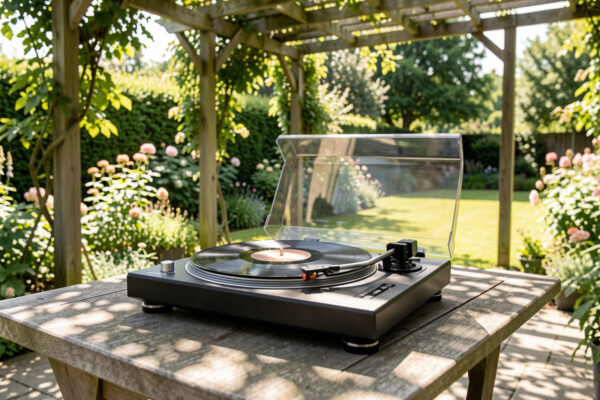
One honest caveat on Bluetooth: it adds latency and a lossy codec between the cartridge and your ears. For casual backyard listening that’s fine — I do it happily. For critical listening it’s not, and no portable is a critical-listening tool anyway. If you want the convenience without the built-in-speaker penalty, prioritize a wireless-out model and pair it to a decent portable speaker. I laid out my actual outdoor rig, feedback traps and all, in can you play records outside — a practical setup.

Battery Life and Off-Grid Playback: What Specs Don’t Tell You
Real off-grid playback needs a genuine rechargeable battery, and only a few portables have one. The Sound Burger’s Li-ion pack is rated around 12 hours, which is roughly twenty LP sides before it needs a charge — enough for a whole afternoon in the yard or a weekend away. Many “portable” decks are portable only in the sense that they have a handle; they still need a wall outlet.
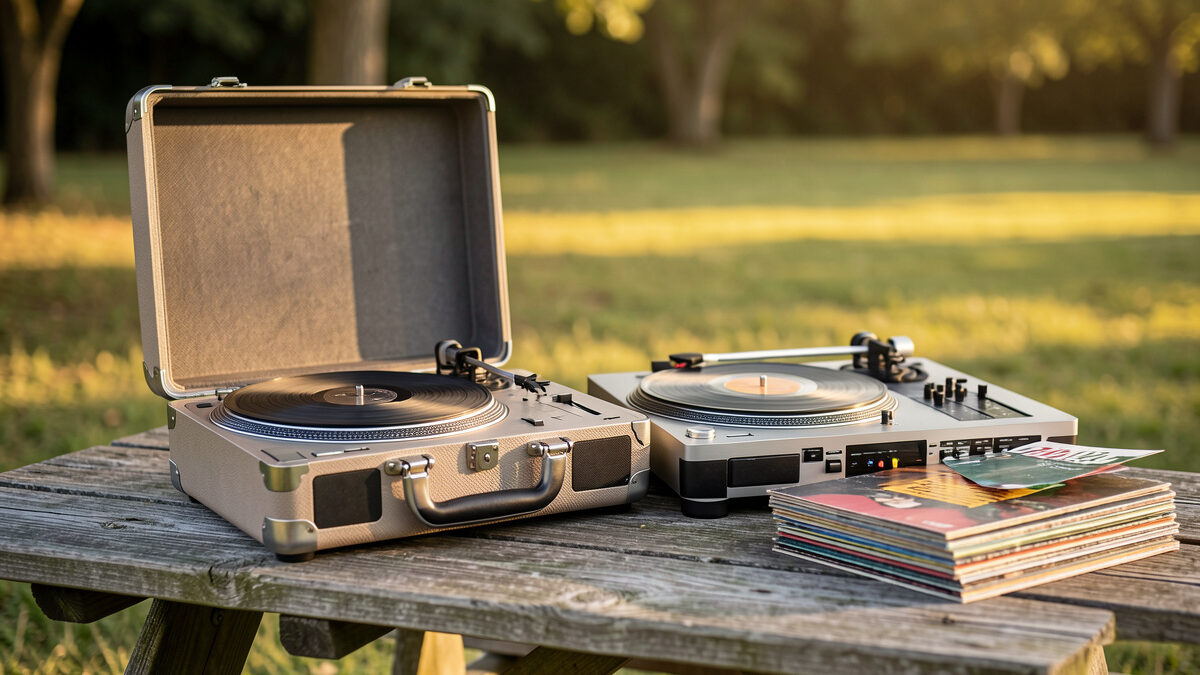
The spec sheets also stay quiet about how battery decks behave as the charge drops. A well-regulated motor holds speed until the battery protection cuts out; a badly regulated one runs slow near empty, and you’ll hear pitch sag on the last side before it dies. I test this by playing a 3150 Hz test tone off a strobe-and-tone record and watching for drift as the battery drains — a trick I borrowed from bench-testing my belt decks. The good units hold pitch to the end. Off-grid also means dust, pollen, and sun: a battery deck left open on a picnic table collects grit that ends up under the stylus, so I brush every side with a carbon-fiber brush and pack the deck in a sleeve between listens.
If your use case is genuinely mobile — camping, a boat, a balcony with no nearby outlet — battery capacity and motor regulation matter more than sound quality, because a dead deck plays nothing. If your “portable” mostly moves between rooms in an apartment, you can ignore battery life entirely and buy on cartridge and speed stability instead. That’s a different buying decision, and I made the case for it in the best travel turntable for a small apartment or dorm.
Portable vs a Real Deck: When to Stop Compromising
A portable is the right tool for playing records somewhere you couldn’t otherwise — a yard, a dorm desk, a trip. It is the wrong tool for being your main system. The moment you find yourself doing critical listening on a portable, or babying a valuable pressing on one, you’ve outgrown the category and should move to a real belt or direct-drive deck with an adjustable arm.
My upgrade order for anyone leaving portables behind is the same order I preach for the whole hobby: clean your records, set the table up right, then spend on the phono stage, then the cartridge, and only last on the table itself. A $100 portable and a $400 entry deck — the class I shortlist in my best turntable around $500 guide — are not two points on one line — the entry deck lets you adjust VTF, align the cartridge on a protractor, and swap the stylus, none of which a sealed portable allows. That adjustability, not the badge, is what you’re actually buying when you step up.
Where portables genuinely shine is as a second deck: the one you grab without thinking, the one that lives by the back door for summer. I keep the Sound Burger exactly there. It is not trying to be my SL-1200-class reference, and I don’t ask it to be. Bought with clear eyes about what it is, a good portable earns its shelf space every warm month of the year.
What to Check Before You Buy a Portable Turntable
Before you buy any portable, run down five checks in this order: cartridge type, tracking force, drive system, battery, and speaker/output layout. Get the first two right and you’ve eliminated 90% of the record-wrecking junk. The rest is matching the deck to where and how you’ll actually use it. I run this same triage on every portable a friend hands me before I’ll spin one of my own records on it.
Cartridge first. If the listing says “ceramic” or doesn’t name a cartridge at all, assume high tracking force and treat it as a thrift-copy-only deck. If it names a moving-magnet cartridge — an AT3600L, an AT-VM95 body, anything with a model number Audio-Technica or Ortofon actually publishes — you’re in safer territory. Tracking force second: a printed VTF in the 1.5 to 3.5 gram range is fine; a blank spec or a number over 5 grams is a red flag I won’t ignore, and if you want to understand what that number actually does to a groove, I break it down in my tracking force adjustment guide. Third, drive: belt drive dominates portables and that’s fine here — the belt actually helps isolate motor noise on a small chassis, and direct drive is overkill at this size and price.
Fourth, battery — but only if you’re going genuinely off-grid. A rechargeable Li-ion pack rated near 12 hours is the gold standard; “battery” that means four AA cells you replace is a nuisance and often means a poorly regulated motor. Fifth, the speaker and output question: a model with Bluetooth or a line output and no built-in speaker will almost always sound cleaner than a self-contained suitcase, because it isn’t shaking the needle with its own drivers. If you only remember two of these, remember cartridge and tracking force. Those two decide whether you own a record player or a record shredder.
Setting Up a Portable Turntable So It Sounds Its Best
Even a sealed portable rewards a few minutes of setup: level it, clean the record, kill vibration, and mind the belt. A portable can’t be aligned on a protractor the way my main decks can — overhang and anti-skate are fixed at the factory — but the variables you can still control make an audible difference. I’ve A/B’d the same portable carelessly plonked on a wobbly table versus set up properly, and the difference in speed steadiness alone is worth the trouble.
Start with a level surface and a bubble level. A portable tilted even a couple of degrees loads the stylus unevenly, exaggerating channel imbalance and inner-groove distortion — the mistake I see most often is someone playing one on a slanted picnic table and blaming the deck for sound that’s actually a setup error — the same fundamentals I cover in my first-time turntable setup guide. Next, clean every side with a carbon-fiber brush before you drop the needle; outdoors especially, pollen and grit under a 3.5-gram stylus grind faster than they would under a light hi-fi arm, and dust — not damage — is behind most of the pops people blame on the record, as I explain in crackle on every record. Third, isolate: a portable on a resonant hollow surface will pick up footfalls and its own speaker. I slip a thin sorbothane pad or even a folded towel under mine when it’s on a flimsy table, the same principle as the isolation feet under my reference deck.
Finally, respect the belt. Portables use thin belts that stretch and slip in heat — a belt left tensioned in a hot car or baking sun will run slow and warble. I store mine with the platter off when it’ll sit unused for weeks, and I’ve learned to let a sun-warmed deck cool before judging its speed. None of this turns a portable into a reference table. But it’s the difference between a portable performing at its honest ceiling and one dragged down by problems that were never the deck’s fault.
How I’d Spend the Money Starting Today
If you want one portable and you care about your records, buy the Sound Burger and be done — it’s the only unit here I’ll track a keeper on, and its 3.5g moving-magnet cartridge plus under-0.25% wow and flutter is the ceiling this category can currently reach without stopping being portable. Pair it with a small Bluetooth speaker for the yard and a carbon-fiber brush, and you have a real off-grid vinyl setup for well under the price of an entry hi-fi deck.
If your budget is tight and the records are all thrift-bin copies you don’t mind wearing, a ceramic suitcase deck will make noise and nobody’s stopping you — just never put an irreplaceable pressing on one. And if you’ve read this far nodding along about VTF and null points, you don’t want a portable as your main deck at all; you want an adjustable entry table, and the money is better spent there. Whatever you pick, check the tracking force before the first side. That one number, and the gauge that reads it, is the difference between playing your records and slowly erasing them.
Portable turntables and the Sound Burger on Amazon. As an Amazon Associate I earn from qualifying purchases.
Related Reading
- Audio-Technica Sound Burger vs Crosley Portable: Tested Take
- Are Battery-Powered Turntables Safe for Vinyl?
- Best Bluetooth Portable Turntable for the Backyard
- Portable Turntable Speed Stability: Why Wow Is the Weak Point
- Can You Play Records Outside? A Practical Setup
- Best Travel Turntable for a Small Apartment or Dorm
What is the best portable turntable overall?
The Audio-Technica Sound Burger (AT-SB2022) is the best portable turntable for most people. It uses a real moving-magnet cartridge tracking at 3.5 grams, keeps wow and flutter under 0.25 percent, offers Bluetooth output, and runs about 12 hours on its rechargeable battery. That mix of a safe cartridge and genuine portability is rare in the category.
Do portable turntables damage records?
Cheap portables can. Suitcase decks with ceramic cartridges track at 5 to 7 grams, roughly three times the safe force, and that pressure permanently wears groove detail. A portable with a moving-magnet cartridge tracking under 2.5 grams, like the Sound Burger, is safe for records you care about.
Are battery-powered turntables worse for sound quality?
No. Battery power does not hurt sound or speed on its own. A regulated motor runs the same on cells or wall power. What limits portable sound is a light platter and small motor, which raise wow and flutter, plus the cartridge quality. Battery life only matters for how long you can play off-grid.
Do I need Bluetooth on a portable turntable?
Bluetooth output is the feature that makes a portable genuinely useful outdoors, letting you send the signal to a speaker without a cable. It adds latency and uses a lossy codec, so it is not for critical listening, but no portable is a critical-listening tool anyway. For backyard use it is worth having.
Why do portable turntables have built-in speakers if they sound bad?
Built-in speakers make a portable self-contained, which sells well, but their vibration feeds back into the stylus and muddies the sound at any real volume. A model with Bluetooth output and no onboard speaker avoids that feedback loop and sounds noticeably cleaner.