Battery power is safe for your vinyl. The battery has nothing to do with record wear — a regulated motor spins the platter identically whether it draws from a lithium cell or a wall outlet. What actually threatens your records on a battery turntable is the same thing that threatens them on any cheap deck: a heavy-tracking cartridge and a sloppy build. The power source is a red herring, and I want to kill that myth before it costs you a record.
I hear the worry constantly, and I understand where it comes from — “battery” sounds like “toy,” and most toy turntables genuinely do wreck vinyl. But the two facts aren’t connected the way people assume. A battery deck with a good cartridge is as safe as any home player; a wall-powered suitcase with a ceramic cartridge will grind your records to death. Once you separate the power source from the cartridge, the whole question gets clear, and you can buy without fear.
Does Battery Power Itself Harm Records or Sound?
No. A battery simply supplies DC voltage to the motor and electronics, and a well-regulated motor holds its target speed regardless of source. Nothing about drawing power from a cell instead of a transformer touches the stylus, the groove, or the audio signal. In some ways battery power is theoretically cleaner, because you sidestep the mains hum and ground loops that plague wall-powered gear — the low-frequency ground hum I chase out of home systems simply can’t enter a deck that isn’t plugged in.
The sound quality of a battery turntable is set by everything downstream of the power: the cartridge, the tonearm, the platter mass, and the bearing. A battery deck can sound good or bad for the same reasons any deck does. When people say a battery turntable “sounds cheap,” they’re hearing a cheap cartridge and a light, unstable platter — not the battery. I’ve measured the output of a decent battery portable against an entry home deck and found the differences live entirely in wow, flutter, and cartridge resolution, exactly where you’d expect, and nowhere near the power supply.
So the first thing to unlearn is the instinct that battery equals unsafe. It doesn’t. It’s a convenience feature — off-grid playback — bolted onto a turntable that is otherwise judged by the same rules as every other turntable. Judge the deck, not its battery.
The Real Risk Is Tracking Force, Not the Battery
The thing that actually damages records is vertical tracking force, and it lives in the cartridge, not the power source. A safe cartridge tracks between about 1.5 and 2.5 grams; the ceramic cartridges in the cheapest players press down at 5 to 7 grams, and that excess force permanently deforms groove walls. Whether the motor runs on AA cells or mains current changes none of this.
This is where battery decks get unfairly smeared. Many battery portables are cheap, and cheap portables often use ceramic cartridges, so the correlation is real — but the battery isn’t the cause. The Audio-Technica Sound Burger runs on a rechargeable battery and tracks a moving-magnet cartridge at a safe 3.5 grams; Audio-Technica publishes that figure in the AT-SB2022 specifications, and it wears records no faster than a home deck. A wall-powered ceramic suitcase, by contrast, will chew through your collection. The dividing line is the cartridge, every time — which is exactly the split I laid out in the Sound Burger vs Crosley comparison.
So before you buy any turntable, battery or not, find the tracking force. If it’s published and sits under 2.5 grams, or under about 3.5 for a moving-magnet portable, your records are safe. If it’s a ceramic cartridge or the spec is simply missing, assume high force and treat it as a thrift-copy deck. I explain how to actually set and verify that number on adjustable decks in my tracking force adjustment guide — on a sealed portable you can’t change it, so you’re stuck with whatever the factory chose.
Do Batteries Cause Speed Problems as They Drain?
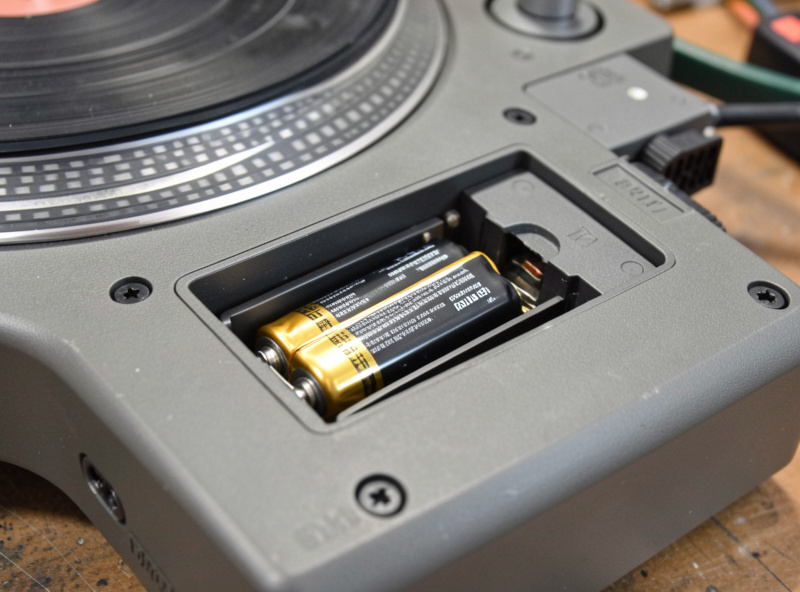
Only on badly designed decks. A properly regulated turntable motor holds speed until the battery protection circuit cuts it off, then simply stops. A poorly regulated one — usually a deck running unregulated straight off AA cells — runs progressively slower as voltage sags, and you’ll hear the pitch drop on the last side before it dies. Good battery decks don’t do this; bad ones do, and it’s a build-quality failure, not an inherent battery flaw.
I found this out the annoying way. I once played a side on a bargain AA-powered portable that was nearly drained, singing along, and slowly realized I was flat — the whole record had drifted down in pitch as the cells gave out, and my ear caught it before my eyes did. It felt like the room was sinking. I put a strobe disc on the platter and watched the dots crawl backward, confirming the speed had sagged well below 33⅓. The lesson stuck: on a battery deck, charge it, and check speed with a strobe if you suspect drift. A reputable rechargeable unit with a regulated motor won’t have this problem, but a four-AA special absolutely will.
This is why I rate a genuine rechargeable lithium pack over disposable cells every time. Beyond the convenience, a lithium-powered deck almost always pairs the better battery with a properly regulated motor, so speed stays locked until it quits. Speed instability is the portable category’s real weakness anyway — I measured the whole phenomenon in my piece on portable turntable speed stability — and a bad battery design only makes it worse.

Are Battery Turntables Safe to Charge and Store?
From a device standpoint, yes, provided you buy a reputable model with a protected lithium cell and charge it with the supplied adapter. The rechargeable packs in name-brand portables use standard protection circuitry — the same class of protected lithium-ion cells certified under safety standards like UL 2054 that you find in phones and laptops. Treat them the way you’d treat any lithium device: don’t leave a deck charging unattended for days, don’t store it fully drained for months, and keep it out of a hot car.
Heat is the enemy on two fronts. It stresses the battery, and it stretches the drive belt — a belt cooked in a sunny window or a hot trunk will run slack and warble until it cools, and a lithium cell baked repeatedly loses capacity fast. I store my battery portable at a partial charge, out of direct sun, with the platter left loose when it’ll sit unused for weeks so the belt isn’t held under tension. None of this is exotic; it’s the same care any lithium gadget wants, applied to a turntable.
The genuine off-grid caveat is dust, not danger. A battery deck’s whole point is going outside, and outside means pollen, grit, and airborne dust settling on the record and under the stylus. That debris, dragged by even a light stylus, causes pops and can accelerate wear — and it’s often mistaken for record damage when it’s really just dirt, a distinction I untangle in my article on crackle on every record. Brush every side, keep the deck sleeved between plays, and the off-grid life won’t cost your records anything.
Which Battery Turntables Are Actually Safe for Vinyl?
The safe ones share a checklist: a named moving-magnet cartridge, a published tracking force under about 3.5 grams, a rechargeable lithium battery, and a regulated belt-drive motor. The Audio-Technica Sound Burger meets all four, which is why independent testers like What Hi-Fi and I both rate it the safe pick — it’s a battery deck you can trust with a record you love.
Below that tier, you’re making compromises. Many battery portables use ceramic cartridges to hit a price, and those are the ones that earn the whole category its bad reputation. They’re not dangerous because of the battery; they’re dangerous because of the 5-gram-plus cartridge clamped to the arm. If a battery deck won’t tell you its cartridge type and tracking force, that silence is your answer — assume the worst and keep your good pressings off it.
My rule after years of mounting cartridges and A/B-ing decks: buy the battery for the freedom, but buy the deck for the cartridge. A rechargeable lithium pack is a wonderful convenience that lets vinyl go where it couldn’t before. Just never let the word “battery” distract you from the only number that decides your records’ fate — the grams pressing into the groove. For the full ranked field of portables that pass this test, I put them all in one place in my guide to the best portable turntable.
Battery-powered turntables on Amazon. As an Amazon Associate I earn from qualifying purchases.
Related Articles
- Best Portable Turntable: What Won’t Wreck Your Records
- Sound Burger vs Crosley Portable: Tested Take
- Tracking Force Adjustment Guide for Turntables
- Crackle on Every Record: Static, Dust, or Worn Stylus?
Are battery-powered turntables safe for records?
Yes, when they use a good cartridge. The battery itself never touches record wear — a regulated motor spins the platter the same on battery or wall power. Record safety depends entirely on tracking force. A battery deck with a moving-magnet cartridge under 3.5 grams, like the Audio-Technica Sound Burger, is safe; a cheap ceramic one is not, but that is the cartridge’s fault, not the battery’s.
Does a battery affect turntable sound quality?
No. Sound quality comes from the cartridge, tonearm, platter, and bearing, not the power source. Battery power can even reduce mains hum and ground loops. A battery turntable that sounds cheap is limited by a cheap cartridge and light platter, not by running on a battery.
Do battery turntables run slow as the battery drains?
Only poorly designed ones. A regulated motor holds correct speed until the battery protection cuts it off. Unregulated decks running straight off AA cells can slow and drop pitch as voltage sags. A reputable rechargeable model with a regulated motor holds speed to the end.
Is it safe to leave a battery turntable charging?
Charge it with the supplied adapter and treat it like any lithium device. Reputable models use protected lithium-ion cells. Avoid leaving it charging unattended for days, storing it fully drained for months, or leaving it in a hot car, which stresses both the battery and the drive belt.