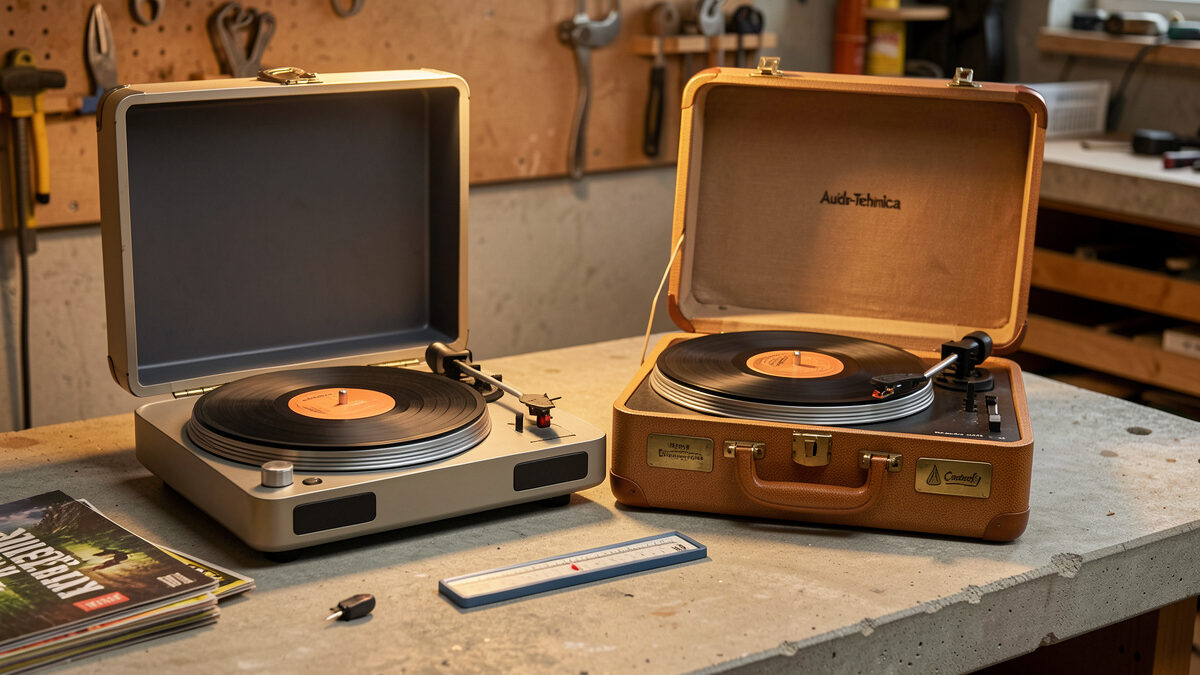
Put the Audio-Technica Sound Burger and a Crosley suitcase portable on the same bench and the contest is over before the music starts: the Sound Burger tracks a moving-magnet cartridge at 3.5 grams, the Crosley presses a ceramic cartridge down at around 6 grams. One plays your records, the other slowly sands them. I’ve had both on my stylus gauge, and that single reading decides everything.
But “one is better” is the lazy version of this comparison, and you came here for the useful one. These two decks are the honest extremes of the portable category — the Crosley is the cheap self-contained suitcase everyone starts with, the Sound Burger is the design-led player that actually respects vinyl. Knowing exactly where each wins tells you which one belongs in your life, and which records you should never let near the loser.
Sound Burger vs Crosley: The Specs That Actually Matter
The decisive difference is the cartridge and its tracking force; almost everything else follows from it. The Sound Burger runs an Audio-Technica AT3600L moving-magnet cartridge at a spring-applied 3.5 grams, with wow and flutter rated under 0.25% WTD. The Crosley Cruiser uses a ceramic cartridge that measures near 6 grams of downforce — nearly double — and offers no published wow-and-flutter figure at all, which by itself tells you where the corners were cut.
| Spec | Audio-Technica Sound Burger | Crosley Cruiser (portable) |
|---|---|---|
| Cartridge | AT3600L moving-magnet | Ceramic (piezoelectric) |
| Tracking force | ~3.5 g (spring dynamic balance) | ~6 g measured |
| Drive | Belt | Belt |
| Wow & flutter | <0.25% WTD at 3 kHz | Not published |
| Bluetooth | Output only | In and out |
| Built-in speaker | None | Two small drivers |
| Power | ~12 h rechargeable battery | AC adapter |
| Speeds | 33 / 45 | 33 / 45 / 78 |
Read that table as a setup tech would. The Sound Burger’s numbers are the numbers of a real, if small, record player. The Crosley’s blanks and its 6-gram cartridge are the numbers of an appliance built to make sound cheaply, not to play records well. The manufacturers themselves publish this: Audio-Technica lists the full AT-SB2022 specifications, while independent measurements of the Crosley — collected in the What Hi-Fi Cruiser review — confirm the heavy tracking force. If tracking force is new to you, I broke down why it matters more than any other setting in my tracking force adjustment guide.
How Do They Actually Sound Side by Side?
Through a good speaker, the Sound Burger sounds like a modest but genuine turntable, and the Crosley sounds like a Crosley — thick, blunted, and one-note in the bass. I ran the same pressing of a Steely Dan reissue through both into my normal Bluetooth speaker in the yard. On the Sound Burger the hi-hats had a metallic edge and the bassline walked; on the Crosley the top end collapsed into gray hiss and the kick turned to cardboard.
That’s the ceramic cartridge’s signature. It’s electrically simple and outputs a big signal, but its compliant stylus can’t resolve fine high-frequency detail, and the high tracking force it needs bulldozes the very information you’re trying to hear. The Sound Burger’s moving-magnet generator, feeding its built-in phono preamp with proper RIAA equalization, keeps the treble intact and the bass defined. It is not a hi-fi deck — wow and flutter is still audible on sustained piano, the speed problem I measured across the whole category in portable turntable speed stability — but it plays music instead of a caricature of it.
The Crosley does have one honest advantage here: its built-in speakers mean you can pull it out of the box and hear something instantly, no pairing, no extra gear. That convenience is real, and for a kid’s room or a dorm where nobody’s precious about the records, it’s the whole appeal. Just understand that the built-in speakers are also the source of the muddiest problem — their vibration feeds back into the platter, which I’ll get to.
Will the Crosley Really Damage My Records?
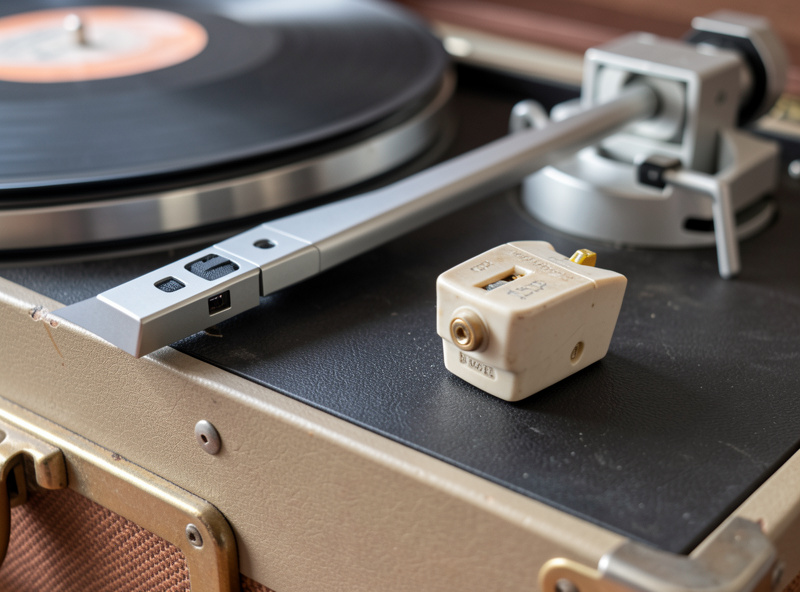
Yes, measurably, if you play records you care about on it repeatedly. At roughly 6 grams of tracking force with a low-grade conical stylus, the Crosley plastically deforms groove walls that a 2-gram cartridge would trace without harm. The damage is cumulative and permanent: each play flattens a little more high-frequency detail, and no cleaning brings it back. The Crosley’s AC-only design also means it isn’t the off-grid option people assume; I sorted which battery decks are actually safe for vinyl in are battery-powered turntables safe for vinyl.
I learned this the expensive way. Years ago I had a ceramic suitcase deck and played a favorite pressing on it for a summer before I knew better. When I finally put that record on a properly aligned deck, the sibilance on the vocals was permanently smeared — the “s” sounds hissed and spat in a way the vinyl simply hadn’t done before. That record is my permanent reminder, and it’s why I check tracking force on every deck now, and why I inspect styli for wear before trusting any player with a keeper. If you want to check your own stylus for the kind of wear that compounds this damage, I wrote up how in inspecting a stylus for wear without a lab microscope.
The Sound Burger’s 3.5 grams is on the firm side for a moving-magnet cartridge — my main decks track their cartridges nearer 1.8 to 2 grams — but it’s within the AT3600L’s design range and well under the threshold where you start deforming vinyl. Play a first pressing on the Sound Burger and you’ll wear it no faster than any entry-level home deck. Play it on the Crosley and you’re spending your record’s life to hear it.
Portability, Battery, and Where Each One Wins
The Sound Burger is the genuinely portable one: it’s flat, runs about 12 hours on its internal battery, and needs no wall outlet, so it goes to the park or the beach and plays. The Crosley, despite the suitcase handle, needs an AC adapter — it’s “portable” the way a toaster with a handle is portable. For actual off-grid listening, that alone settles it.
Where the Crosley wins is price and self-containment. It’s a fraction of the Sound Burger’s cost, and it needs nothing else to make noise. If your use case is a first turntable for a child, a decorative piece, or a beater for records you bought for a dollar, the Crosley does that job and the Sound Burger is overkill. I don’t sneer at that — everyone’s vinyl story starts somewhere, and mine started on a deck not much better than a Cruiser.
The Sound Burger wins on everything that involves respecting the record or listening seriously: cartridge, speed stability, no feedback-prone built-in speaker, and true battery portability. It costs more because it’s actually a turntable. For the full field of portables beyond just these two, I ranked them all in my guide to the best portable turntable — but as a straight two-way, the Sound Burger is the one that earns a place next to a real collection.
The One Setup Detail Both Decks Get Wrong
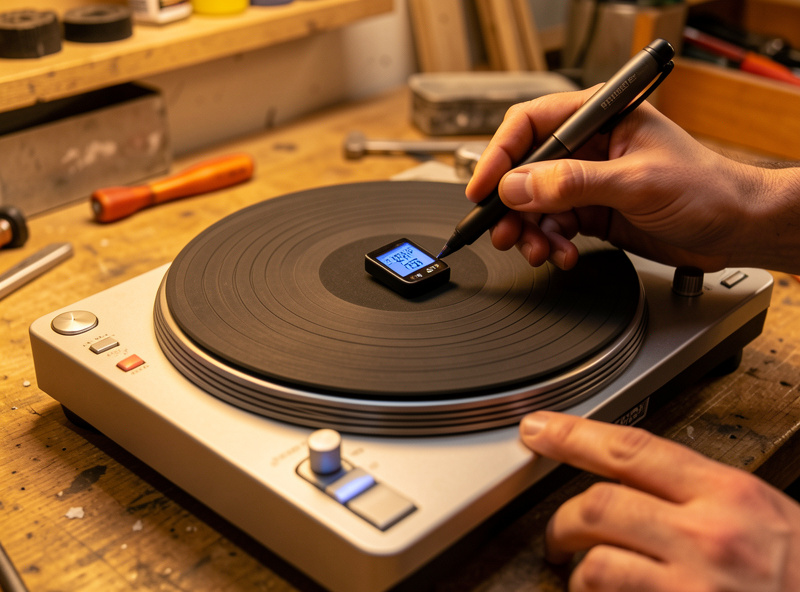
Neither deck lets you align the cartridge, and that fixed geometry is the compromise you accept with any sealed portable. On my main tables I set overhang and null points on a two-point protractor and dial anti-skate against a blank groove; on the Sound Burger and the Crosley, those are locked at the factory and simply are what they are. It’s the price of the form factor, and it’s why I keep saying portables are second decks, not reference tools.
What you can control is the surface and cleanliness. The Crosley’s built-in speakers make this critical: on a hollow table at any volume, the cabinet resonates, the platter picks it up, and the stylus starts chasing its own output — audible as a woolly, feeding-back muddiness. Slide it onto something solid and damped and it improves. Both decks also benefit from a carbon-fiber brush before every side, because grit under a heavy stylus grinds fast, and pops from dust are often mistaken for record damage — a distinction I untangle in my piece on crackle on every record. The independent Sound Burger review at What Hi-Fi reaches the same verdict I did on the bench: within its limits, it’s the real thing, and the suitcase decks aren’t.
Which One Should You Actually Buy?
Buy the Sound Burger if you own records you’d be sad to wear out, want genuine battery portability, or care what the music sounds like — it’s the safe, real-turntable choice and the one I keep by my own back door. Buy the Crosley only if the budget is tiny, the records are disposable, and you want a self-contained noise-maker for a kid’s room or a decorative shelf. There’s no shame in the second choice, as long as you go in knowing exactly what it costs your vinyl.
The connectivity split is worth a last word, because it flips the usual logic. The Crosley actually has more ports — Bluetooth in and out, so it can double as a speaker for your phone — while the Sound Burger is Bluetooth-out only, a deliberately narrow player — and if wireless is your priority for the yard, I compared the field in the best Bluetooth portable turntable guide. That looks like the Crosley winning on paper. In practice the Sound Burger’s restraint is the point: it does one job, playing records without harming them, and does it well, while the Crosley spreads a cheap budget across features that each end up mediocre. My rule after years of mounting cartridges holds here too — a deck that does the fundamentals right beats one with a longer spec list every time. If either becomes your gateway into taking vinyl seriously, the natural next step is a deck you can actually align, and I mapped those out in the portable turntable buyer’s guide.
Check the Sound Burger on Amazon. As an Amazon Associate I earn from qualifying purchases.
Further Reading
- Best Portable Turntable: What Won’t Wreck Your Records
- Tracking Force Adjustment Guide for Turntables
- How to Inspect a Stylus for Wear Without a Lab Microscope
- Crackle on Every Record: Static, Dust, or Worn Stylus?
Is the Audio-Technica Sound Burger better than a Crosley?
Yes, clearly. The Sound Burger uses a moving-magnet cartridge tracking at 3.5 grams and has real battery portability, while the Crosley uses a ceramic cartridge pressing near 6 grams and needs AC power. The Sound Burger plays records safely and sounds like a genuine turntable; the Crosley is a cheap self-contained appliance.
Does the Crosley portable turntable ruin records?
It can with repeated play. Its ceramic cartridge tracks at about 6 grams, nearly triple a safe force, which permanently deforms groove detail. It is fine for cheap thrift copies but should never play records you value.
Can the Sound Burger play records safely?
Yes. Its 3.5-gram tracking force is on the firm side for a moving-magnet cartridge but well within the design range and safe for vinyl. It wears records no faster than a typical entry-level home turntable.
Does the Crosley have built-in speakers and the Sound Burger not?
Correct. The Crosley has two small built-in speakers so it works out of the box, while the Sound Burger has no speaker and sends audio out over Bluetooth or a line output. The Sound Burger sounds cleaner partly because it avoids the speaker vibration that feeds back into the stylus.