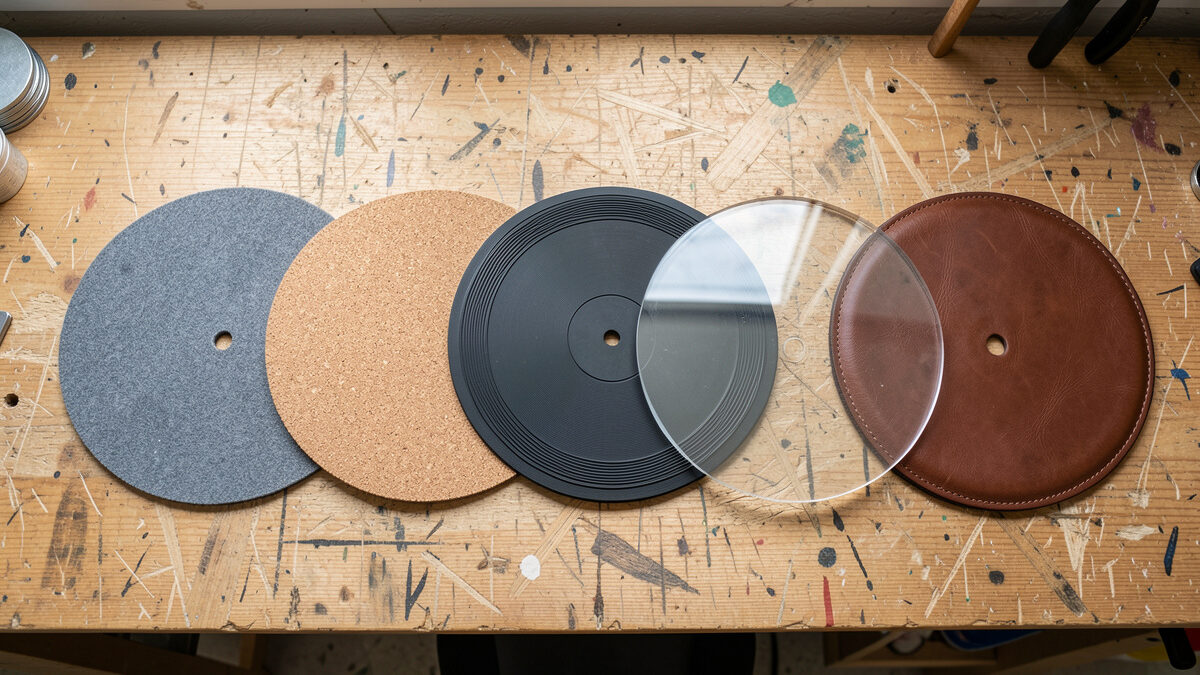
The best turntable platter mat depends on your platter material and the problem you’re solving, not on a universal ranking. Felt is cheap and grippy but static-prone; cork damps ring and kills static well on metal platters; rubber adds mass and isolation; acrylic suits acrylic platters; leather sits between cork and rubber. The honest truth is that a mat is a subtle, character-level tweak — real, but never a new cartridge.
I’ve run all of these across three decks — a Technics SL-1200-class direct drive with a steel platter, a rebuilt Rega P3, and a Pro-Ject with an acrylic platter — swapping mats back and forth on the same pressing to hear what each one actually does. This is the comparison I wish more people did before spending $90 on a “reference” mat: side by side, same record, same setup, listening for ring, static and surface noise rather than reading the marketing. Here’s what each material does and which one belongs on your table. It’s one of the cheapest experiments in the whole turntable upgrades and mods playbook.
What a Platter Mat Actually Does
A platter mat sits between the record and the platter and controls three things: how the record couples mechanically to the platter, how static builds and discharges, and how much the platter’s own resonance reaches the disc. That’s the whole job — it doesn’t amplify, equalize or “open up the soundstage” the way ad copy claims. The audible effect is a shift in how ring and surface noise present, and on a metal platter that shift is real and worth chasing.
The reason the effect is subtle is that the stylus is reading a groove modulated in microns, and the mat’s contribution is a second-order damping change, not a signal-path change. When someone tells me a mat “transformed” their system, I ask what their cartridge alignment looks like — nine times out of ten the bigger gain was sitting in an untouched setup and calibration job. Get the deck aligned first, then a mat is the fine-tuning pass.
Felt: Cheap, Grippy, Static-Prone
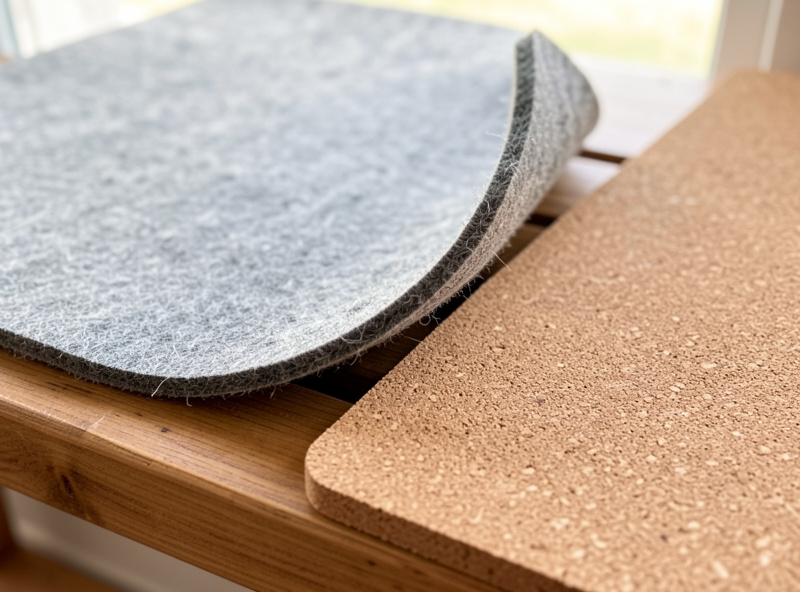
Felt is the stock mat on most belt decks because it’s cheap, light and lets you cue and slip the record easily. It couples loosely, adds almost no mass, and its big drawback is static — felt loves to cling to the record and lift with it when you pick the disc up, dragging dust onto the stylus. On a dry winter day in my listening space, felt is the worst static offender of the lot.
Felt isn’t wrong, it’s just basic. If you DJ or cue by hand, the slip is a feature. For pure listening, felt’s static and its tendency to let a metal platter ring are the two reasons most people swap it out first. An anti-static routine helps — I cover that in the anti-static guide — but the simpler fix is usually a different material. Felt is where you start, not where you stay.
Cork: The Quiet All-Rounder
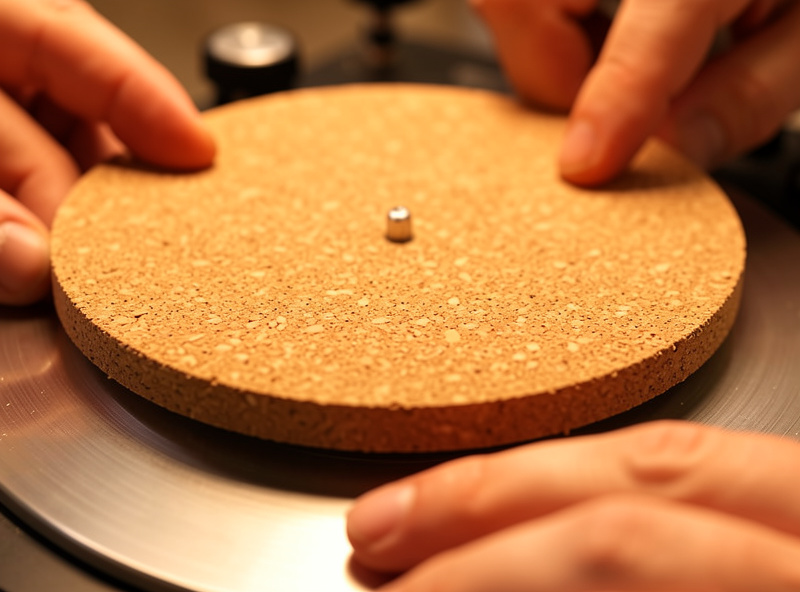
Cork is the mat I reach for most on a metal platter. It damps platter ring better than felt, generates almost no static, and grips the record without clinging to it. It adds a little mechanical damping without the mass penalty of rubber, and it’s cheap. On my steel Technics platter, going from felt to cork is the most consistent small improvement I hear — a slightly quieter background and less of that faint metallic ring on piano and cymbals.
The tradeoff is that pure cork can be a touch grabby on a warped record and it wears over years. Cork-rubber composite mats split the difference, adding a bit of mass and durability. For most people on a metal-platter deck fighting static and ring, cork is the highest-value mat upgrade and the one I recommend first. A simple cork platter mat costs little and is fully reversible.
Rubber: Mass and Isolation
Rubber mats add mass and do the best job of mechanically isolating the record from platter and motor vibration. A thick rubber mat damps ring aggressively and couples the record tightly, which can tighten bass on a lightweight platter. The cost is that rubber can grip dust, can outgas onto records if it’s cheap compound, and the extra height changes your VTA/SRA slightly, so you may need to re-check arm height after fitting one.
I keep a rubber mat around for lightweight platters that ring badly, where the added mass genuinely helps. On a heavy platter it’s redundant. Rubber is the most “engineered” feeling option and the one most likely to need a follow-up tweak elsewhere — recheck tracking force and arm height after fitting one, the same discipline from the tracking force guide.

Acrylic: Match It to the Platter
Acrylic mats — and acrylic platters — are a special case. Acrylic has a mechanical impedance close to vinyl itself, so an acrylic surface couples to the record very evenly and damps without adding ring. On my acrylic-platter Pro-Ject I run no mat at all, because the platter is already the ideal surface; adding felt on top would only undo that. If you have a metal platter and want the acrylic sound, an acrylic mat gets you part way there.
The catch with acrylic is static — it can build a charge, so an anti-static brush before each play matters. And like rubber, an acrylic mat changes platter height and therefore VTA. If you’re considering a whole acrylic platter rather than just a mat, that’s a bigger upgrade covered in platter upgrades. For most people an acrylic mat is a way to taste the acrylic character cheaply before committing to a platter swap.
Leather: The Boutique Middle Ground
Leather mats sit between cork and rubber: they damp well, generate little static, grip gently and look the part. Sonically I find them very close to cork — a quiet, even presentation with good ring control — which is why I treat the price premium with suspicion. A good leather mat is a fine choice; a $90 leather mat sold as a transformation is the romance talking. I broke leather out against felt and cork in a dedicated leather vs felt vs cork test, and the short version is that cork gets you 90% of the leather result for a third of the money.
Where leather earns its keep is on a deck where looks matter and you want cork’s behavior without the cork wear. It’s a lifestyle-and-sound choice, not a pure-sound one, and there’s nothing wrong with that as long as you know which you’re buying.
Platter Mat Materials Compared
Here’s how the five materials stack up on the things that actually matter at the platter:
| Material | Static | Ring damping | Adds mass | Best on | Typical cost |
|---|---|---|---|---|---|
| Felt | High (worst) | Low | No | DJ / cueing, stock decks | $5–15 |
| Cork | Very low | Good | Slight | Metal platters | $15–30 |
| Rubber | Low | High | Yes | Lightweight platters | $15–40 |
| Acrylic | Moderate | Good (even) | Slight | Matching acrylic sound | $25–60 |
| Leather | Very low | Good | Slight | Looks + cork-like sound | $30–90 |
Read across the “best on” column and the choice usually makes itself: metal platter fighting static and ring, buy cork; lightweight ringy platter, try rubber; acrylic platter, use no mat or acrylic; want the look, leather.
The VTA Detail Nobody Mentions
Any mat that’s thicker or thinner than your stock one changes the height of the record, which changes the vertical tracking angle (VTA) and stylus rake angle (SRA) of your cartridge. Go from a 2mm felt mat to a 5mm rubber one and you’ve effectively lowered the back of the cartridge — a real geometry change. On budget decks with fixed arm height it’s something you live with; on a deck with adjustable VTA, recheck it after a mat swap.
This is why I treat a mat change as a small setup event, not just a drop-in. The effect is subtle but it’s exactly the kind of thing that makes one listener swear a mat “fixed the highs” — they changed SRA as a side effect. If you want to understand that interaction fully, the setup and calibration guide walks VTA and SRA, and the broader spending logic lives in the upgrades and mods guide.
Frequently Asked Questions
What is the best turntable platter mat?
There is no single best mat. For a metal platter fighting static and ring, cork is the highest-value choice. Lightweight ringy platters benefit from rubber, acrylic platters are best with no mat or acrylic, and leather offers cork-like sound with a nicer look at a price premium.
Do platter mats actually improve sound?
Yes, but subtly. A mat changes how the record couples to the platter and how static and ring behave. The effect is a quieter background and less metallic ring on a metal platter, not a transformation. Cartridge alignment moves the sound far more than any mat.
Is cork better than felt for a turntable?
For listening, usually yes. Cork generates almost no static, damps platter ring better than felt, and grips without clinging. Felt is cheaper and better for DJ cueing because it lets the record slip, but it is the worst material for static and ring control.
Should I use a mat on an acrylic platter?
Usually no. Acrylic has a mechanical impedance close to vinyl, so an acrylic platter already couples to the record ideally. Adding a felt or rubber mat on top undoes that benefit. Run an acrylic platter bare and use an anti-static brush before each play.
Does changing a platter mat affect VTA?
Yes. A thicker or thinner mat raises or lowers the record, changing the vertical tracking angle and stylus rake angle of the cartridge. On decks with adjustable arm height, recheck VTA after a mat swap. On fixed-height budget arms, the small change is something you live with.
As an Amazon Associate I earn from qualifying purchases.