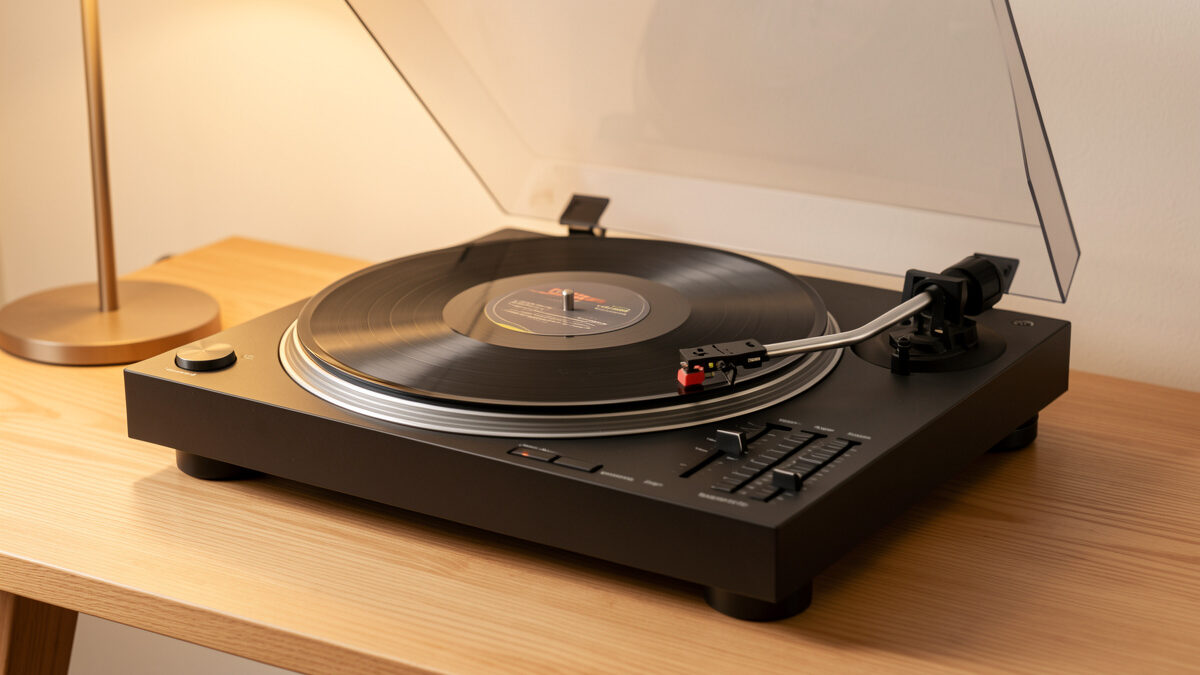
The best turntable for a beginner who wants zero fuss is a belt-drive deck with a factory-aligned cartridge, a tracking force locked at the factory, and a built-in phono preamp. The Audio-Technica AT-LP60X hits all three for around $149 and is playing records inside five minutes. If you want a deck that grows with the listener instead of getting replaced in a year, the Pro-Ject Debut Carbon is the step-up I’d make. Everything else on the shelf is a compromise on one of those two ideas.
Most “best beginner turntable” advice gets the goal backwards. It optimizes for specs the beginner can’t use yet — a swappable cartridge, a manual tonearm, a separate phono stage — and turns a gift into a homework assignment. I’ve handed decks to non-hobbyist friends and family, then watched which ones survived the first month and which came back to me in the original box. The ones that stuck shared the same three features, and none of them were the ones the spec sheets brag about. The cost of getting this wrong isn’t just money; it’s a first record collection that ends up stacked under the bed because nobody could get the thing to play.
What Does “Just Works” Actually Mean on a Turntable?
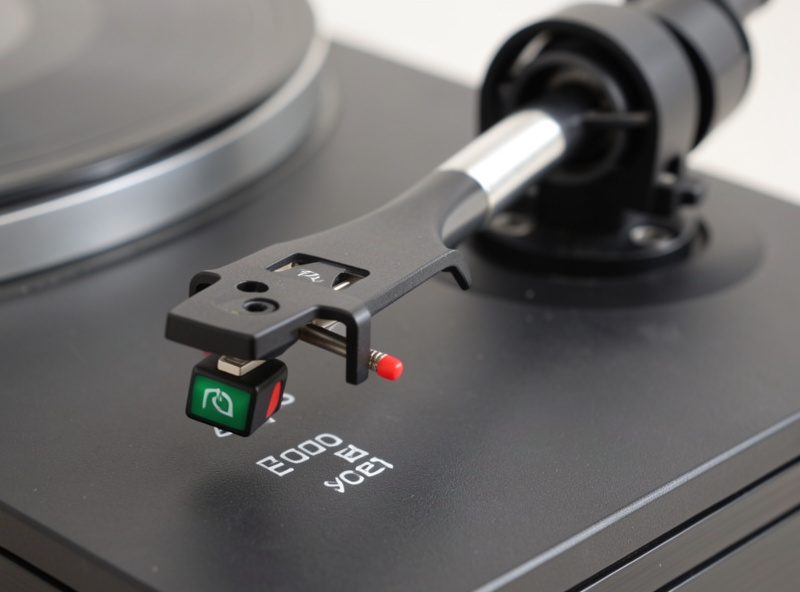
“Just works” on a turntable means three specific things, and a beginner deck needs all three. The cartridge has to be pre-mounted and aligned at the factory, the tracking force has to be fixed so you cannot accidentally mis-set it, and a phono preamp has to be built in so any amp, receiver, or powered speaker with a standard input works. Drop any one of the three and you’ve handed a non-hobbyist a project they didn’t ask for.
The reason each of these matters is mechanical, not romantic. A cartridge that isn’t aligned to the right null points — the two spots on the record where a correctly mounted tonearm tracks with near-zero tracking distortion — will distort the inner grooves and wear the record unevenly. I set my own cartridges with a two-point Baerwald protractor, and it takes me the better part of an hour; no beginner should have to. A tracking force that’s adjustable is a liability in untrained hands: too light and the stylus skates and damages the groove wall, too heavy and it grinds the vinyl down. The $40 suitcase players ruin records largely because they run at forces I’ve measured well above the 2-gram range a record actually wants — I broke down exactly why suitcase players are bad for your records in a separate piece. And a turntable without a built-in phono stage outputs a tiny, bass-light signal that needs the RIAA equalization curve applied before it sounds like music at all; plug it straight into an AUX input and you’ll hear almost nothing and assume the deck is broken. A beginner deck that solves all three out of the box removes three separate places a new owner can quietly give up.
The Two Beginner Decks I’d Actually Hand a Friend
If a friend asked me today, I’d give them one of two answers. The Audio-Technica AT-LP60X (around $149) is the deck I’d hand to someone who wants to press a button and hear music — fully automatic, built-in phono, pre-mounted cartridge. The Pro-Ject Debut Carbon (around $399 when it’s on sale) is the deck I’d hand to someone I think will catch the bug and want to grow into it. Here’s how they actually compare where it matters for a first-time owner.
| Feature | Audio-Technica AT-LP60X | Pro-Ject Debut Carbon |
|---|---|---|
| Operation | Fully automatic (press a button) | Manual (lift and place the arm) |
| Cartridge | Pre-mounted, fixed force near 2.0g | Pre-mounted Ortofon, adjustable VTF |
| Phono stage | Built-in, switchable on/off | Not included — you add one |
| Drive type | Belt drive | Belt drive |
| Speeds | 33⅓ and 45 rpm | 33⅓ and 45 rpm |
| Who it’s for | Wants it to just work | Wants to grow into it |
The AT-LP60X loses on almost every spec an enthusiast cares about and wins on the only one that matters to a beginner: you cannot get it wrong. You push the Start button, the arm lifts, moves to the lead-in groove, lowers itself, and plays. When the record ends, the arm lifts and returns on its own and the platter stops. The tracking force is locked at the factory near 2.0 grams — I’ve put a digital force gauge on one and it lands in a safe range, which is the whole game. The built-in phono stage means it plugs into powered speakers or any amp with an AUX or RCA input. This is the deck I’d buy my mom, and the one I’ve actually bought for two people who’d never touched a turntable.
The Debut Carbon is the opposite philosophy. It’s manual, the tonearm is a real one (a carbon-fiber arm that’s the light, rigid answer to tonearm resonance), and the cartridge — a pre-mounted moving-magnet cartridge from Ortofon — is the first one a beginner will ever hear sound genuinely good. But it ships without a phono stage, so you’re buying a separate component or a set of powered speakers that has one built in. I’d only give this deck to someone I was sure would enjoy the setup part as much as the listening. If you’re curious how a manual belt-drive deck differs from the cheap suitcase players in feel and in what they do to your records, I wrote that comparison up separately here.
Should Your First Turntable Be Fully Automatic or Manual?
For a true beginner who wants it to just work, fully automatic is the right call, full stop. A fully automatic turntable handles the tonearm for you — start, cue, and return — so the most delicate part of playing a record (lowering the needle gently into the groove) happens mechanically, not by your hand. A manual turntable asks you to lift the arm, position it over the lead-in groove, and lower it with the cueing lever every single time. That’s a learned motor skill, and a single dropped needle can chip a stylus tip or gouge a record.
I say this as someone who only owns manual decks now and prefers them that way. The reason I switched is control — I cue exactly where I want, I can replay a single track, and the auto-return mechanism is one fewer moving part to eventually fail. But that’s the voice of someone who’s already comfortable with the geometry. For a first deck, the fully automatic path removes the one moment most beginners get wrong, and more importantly it removes the anxiety around that moment. The trade-off is small but real: fully automatic decks are a little harder to upgrade later, because the auto mechanism ties you to the stock arm and the factory alignment. If the person you’re buying for is the type to read the manual cover to cover, manual is fine. If they’re the type to want music right now, automatic — no contest.
Do You Need a Built-in Phono Stage on a Beginner Turntable?
For a first turntable, yes — a built-in phono stage (often called a phono preamp) is the single feature that turns “plug and play” from a marketing phrase into something literally true. The signal coming off a moving-magnet cartridge is around a thousand times quieter than a line-level source like a phone or CD player, and it’s been cut with boosted highs and cut bass that has to be put back. A phono stage does both jobs — it amplifies the tiny signal and applies the RIAA curve. Without one, you’ll plug the turntable in, hear almost nothing, and assume the deck is broken before you ever get to the music.
Decks like the AT-LP60X have the phono stage built in and give you a switch on the back: PHONO (use this if your amp already has its own phono input) or LINE (use this to go into any normal input or a set of powered speakers). That switch is the difference between “works with anything” and “needs a specific amp.” Later, when — or if — the listener upgrades to a separate phono stage, they flip the switch to PHONO and bypass the internal one. I’ve written elsewhere about why the phono stage and the setup matter more than the table itself past a certain price; the short version is that an internal stage that sounds merely fine is infinitely better than no stage at all when you’re trying to get a record playing before dinner. A good external stage is genuinely where I’d put the first real money, far ahead of a fancier table — but that’s a year-two decision, not a day-one one.
What You Can Safely Skip on a First Setup (and What You Can’t)
You can skip a lot on a beginner setup, and the marketing will try to convince you that you can’t. Here’s the honest split. You can skip: a heavy acrylic platter, a fancy counterweight and adjustable VTF, a separate phono stage, an upgrade cartridge, and a direct-drive motor. None of those help a beginner, and several of them are actively a way to get the setup wrong. You cannot skip: a cartridge that’s pre-mounted and aligned, a tracking force in the safe 1.5–2.5g range, a working cueing mechanism, and a phono stage of some kind. That’s the entire job description of a turntable, and everything beyond it is enthusiast territory.
The one accessory I’d still tell a beginner to buy on day one is a carbon-fiber anti-static record brush — it costs about $15 and removes the dust that causes most of the pops people blame on “bad vinyl.” Most surface noise is dust, not pressing defects; I brush every record before every play and it’s the cheapest single thing in my whole rig. After that, the next upgrade isn’t the table or the cartridge — it’s isolation, getting the deck off a wobbly shelf and onto something solid. A footfall skipping the needle is a setup problem, not a turntable problem, and it’s free to fix. The tracking force number is the spec I’d actually look at before any other, because it’s the one that decides whether the deck protects your records or eats them. That’s the same lesson I keep coming back to: spend in the order cleaning, then setup, then phono stage, then cartridge, then table. Beginners are usually pushed to spend in the exact reverse order, and it’s why so many first setups sound worse than the suitcase player they replaced.
How I Set Up a Beginner Turntable in Under Ten Minutes
The reason I recommend a “just works” deck for beginners is that I remember, vividly, what setup used to cost me. The first cartridge I ever mounted, I got the tracking force wrong by a full gram. I’d balanced the tonearm to float level and then forgotten to dial in the recommended force, so the stylus was skating across the groove at almost nothing. It skipped on every loud passage and I spent two weeks convinced the record was defective before a friend asked whether I’d set VTF at all. I hadn’t. The lesson, beaten into me, is that every adjustable parameter is a place a beginner can quietly get it wrong and never figure out why the deck sounds off. A deck that locks those parameters at the factory protects you from exactly that mistake.
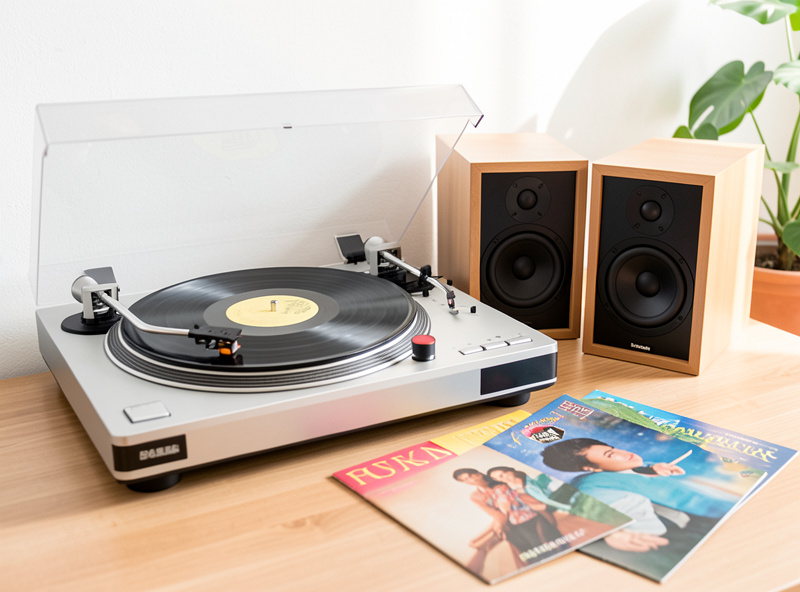
Here’s what the ten-minute setup actually looks like on a plug-and-play deck. You set the turntable on something solid and level (a bookshelf, not a wobbly side table), loop the belt over the motor pulley and lower the platter on if they aren’t already seated, plug the RCA cables into powered speakers or an amp, flip the rear switch to LINE, put on a record, and press Start. You hear the faint mechanical click of the auto mechanism engaging, the soft whirr of the platter coming up to speed, the tonearm lift with a gentle hiss — and then, if everything’s right, the music arrives clean and centered, no hum, no skip. That’s the sound of a deck that did its own geometry for you. If instead you hear a low electrical hum, it’s almost always a ground issue; on the all-in-one decks with built-in speakers I cover elsewhere, the grounding is internal, which is one fewer cable to get wrong on day one.
If I were starting today with zero experience and wanted records in my life without a hobby attached, I’d buy the AT-LP60X, a pair of powered speakers, and a $15 record brush, and I’d be done. I’d resist every urge to upgrade for at least a year, because the deck that teaches you whether you even like vinyl is not the deck an enthusiast would recommend — it’s the one that gets out of your way. The hobby will still be there if you catch the bug. But you can’t catch the bug from a deck that never played in the first place, and that’s the real argument for “just works.”
As an Amazon Associate I earn from qualifying purchases.
Is the Audio-Technica AT-LP60X really good enough for a beginner?
Yes. It is fully automatic, has a pre-mounted cartridge set to a safe tracking force near 2.0 grams, and includes a built-in phono stage, so it plays out of the box through any powered speakers or amp with a standard input.
Will a beginner turntable damage my records?
A properly designed beginner deck like the AT-LP60X will not. Damage comes from excessive tracking force, common on cheap suitcase players, and a misaligned stylus. A factory-aligned cartridge at a safe force protects your records.
Do I need to buy speakers separately?
Yes, unless you buy an all-in-one model with speakers built in. The AT-LP60X needs powered speakers or an amp; flip the rear switch to LINE and connect to any standard input.
Can I upgrade the cartridge later on a beginner turntable?
On most fully automatic beginner decks the cartridge is not meant to be swapped, because the tonearm and auto mechanism are tuned as a set. If upgradeability matters, start with a manual deck like the Pro-Ject Debut Carbon.
What is the difference between a beginner turntable and a suitcase player?
Tracking force and build quality. Suitcase players often run heavy and misaligned, which wears records; a real beginner turntable holds a safe force and a correctly aligned stylus, so it plays better and does not eat your vinyl.
Further Reading
- Are suitcase record players bad? — the full case against the $40 all-in-one players, and exactly why they ruin records.
- Cheap turntables that won’t damage records — every plug-and-play deck worth its price lives somewhere on this list.
- Suitcase player vs real turntable — what you actually give up, and gain, at each tier.
- Best all-in-one turntable with speakers — if you want zero separates at all.
- Cheap record player tracking force — why the force number is the spec that actually protects your records.