
When the last song on a vinyl side turns harsh, grainy, or distorted and the rest of the record plays clean, you are hearing the inner-groove problem. The groove near the label is moving past the stylus at roughly half the linear speed of the outer groove, so the same high frequencies are packed into far less vinyl — and a pivoting tonearm hits its worst tracking error in exactly that region. It is a setup fault the large majority of the time, and the fix is force, alignment, anti-skate, and stylus profile, in that order.
This spoke is part of the inner-groove distortion cluster. The hub covers the full family of end-of-side and channel-balance faults; this one focuses on the single most common complaint I get — the final track on the side — and walks through what is actually happening in those last two grooves and how I clear it on the bench.
The Physics: Why the Inner Groove Is the Hard Part
A turntable spins at a fixed rotational speed, 33⅓ rpm for an LP, but the groove is a spiral. That means the physical length of groove passing under the stylus every second falls steadily as the music moves inward. At the outer wall the groove can be travelling past the stylus at around 0.5 metres per second; by the time the music reaches the run-out near the label, that has dropped toward 0.2 m/s. The cutting lathe faced the same problem in reverse — it had less and less real estate to cut the same waveform into.
High frequencies are encoded as tight, closely-spaced undulations in the groove wall. When the groove is moving slowly, those undulations are packed into a shorter and shorter physical wavelength, to the point where the wavelength approaches the contact radius of the stylus tip. At that point the stylus can no longer follow the true shape of the groove — it traces a smoothed-out approximation of it — and the playback gains harmonic distortion, concentrated in the upper midrange and treble. The musical result is a hard, splatty, congested sound on loud or bright passages, almost always worst in the final minutes of the side. This is not a defect in your copy; it is the format working against you, and a well-set-up table makes it dramatically less obvious.
Tracking Error Piles On at the Inner Groove
The geometry of a pivoting arm makes the inner groove harder still. The groove is cut by a lathe whose cutter head moves in a straight line across the disc, but a pivoting playback arm traces an arc. No pivoting arm can match that straight line perfectly, so we use a compromise alignment — Baerwald or Stevenson — that places two zero-error null points on the record and accepts some tracking error everywhere else. That error is not uniform: it is highest at the outer edge and the inner groove, and lowest at the two null points.
So at the inner groove you get the worst of both effects stacked: the slowest groove speed and the highest tracking-error distortion. A cartridge that tracks cleanly through the null points can still mistrack badly three minutes from the end of the side, which is exactly why the symptom is so specific. The geometry behind this — and why overhang is the single most important number to get right — is worked through in the dedicated overhang distortion spoke.
The Setup Causes I Find When the Last Track Distorts
When the final track on every record distorts, four setup faults account for almost every case I see, and they map cleanly onto the physics above.
Tracking force too light. The sharp inner-groove accelerations demand more force to hold the stylus in the groove, and a force set near the bottom of the cartridge range will let the tip micro-hop on loud inner passages. The right setting for an inner-groove complaint is almost always in the upper third of the specified range, confirmed with a digital gauge rather than the tonearm dial. The method is in the tracking force adjustment guide.

Overhang or null-point error. If the overhang is off, both null points fall in the wrong place and the inner-groove tracking error never gets minimised. Re-checking the two-point alignment is the single most effective end-of-side fix after tracking force.
Anti-skate mismatched. The sideways bias force is doing its most work at the inner groove, and if it is set too high the stylus rides the inner wall and the right channel distorts first. The interaction is detailed in anti-skate and inner-groove distortion.
Stylus profile too wide. A conical tip physically cannot resolve the tight inner-groove wavelengths, so it distorts there even on a perfectly aligned arm. A nude elliptical or Shibata traces the same groove far more faithfully — the tradeoffs are in the stylus types comparison.
The Fix, in the Order I Do It
I work an end-of-side complaint in a fixed sequence, free fixes before expensive ones.
1. Gauge the tracking force and set it to the upper third of the cartridge range. This alone clears a surprising share of complaints.
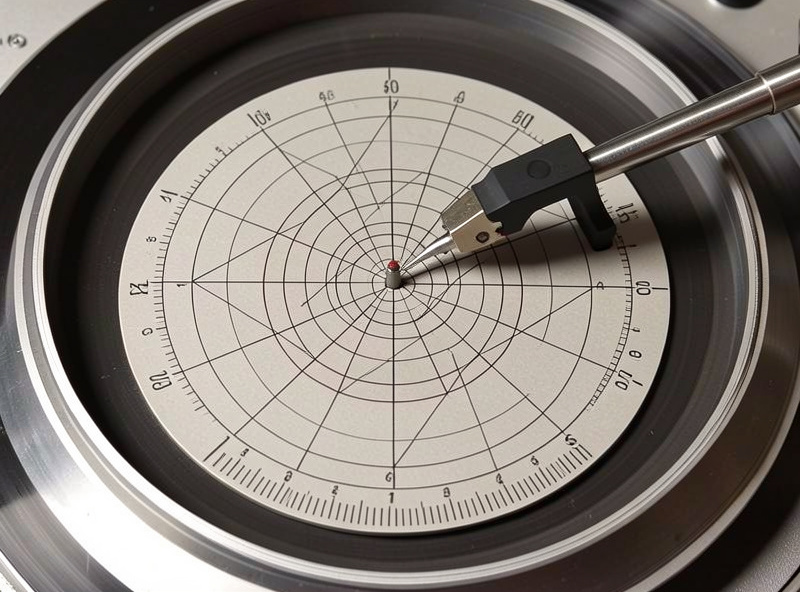
2. Re-check the two-point alignment. Put the protractor on, confirm both null points and the overhang, and re-square the cartridge in the headshell. The full walkthrough is in the cartridge alignment guide.
3. Re-set anti-skate to match the new force, so both channels track the loud inner passage equally.
4. Consider the stylus profile. If the geometry is correct and the inner groove still distorts, the profile is the ceiling, and a nude elliptical or Shibata is the only thing that moves it.
Telling Pressing Damage From a Setup Fault
Not every end-of-side distortion is your table. Some is pressed in — an over-cut master, a hot cut at the plant — and some is physical groove damage from a previous owner’s worn stylus. The diagnostic is consistency. If the same passage distorts on a second cartridge or a second pressing, it is the record. If a known-clean copy plays silent to the run-out, your table is the variable. The related skill of separating groove damage from mistracking is covered in telling record damage from mistracking.
The Records That Distort Even When Set Up Right
Some pressings are simply harder to cut clean at the inner groove, and a perfectly aligned deck will still show it. Long sides — twenty-plus minutes packed onto one side of an LP — leave less room per minute of music, so the cutter had to cut hotter and tighter to fit, and the last track pays for it. Heavily modulated bass-and-treble material at the end of a long side is the worst case. Twelve-inch singles, by contrast, have far more groove length per minute of music and usually track cleanly to the end even with a modest cartridge, which is part of why DJs cut them loud. None of this changes the fix — a better-aligned arm and a finer stylus still reduce the distortion — but it sets realistic expectations for what any setup can do with an over-stuffed side.
Frequently Asked Questions
Why does the last song on a vinyl record sound distorted?
The groove near the label moves past the stylus more slowly, so high frequencies are cut into a much shorter length of vinyl that the stylus struggles to trace. Tracking error from a pivoting arm is also highest there. Both effects stack, so the final minutes of the side distort first.
Can inner-groove distortion be fixed?
Usually yes. Set tracking force to the upper third of the cartridge range, confirm overhang and both null points with a two-point protractor, match anti-skate, and if it remains, move to a nude elliptical or Shibata stylus. Most end-of-side harshness is a setup fault, not the pressing.
Is some inner-groove distortion normal?
A small amount is inherent to the format because groove speed falls toward the label. But a well-cut record on a properly aligned deck should stay clean to the run-out. If the last two minutes are harsh on every record, that is a setup fault, not the vinyl.
Does raising tracking force help end-of-side distortion?
Often it is the first thing that helps. A light force lets the stylus micro-hop on the sharp inner-groove accelerations. Setting it to the upper third of the specified range, checked with a digital gauge, holds the tip in the groove through those passages.
Will a better cartridge fix inner-groove distortion?
Only after alignment is correct. A nude elliptical or Shibata has a smaller contact radius and resolves the tight inner-groove wavelengths a conical tip cannot, so it is the biggest single improvement once force, overhang, and anti-skate are set. On a misaligned arm it can still distort.
Why does only one channel distort at the end of a side?
Usually anti-skate or azimuth. The cutting geometry cuts the left wall at higher velocity, and a sideways bias or a tilted stylus lets one channel mistrack first, often the right. Re-set anti-skate to match tracking force and confirm azimuth is perpendicular.
Where to Go Next
- Inner-Groove Distortion Fix: The Complete Setup Guide
- How Overhang Errors Cause Distortion at the Record’s End
- Sibilance and Distortion on Vocals: A Stylus and Alignment Check
- Does Anti-Skate Affect Inner-Groove Distortion? Tested
- How to Align a Turntable Cartridge: Protractor and Null Points