Overhang is the single geometry number most likely to cause inner-groove distortion, because getting it wrong shifts both of your alignment null points off-target at once and concentrates tracking error right where the record is hardest to track — near the label. When the last minutes of every side distort and the rest plays clean, the overhang is the first geometry fault I suspect, and it is set by sliding the cartridge forward or back in the headshell slots until a two-point protractor lines up at both nulls.
This is the geometry deep-dive of the inner-groove distortion cluster. The hub and the last track on the side spoke cover the symptom; this one explains the alignment maths behind it — why overhang exists, why an error in it lands at the inner groove, and how to set it with a protractor rather than guessing.
What Overhang Actually Is
A pivoting tonearm cannot perfectly track a groove cut by a straight-line lathe, so the arm is set up to approximate that straight line as closely as possible across the playing surface. Two geometry parameters make that approximation work: the offset angle, which is the angle the cartridge is twisted relative to the tonearm tube, and the overhang, which is how far the stylus tip sits beyond a straight line drawn between the tonearm pivot and the spindle. Both are engineered together so that the arm traces an arc that touches the ideal straight cutting path at two points — the null points — where tracking error is exactly zero.
Overhang is the parameter you can actually adjust on a normal turntable. The offset angle is largely fixed by where the cartridge sits in the headshell, but the stylus position front-to-back — the overhang — is set by sliding the cartridge in the slotted headshell holes before you tighten the mounting screws. Those slots exist for exactly this reason. Get the overhang right and the two null points fall in the correct place on the record; get it wrong and the whole error curve shifts.
Why an Overhang Error Lands at the Inner Groove
Tracking distortion is not constant across a record — it follows a curve that is highest at the outer edge and the inner groove, and dips to zero at each null point. The job of the alignment is to place those two null points so that the worst of the error is spread as evenly as possible and never gets bad enough to mistrack. When the overhang is wrong, the null points move together — both shift inward if the overhang is too short, both shift outward if it is too long — and the error curve tilts with them.
The inner groove loses first. As the inner null point drifts away from the hard-to-track region near the label, the error there climbs sharply, because that region is already the most fragile — the slowest groove speed and the tightest wavelengths. So a cartridge that is only a millimetre or two off on overhang can track cleanly through the middle of the record and mistrack audibly in the last two minutes, which is exactly the complaint that sends people looking for an inner-groove fix. The good news is the inverse: restore the correct overhang and the inner null moves back over the problem region and the distortion drops away.
Setting Overhang With a Two-Point Protractor
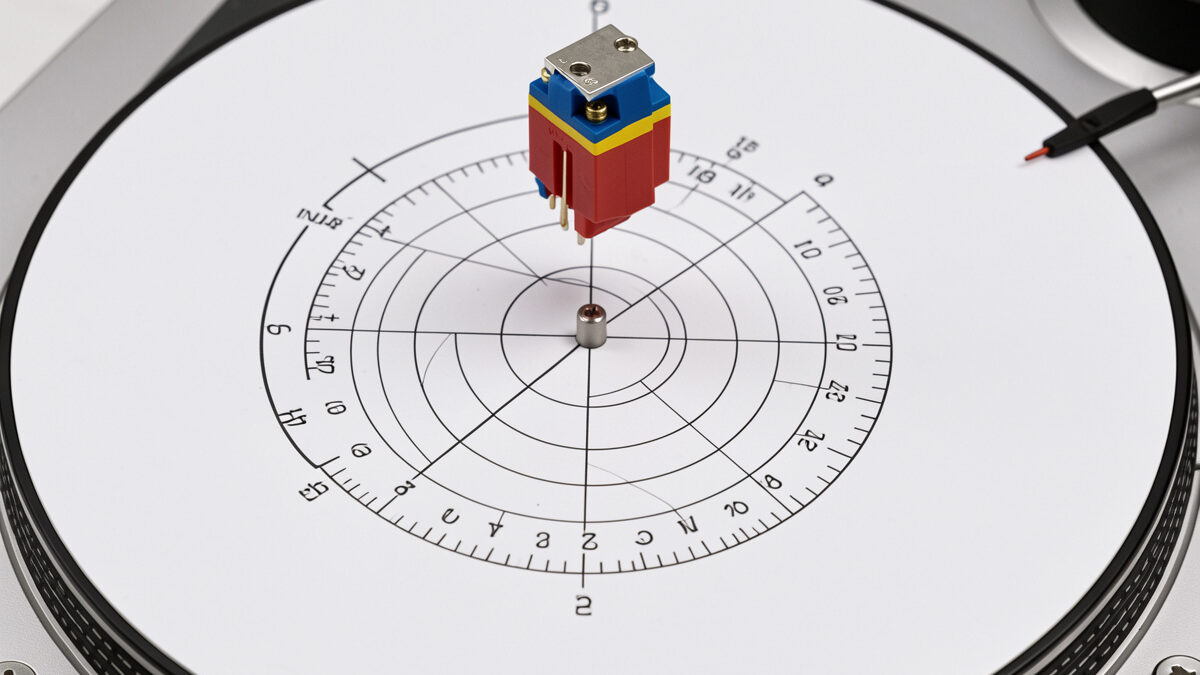
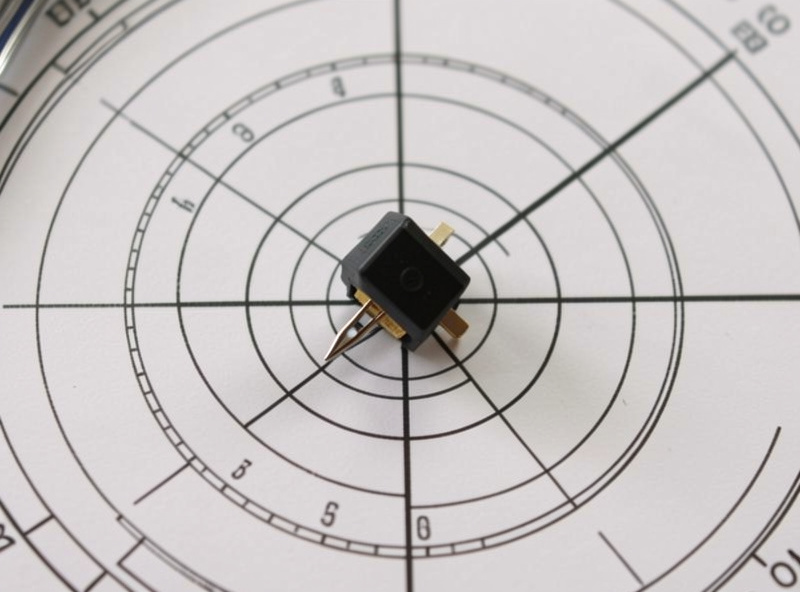
The reliable way to set overhang is a two-point protractor — a printed card that places a null-point crosshair at two specific radii on the record. The method is the same whether you print a Baerwald or a Stevenson card: place the protractor on the platter over the spindle, lower the stylus onto the outer null crosshair, and sight along the printed grid to check the cartridge body is parallel to the grid lines. Then move the arm to the inner null crosshair and check again.
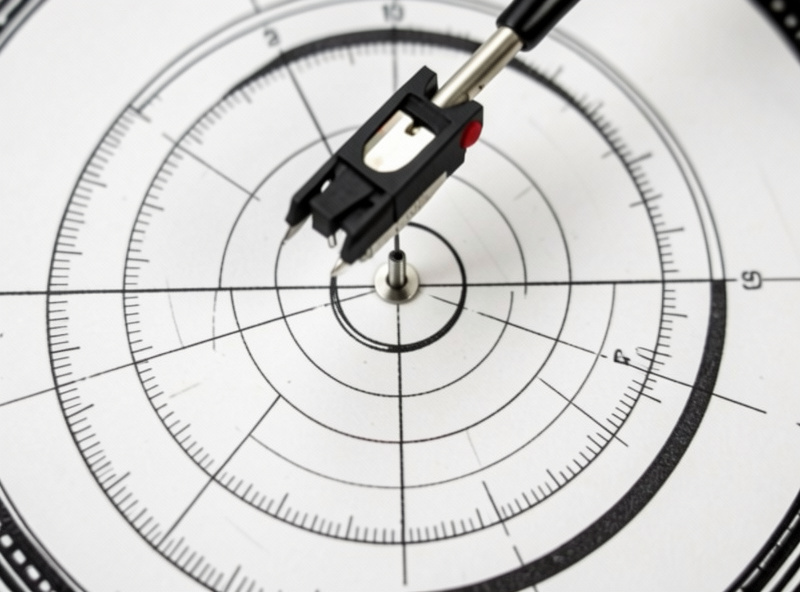
Here is the diagnostic that tells you whether overhang is right. If the cartridge lines up parallel at the outer null but is twisted at the inner null, your offset angle is off — the cartridge needs rotating in the headshell. But if the cartridge is parallel at one null and the stylus sits off the crosshair at the other — too far forward or back — your overhang is off. The fix is to loosen the mounting screws and slide the whole cartridge body forward or back in the slots until the stylus lands on both crosshairs while staying parallel. Iterate: a small move changes both points, so you walk it in over two or three passes until both nulls line up simultaneously.
The Headshell Slots Are the Adjustment
Everything above comes down to a mechanical detail: the slotted holes in the headshell. Those slots give you a few millimetres of fore-aft travel, and that travel is the overhang adjustment. Loosen the two mounting screws just enough that the cartridge slides with light finger pressure, nudge it to the position the protractor calls for, and re-tighten evenly so the body does not twist when the screws clamp down.
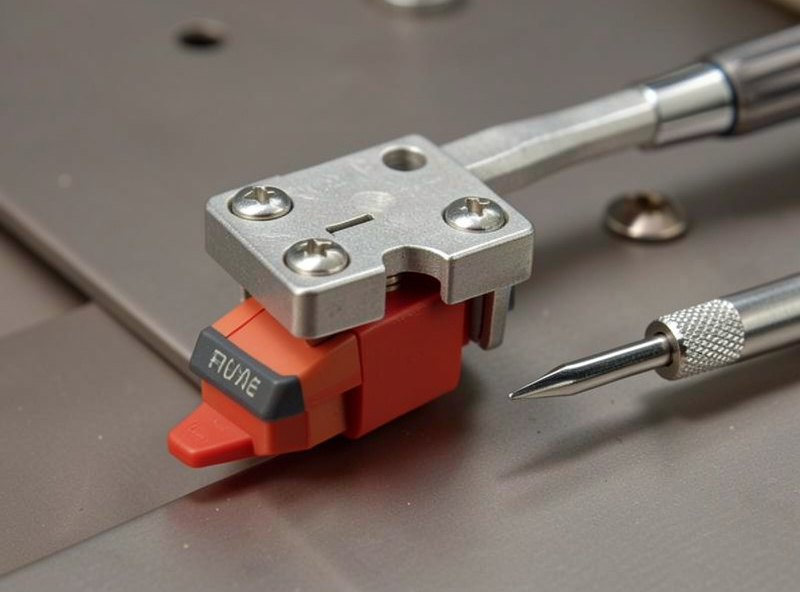
The two mistakes I see most are tightening one screw before the other, which twists the cartridge and ruins the offset angle even when the overhang is right, and not re-checking both null points after every move, because moving the cartridge fore-aft changes both crosshair positions at once. Set overhang and offset together, in small passes, re-checking both nulls each time. The full step-by-step, including how to verify the printed protractor is actually to scale before you trust it, is in the cartridge alignment guide.
Baerwald Versus Stevenson: Which Null Points
Both standards are two-point alignments, but they place their null points differently, and the choice has a small but real effect on the inner groove. Baerwald puts its nulls at roughly 66.0 and 120.9 millimetres from the spindle, minimising the worst-case distortion anywhere on the record — the balanced choice most modern setups default to. Stevenson puts the inner null at 60.3 millimetres, lining up with the inside edge of the standard playing band, deliberately trading a little more mid-record error for zero distortion right at the innermost grooves. If your end-of-side distortion is the one thing you cannot eliminate, Stevenson’s inner-null placement can buy you a fraction of cleanliness at the very end of the side. The hub covers the comparison in more depth.
Verifying Overhang Without Guessing
A printed protractor only works if it is printed at exactly full scale, because every millimetre on the card has to equal a millimetre on the record. Before trusting one, measure the printed spindle-to-null distance against a steel rule; if the card has shrunk in the printer by even a couple of percent, your null points are in the wrong place and the alignment is fiction. Some arms also publish a pivot-to-spindle distance and an effective length in the manual, and you can cross-check overhang arithmetically from those — the stylus should sit at the effective length minus the pivot-to-spindle distance, roughly. Both methods agree when the geometry is right, which is the check I use to confirm a protractor alignment is trustworthy rather than just close.
Frequently Asked Questions
What is overhang on a turntable?
Overhang is how far the stylus tip sits beyond a straight line drawn between the tonearm pivot and the spindle. It is one of two geometry parameters that let a pivoting arm approximate a straight cutting path, and it is adjusted by sliding the cartridge forward or back in the slotted headshell holes.
Can wrong overhang cause inner-groove distortion?
Yes. A wrong overhang shifts both alignment null points off target, tilting the tracking-error curve so it peaks at the inner groove. A cartridge only a millimetre or two off can track clean through the middle of a record and mistrack audibly in the last two minutes of the side.
How do I set overhang on a turntable?
Use a two-point protractor. Place it on the platter, align the cartridge body parallel to the grid at the outer null, then check the inner null. If the stylus sits off one crosshair, loosen the mounting screws and slide the cartridge fore or aft in the headshell slots until it lands on both nulls while staying parallel.
Why does my cartridge line up at one null point but not the other?
If the body is parallel at one null but twisted at the other, the offset angle is off and the cartridge needs rotating. If the body is parallel at one null but the stylus sits forward or back of the other crosshair, the overhang is off and the cartridge needs sliding fore or aft in the slots.
Is Baerwald or Stevenson better for the inner groove?
Baerwald is the balanced choice that minimises distortion anywhere on the record. Stevenson places its inner null right at the edge of the playing band, so it can give slightly less distortion in the very last grooves at the cost of a little more mid-record error. For a stubborn end-of-side fault, Stevenson can help.
Keep Building
- Inner-Groove Distortion Fix: The Complete Setup Guide
- How to Align a Turntable Cartridge: Protractor and Null Points
- Last Song on the Side Sounds Distorted: The Inner-Groove Problem
- Does Anti-Skate Affect Inner-Groove Distortion? Tested
- Sibilance and Distortion on Vocals: A Stylus and Alignment Check
- VTA and SRA for Turntables Explained