Headshell weight matters because it sets the tonearm-cartridge resonant frequency, which needs to land between 8 and 12 Hz. That resonance is a mass-on-a-spring problem: the combined effective mass of arm, headshell, screws, and cartridge bounces against the cartridge’s suspension compliance. Too little mass and resonance climbs toward the audible band; too much and it drops into the warp-and-footfall region below 8 Hz. Choosing a headshell is really choosing a mass to hit that window.
This is the single most misunderstood point in headshell selection, and it is why “a heavier shell tightened up the bass” is sometimes true and sometimes nonsense from the same person on different setups. The math is not optional, but it is not hard either — one formula, one look-up of your cartridge’s compliance, and you know before you buy whether a shell will help or wreck things. I keep a light and a heavy shell on the bench precisely so I can move effective mass without changing arms, and I check the number rather than guess.
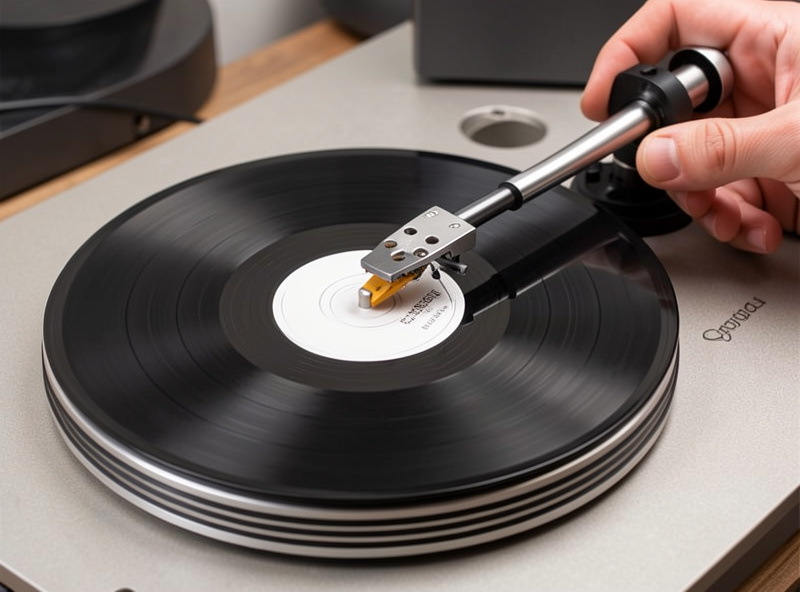
Why Does Headshell Weight Affect Resonance at All?
A phono cartridge’s stylus sits on a tiny suspension that behaves like a spring, and the whole arm assembly hanging off that suspension behaves like a mass. Any mass on a spring has a natural resonant frequency, and here that frequency depends on the total effective mass and the cartridge’s compliance. Add mass with a heavier headshell and the resonance drops; remove mass and it rises.
You want that resonance parked in a quiet zone between the two things that would excite it. Below about 8 Hz live record warps and footfall vibrations, which are the low-frequency energy that will set a too-low resonance ringing — that is the warp-wobble you see in a woofer and feel as mistracking. Above about 12 to 14 Hz you start creeping into the bottom of the audible range and the recorded bass itself can excite the resonance, muddying low-end control. The 8-to-12 Hz window threads between them, and headshell mass is your main tool for landing there. This is why the turntable headshell guide treats weight as a calculated decision, not a preference.
How Do You Calculate Tonearm Resonance?
The formula is F = 1000 / (2π × √(M × C)), where F is the resonant frequency in hertz, M is the total effective mass in grams, and C is the cartridge’s dynamic compliance in units of 10⁻⁶ cm/dyne. Add up your arm’s effective mass, the headshell, the screws, and the cartridge for M, use the cartridge’s compliance for C, and the formula gives you the resonance directly.
Getting M right is the fiddly part. For a universal arm, the arm has a stated effective mass that usually already assumes a standard headshell; if you fit a heavier or lighter shell than standard, adjust M by the difference. For a fixed arm, the stated effective mass includes the integrated headshell, so you just add the cartridge and screws. Compliance is the other input, and here is a trap: makers sometimes quote static or 100 Hz compliance, but the number that belongs in this formula is dynamic compliance at 10 Hz. If your cartridge’s spec sheet gives a 100 Hz figure, the 10 Hz dynamic figure is typically noticeably higher, so use the maker’s dynamic number where you can and treat a lone 100 Hz figure as a rough guide only. The compliance figures you need are published on cartridge datasheets from makers like Ortofon and Audio-Technica.
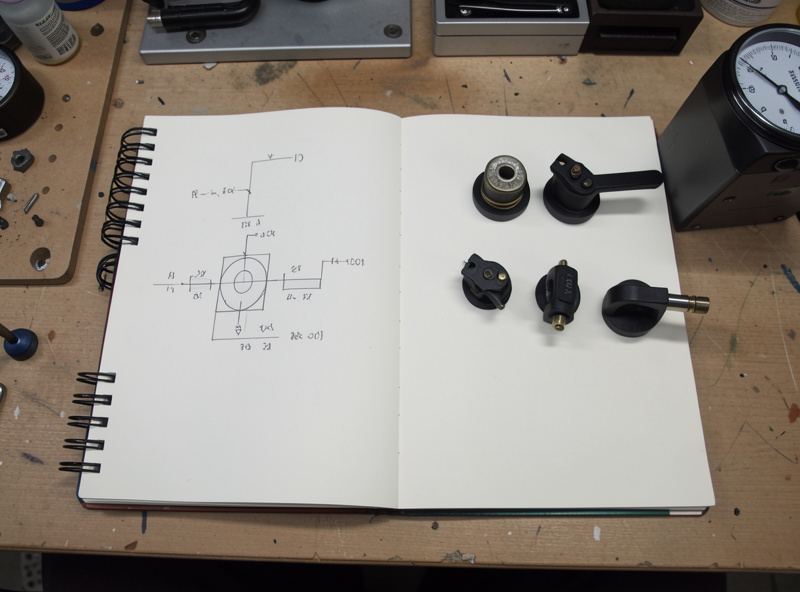
A Worked Resonance Example
Take a medium-compliance cartridge with a dynamic compliance of 20 and a total effective mass of 12 grams. Plug in: √(12 × 20) = √240 = 15.5, times 2π is 97.3, and 1000 divided by 97.3 is about 10.3 Hz. That lands dead center in the safe window — a healthy pairing.
Now change one thing at a time and watch it move. Swap in a heavy brass shell that pushes total effective mass to 18 grams with the same cartridge: √(18 × 20) = √360 = 19.0, times 2π is 119, and the resonance falls to about 8.4 Hz — still just inside the window, but near the low edge. Push to 24 grams and it drops to roughly 7.3 Hz, into warp territory, and you will see the woofer pump on warped records. Go the other way with a springy high-compliance cartridge at compliance 30 on that heavy 18-gram setup and you get about 6.9 Hz — badly too low, the classic high-compliance-plus-heavy-shell mismatch. Put that same compliance-30 cartridge on a light 10-gram setup and √(10 × 30) = √300 = 17.3, times 2π is 108.8, giving about 9.2 Hz — right where you want it. That is the whole lesson: stiff cartridges want mass, springy cartridges want lightness, and the formula tells you which shell gets you there.
What Happens If Resonance Is Too High or Too Low?
Too low, below 8 Hz, and record warps and footfalls excite the resonance: you get audible woofer pumping, mistracking on warped discs, and a woolly, unstable bass. Too high, above roughly 14 Hz, and recorded low bass starts exciting it, producing a boomy or ill-defined low end and, in extremes, tracking problems on heavy bass passages.
Both failure modes are things you can hear and see, not just calculate. The low-resonance case is the more common and the more damaging — a high-compliance cartridge on a heavy arm or shell will visibly wobble a warped record and lose the plot on bass. I hit this myself early on, dropping a light aluminum shell for a fancy heavy one under a compliant moving-magnet because heavier “had to be better,” and the bass went soft and the warps got worse until I did the arithmetic and put the light shell back. The high-resonance case is rarer because most arms carry enough mass, but a very light shell under a stiff moving-coil can bring it on. Either way, the fix is the same: change effective mass with a different headshell until the number lands in the window. Once it does, the rest of your tracking force and alignment work actually holds.
How Do You Measure Resonance on Your Own Deck?
The practical way is a test record with a resonance-sweep track: it plays descending low-frequency tones, and you watch the cartridge and woofer for the frequency at which the arm visibly resonates — the biggest lateral or vertical wobble. That observed frequency is your real resonance, accounting for the actual masses in your setup, and it should fall in the 8-to-12 Hz band.
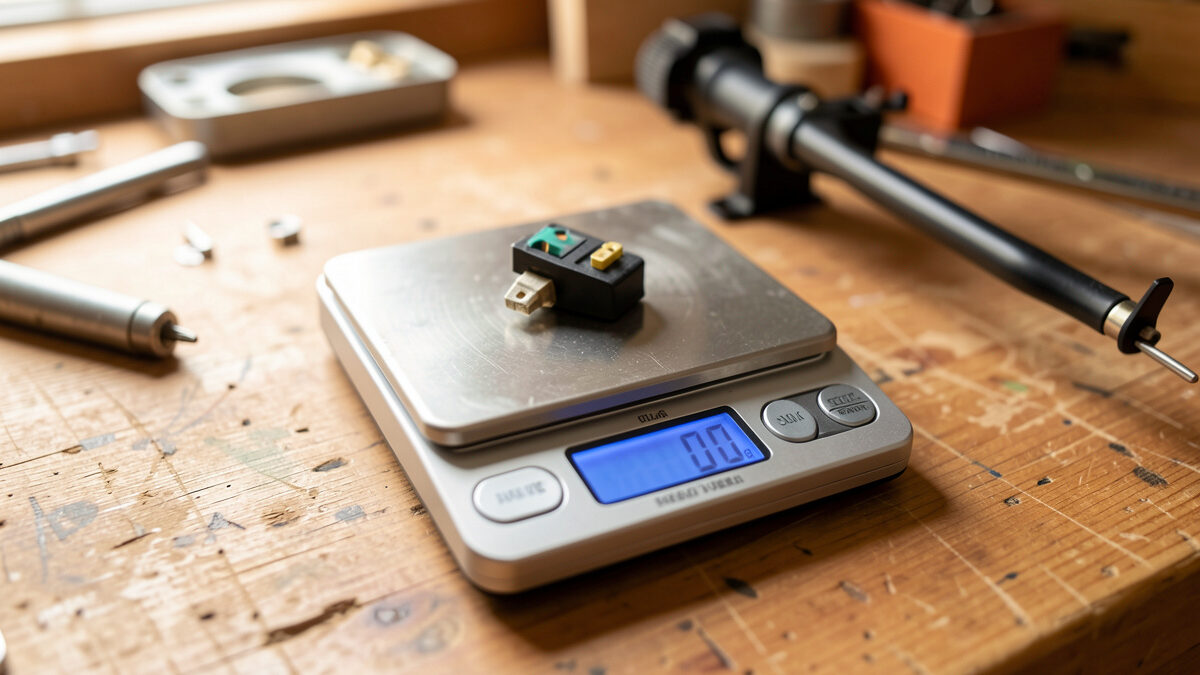
I trust the test record over the calculation for the final word, because it captures the true effective mass including your specific shell, screws, and any shims, which the formula can only estimate. Watch the arm from the front for lateral resonance and from the side for vertical, note the frequency where the wobble peaks, and compare to the window. If it is too low, go lighter; too high, go heavier. A cheap digital scale to weigh your shell and cartridge, plus a test record, are the two tools that turn this from guesswork into a five-minute check. This is also where headshell material quietly enters the picture — a lighter carbon shell versus a heavier aluminum one is really a resonance decision in disguise, which is exactly the point I make in aluminum vs carbon vs wood headshells, and the mount type you have shapes how easily you can swap shells to tune it, covered in universal vs fixed headshells.
What is the ideal tonearm resonance frequency?
Between 8 and 12 Hz. This window sits above record warp and footfall energy, which lives below 8 Hz, and below the audible bass range, which starts exciting the resonance above about 14 Hz. Landing your tonearm and cartridge resonance in this band avoids both mistracking and boomy bass.
How do I calculate tonearm cartridge resonance?
Use F = 1000 divided by (2 times pi times the square root of M times C), where M is total effective mass in grams and C is the cartridge dynamic compliance in units of ten to the minus six cm per dyne. Add arm effective mass, headshell, screws, and cartridge for M, then use the cartridge dynamic compliance for C.
Does a heavier headshell lower the resonant frequency?
Yes. Adding mass with a heavier headshell lowers the tonearm and cartridge resonant frequency, while a lighter shell raises it. That is why stiff low-compliance cartridges pair with heavier shells and springy high-compliance cartridges pair with lighter ones, each to land resonance in the 8 to 12 Hz window.
How do I measure my turntable’s resonance?
Play a test record with a resonance sweep track, which descends through low frequencies, and watch the cartridge and woofer for the frequency where the arm wobbles most. That observed frequency is your true resonance, including your actual shell and cartridge masses, and it should fall between 8 and 12 Hz.
How Does Cartridge Compliance Change the Headshell You Need?
Compliance is the other half of the equation, and it flips the whole recommendation. High-compliance cartridges — typically moving-magnets with soft suspensions and dynamic compliance figures around 25 to 35 — want a light arm and a light headshell. Low-compliance cartridges — many moving-coils, with stiff suspensions and figures around 5 to 12 — want a heavy arm and a heavier headshell. Medium compliance, roughly 12 to 25, is the flexible middle that suits most common arms.
This is why there is no universally “best” headshell weight — the right answer is defined by the cartridge in front of you. A springy moving-magnet on a heavy arm is the classic mistake that drops resonance below 8 Hz and wobbles on warps; a stiff moving-coil on a feather-light arm is the opposite error that pushes resonance too high and softens the bass. Before you buy a headshell, look up your cartridge’s dynamic compliance and decide which way you need to move mass. If the number is high, favor a light carbon or aluminum shell and skip the brass; if it is low, a heavier aluminum, wood, or brass shell brings resonance down into range. Matching the two is the entire game, and it is the reason I keep shells of different weights rather than one “best” shell — different cartridges need different mass, and the formula plus a test record tells me exactly how much.
Keep Building
- Turntable Headshell Guide: Wiring, Weight, Mounting & VTA
- Aluminum vs Carbon vs Wood Headshells: Does Material Matter?
- Universal vs Fixed Headshells: Which Tonearm Mount You Have
- Tracking Force Adjustment Guide for Turntables